
The Overwhelm Recovery ProtocolWellness & Routines · ~5 min
About this template · Updated November 2026
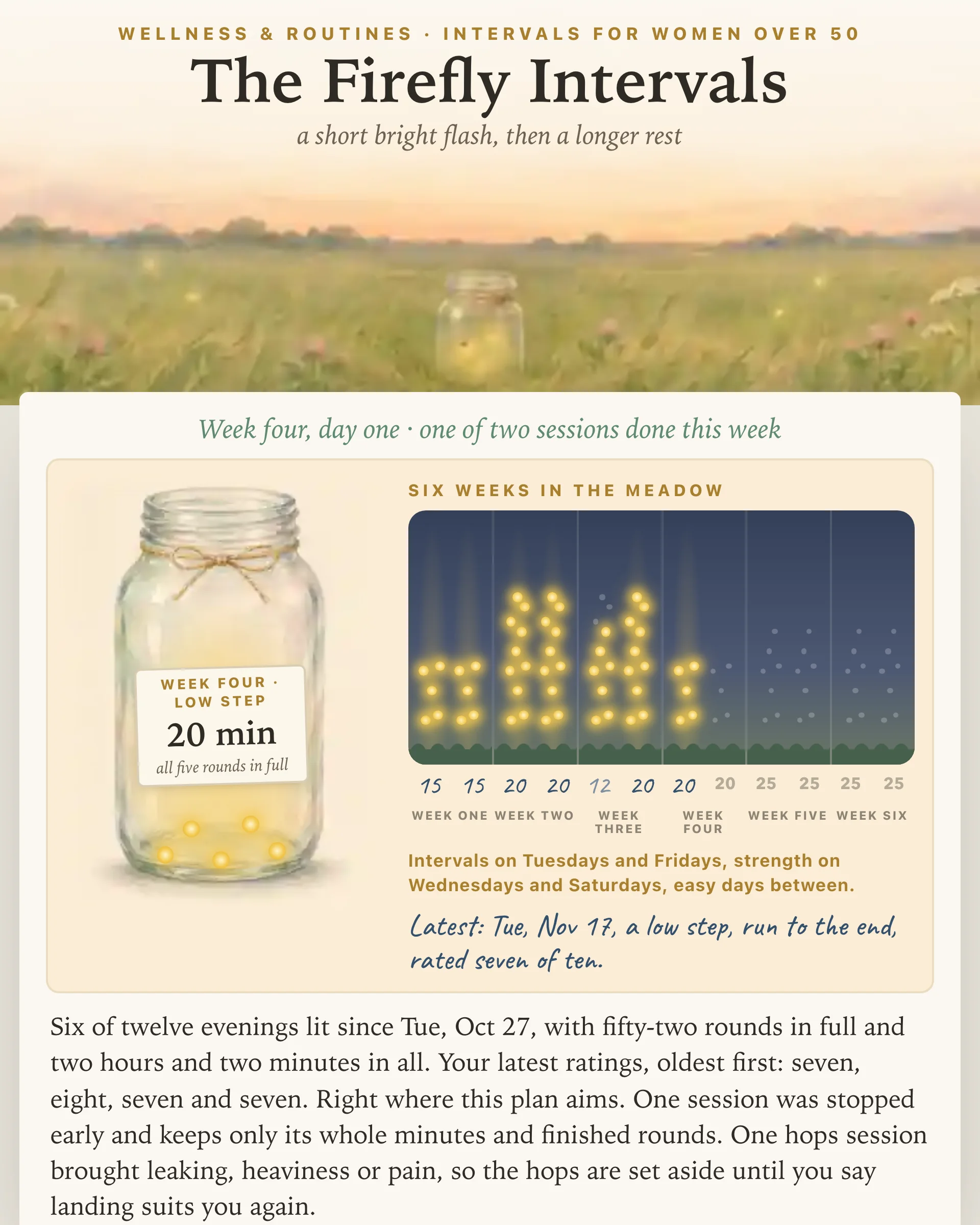
A HIIT workout for women over 50 does not need burpees or box jumps. Interval training means working hard for a short spell, easing off for at least as long, and repeating. This page builds that into a fifteen to twenty-five minute home session with a choice about impact: no jumping, a low step, or small hops only if your joints and pelvic floor are fine with landing. Two sessions a week for six weeks sit beside your strength days, not in place of them.
Every session opens with a five-minute warm-up and closes with five or six minutes of cool-down. Between them come rounds: a hard spell, then an easy spell never shorter than it. Pick twenty seconds hard and forty easy, thirty and thirty, forty and eighty, or a minute and a minute, then fifteen, twenty or twenty-five minutes in all. The page fits the rounds so the parts always add up: five minutes, five one-minute rounds and five minutes make fifteen.
The plan opens with five rounds of twenty seconds and ends with seven rounds of a full minute, growing from fifteen minutes to twenty-five.
No jumping keeps a foot on the floor: a fast march, then quick side steps. Low step uses the bottom stair or a sturdy step four to six inches high, switching the leading foot each round. Small hops alternate low, soft hops with a fast march, so you land only every other round, and the page first asks you to confirm that your knees, hips and pelvic floor take landing well. After every hops session it asks whether landing brought leaking, heaviness or pain. A yes sets the hops aside and points you back to the other two.
The CDC's page on measuring activity intensity describes the talk test: at a moderate effort you can talk but not sing, and at a vigorous one you cannot say more than a few words without pausing for breath. On its zero-to-ten scale, moderate sits at five or six and vigorous begins at seven or eight.
Weeks one and two aim for six or seven in the hard spells, short phrases only; from week three, seven or eight. Each easy spell should bring full sentences back. Rate the hard spells afterward: a single nine or ten suggests easing off, while a nudge to push harder waits for two whole sessions in a row rated five or under.
The painted jar is the timer. A round's firefly flashes through its hard spell, dims through the easy one and glows once both are done. The clock reads real time, so a locked phone keeps your place, and a pause never counts. Stop early and you keep whole minutes and only the rounds you finished. One tap on "I feel unwell, stop" ends the session and moves the stop rules to the top of the page.
Finished sessions light a six-week meadow, two evenings a week, with strength on days two and five.
The Copenhagen Women Study gave 73 healthy, inactive women aged 45 to 57 twelve weeks of interval cycling, three sessions a week of about fifty minutes, led by instructors with heart rate monitors. In the women past menopause, peak oxygen uptake rose about nine percent and resting heart rate fell by three beats a minute, much as in the women not yet there. Anyone with high blood pressure, heart disease or diabetes was excluded.
A Brazilian trial gave 24 postmenopausal women with obesity twelve weeks of either intervals (ten rounds of stepping up and squatting between light walks, three times a week) or walking plus resistance exercises. Both groups got up from a chair faster. Only the resistance group grew stronger and walked faster, which is why this plan sits beside strength work. Fitness professionals adjusted every set to keep it hard.
Neither trial tested unsupervised sessions at home, measured the pelvic floor or bone, or looked at falls or heart events. If you are in your forties, the plan fits you as well: the Copenhagen trial enrolled women from 45.
Ask your doctor first if you have a heart condition, high blood pressure or diabetes, or have had a heart attack, a stent or heart surgery, and before any hops if you have osteoporosis. Check with a doctor or physical therapist after a fall, dizziness or a joint replacement, or with pain that keeps returning. Keep a sturdy chair or counter within reach, stop anything that hurts, and stop at once for chest pain or pressure, faintness, or breathlessness the easy spell does not settle.
Strength Training for Women Over 50 is the other half of each week. The Pelvic Floor Hammock trains the muscles the hops lean on, and The Osteoporosis Exercise Pagoda suits low bone density. The Snow Globe Intervals paces longer spells for older adults, The Windsock Cardio Plan is steady cardio with no hard spells, The Beginner HIIT Pinwheels is a five-move circuit, and The HIIT Timer is a bare clock for rounds you already know. This page is narrower: intervals for women past fifty, with the impact choice and the pelvic floor and bone notes built in.
For many healthy women it is, when the hard spells are short, the recoveries are long and the effort is set by how well you can talk. The trials in women past menopause were supervised, so ask your doctor first if you have a heart condition, high blood pressure or diabetes, or have had a heart attack, a stent or heart surgery. Stop at once for chest pain, faintness or breathlessness that the easy spell does not settle.
Yes. A fast march, quick side steps or brisk step-ups on the bottom stair can push your breathing just as high with a foot always on the floor. Jumping is a choice, not the point, and it is the first thing to drop if you leak, feel heaviness low in your pelvis or have joint pain.
Two sessions a week is a sound start, with a strength day or an easy day between them. The plan here keeps intervals on days one and four of each week and suggests strength work on days two and five, because intervals alone did not build strength in a trial of women past menopause.
It does. The rounds, the talk test and the impact choice work the same in your forties, and the largest interval trial cited here enrolled women from age 45, both before and after menopause. Start at week one whatever your age, since the first weeks are about learning the effort.
About six or seven out of ten in the first two weeks, where only short phrases come, then seven or eight, where you manage a few words before a breath. Nine or ten is more than a home plan asks, so slow down there. Every easy spell should bring you back to full sentences.
By the team behind Fabulous, the science-based self-care app used by over 30 million people.


