
The Overwhelm Recovery ProtocolWellness & Routines · ~5 min
About this template · Updated September 2026
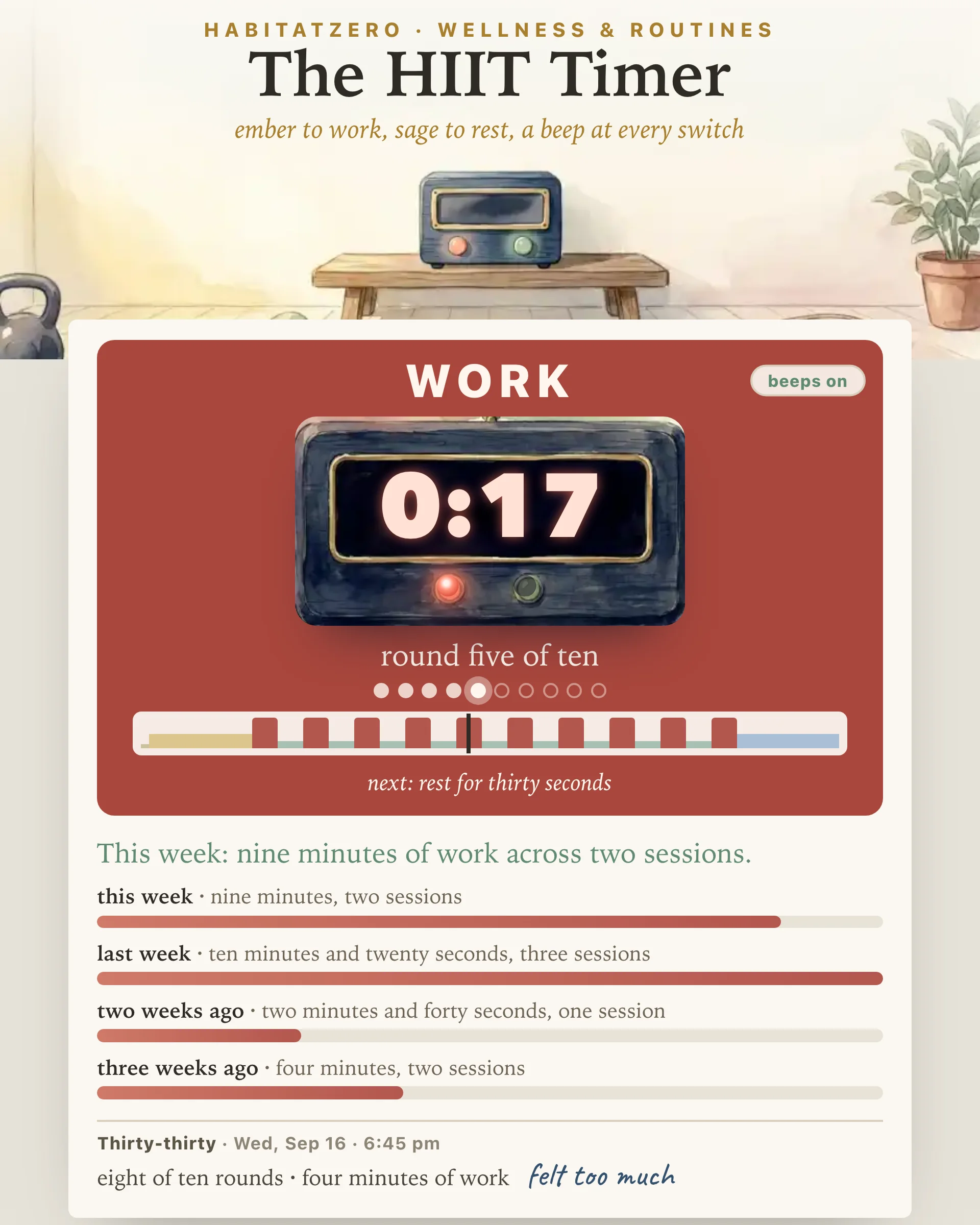
Interval training asks two things of you at once: go hard, and keep count. Somewhere in the fourth round of burpees, arithmetic is the first thing to go, and a glance at a phone on the floor costs you the rhythm you were fighting to hold. A HIIT timer takes the counting off your hands. You shape the session while you are fresh, and after that your only job is the effort.
This page draws that timer as a gym interval clock: a painted wooden case with a glowing window and two lamps, one ember for work and one sage for rest.
Start from a preset or build your own. Tabata runs twenty seconds on and ten off for eight rounds. Thirty-thirty gives you ten rounds of equal work and rest, and forty-twenty leans harder. Easy start flips the ratio to twenty on and forty off for six rounds, while ten by one is a minute on and a minute off, ten times. Below them, nudge work and rest five seconds at a time, set one to thirty rounds, and stack up to six sets with a break between.
Then add a warm-up and a cool-down of one to five minutes. Whenever you change something, the tape under the clock redraws the session to scale, tall ember bars for work and low sage ones for rest, and the window shows the total. Past an hour and a half, the clock refuses and says why.
Press start and you get ten seconds to put the phone down. Then the whole screen changes color: ember while you work, pale sage while you rest, wheat while you warm up. The countdown fills the window in figures you can read from the floor, and the line beneath names the round and what comes next.
Three short pips count down the last seconds of every interval, then a rising two-note tone opens the work and a lower one opens the rest. The page makes these beeps itself, from your tap on start, and a mute sits in the corner. A locked phone, a sleeping tab or a silent switch can quiet them, so the page asks your phone to keep its screen awake while the clock runs. The color, the countdown and the round count carry every change on their own, so a muted session loses nothing you need.
Because it runs from the real clock, a pause holds your place to the second, and an early stop keeps only the work you did.
When the last round ends, tap how it felt and log it. Each session joins a list with its date, rounds and minutes of work, and the page adds them up by week in plain words: this week, last week and the two before. The weekly total is the number worth watching: a steady handful of short sessions beats one heroic effort and two weeks on the couch.
The strongest case for HIIT is about time. In a twelve-week trial from Martin Gibala's lab at McMaster University, sedentary men who did three twenty-second all-out sprints inside a ten-minute session, three times a week, improved their aerobic fitness and insulin sensitivity about as much as men who cycled steadily for forty-five minutes. It was a small study of men on laboratory bikes, so read it as a promise, not a guarantee.
The Tabata preset borrows its numbers from Izumi Tabata's 1996 study, in which seven people did seven or eight twenty-second bouts with ten seconds of rest between them, five days a week for six weeks, at roughly a hundred and seventy percent of the workload that matched their maximal oxygen uptake. The paper itself calls the training exhaustive. This clock is independent work, with no connection to Tabata or his research group.
What HIIT does not do is melt fat faster. A 2017 review of thirteen trials in adults with overweight or obesity found that interval training and steady exercise trimmed body fat by similar, modest amounts, and the intervals simply took about forty percent less time.
Hard is relative: a sprint up a hill for one person, a brisk climb up two flights of stairs for another. The American College of Sports Medicine bases its screening advice on how active you already are, whether you have heart, metabolic or kidney disease or symptoms that could point to it, and how intense you plan to go. HIIT sits at the intense end of that last question. If you live with a heart condition, or you are new to exercise, talk to a clinician before you push toward all out, and begin with the easy start preset.
Reach for it whenever you would rather not time a workout by eye: a Tabata before breakfast, sprints on a bike, a circuit in the living room. If running is where you want to end up, the Couch to 5K Plan is interval training at a gentler pace, and on the days between hard sessions a Walking Challenge keeps you moving without adding strain. To turn short sessions into a month-long habit, give The 30-Day Challenge the movement theme and let this clock keep the time.
HIIT stands for high-intensity interval training: short bursts of hard effort, each followed by a rest, repeated for a set number of rounds. A HIIT timer counts the work and the rest and signals every change, so your attention stays on the movement rather than on a clock. This one also floods the screen ember for work and sage for rest.
Often shorter than people expect. In a twelve-week McMaster University study, three twenty-second all-out sprints inside a ten-minute session, three times a week, raised fitness about as much as forty-five minutes of steady cycling. With two minutes of warm-up and cool-down, the Tabata preset here takes eight minutes and the thirty-thirty preset a little under fourteen.
Begin with more rest than work. The easy start preset runs twenty seconds on and forty off for six rounds, which leaves time to recover and keep good form. Once that feels comfortable over several sessions, try thirty on and thirty off, then forty on and twenty off. If you have a heart condition or have not exercised in a long while, check with a clinician first.
Not always. The page makes the beeps itself, so a locked screen, a sleeping tab or a silent switch can mute them. While the clock runs, the page asks your phone to keep the screen on, and the full-screen color, the large countdown and the round count carry every change, so a session works with the sound off.
The public page shows a filled-in example so you can see how the clock behaves. Personalizing it in HabitatZero, which costs nothing, gives you the working timer and a log that keeps your sessions and weekly totals between workouts.
By the team behind Fabulous, the science-based self-care app used by over 30 million people.


