
The Overwhelm Recovery ProtocolWellness & Routines · ~5 min
About this template · Updated September 2026
A walking challenge is a promise with edges: a set number of days, a daily target, and a finish you can see coming. The edges are what make it work. Walking more is a wish, while seven thousand steps a day for four weeks is a plan you can check against your phone tonight.
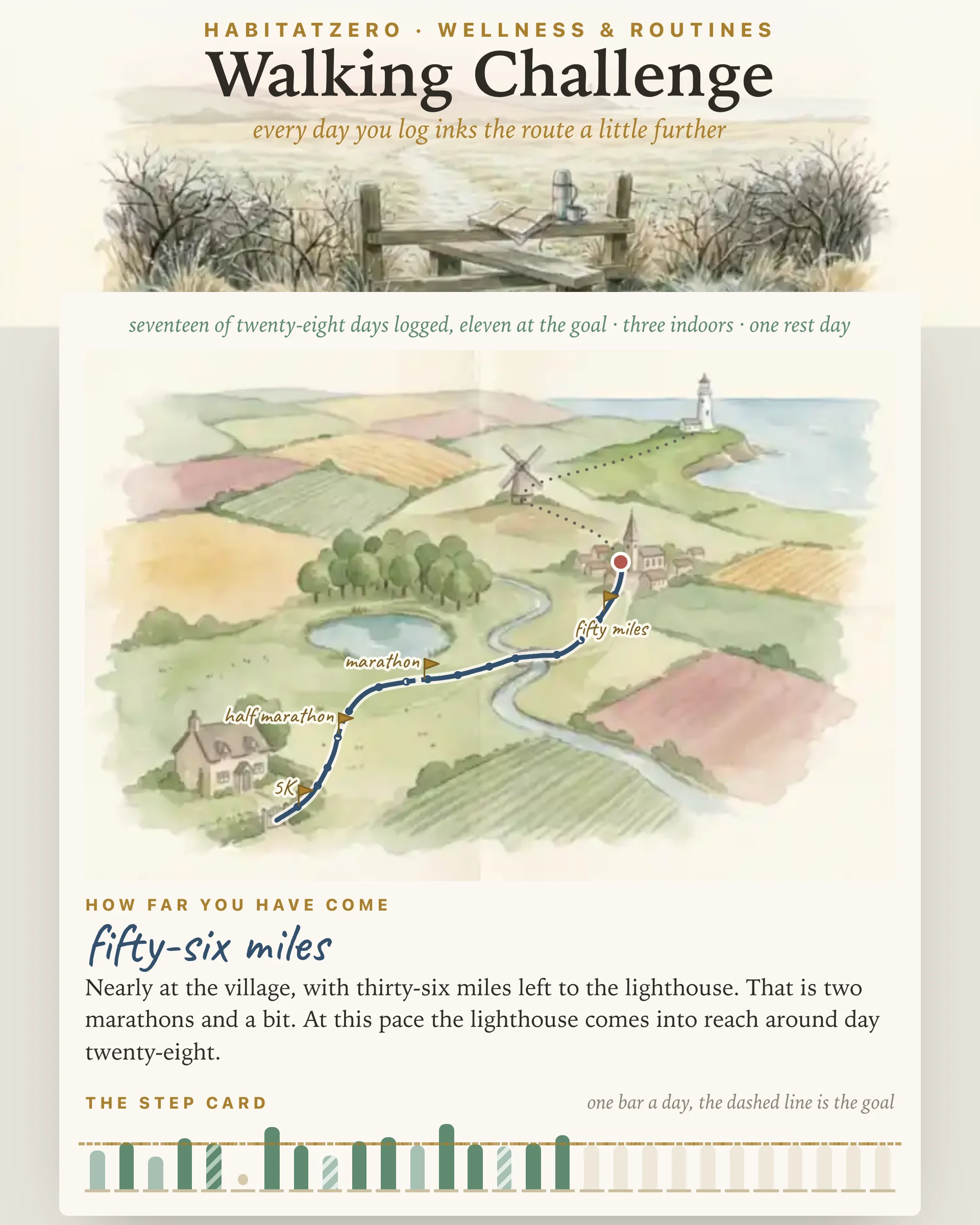
This page adds one more edge, a place to walk to. The whole challenge becomes a route on a painted map, from a garden gate to a lighthouse on the coast, and each day you log inks its own share of the way.
Start by choosing the length, fourteen, twenty-one or twenty-eight days, and the daily goal. The goal can be steps, anywhere from two thousand to fifteen thousand, or minutes, from ten up to an hour and a half. The route is drawn to exactly the distance you would cover by meeting the goal every day, so twenty-eight days at seven thousand steps makes a walk of roughly ninety-three miles, and fourteen days at five thousand makes about thirty-three.
Each evening, open the day and slide to the count your phone or watch recorded, or tap the goal if you hit it on the nose. The map counts about two thousand one hundred steps to the mile, which suits a middling stride: a tall walker covers a little more ground than it shows, a shorter stride a little less. If you log minutes instead, each one counts as a hundred steps, the pace researchers treat as a rough threshold for moderate walking, and Tudor-Locke and colleagues set out the evidence behind that figure.
Your share of the route is inked from the gate one day at a time, with a small bead where each day ended. Flags stand at real distances along the way, such as the 5K, the half marathon and the marathon, and turn gold once you pass them. Under the map, the page tells you in words how far you have come, which landmark you are near, how many miles are left to the lighthouse, and where your average so far should leave you on the final day. When that projection falls short, it says so and names the fix: a little more each day, or a smaller goal. The goal is the thing to adjust; the days you have walked stay on the map.
Rest days go on the step card too: they add no distance, and nothing resets.
Probably not for everyone. The figure has a commercial origin: it most likely comes from the trade name of a pedometer sold in Japan in 1965, the manpo-kei, or ten-thousand-step meter. The same paper followed nearly seventeen thousand women with an average age of seventy-two and found that those taking about 4,400 steps a day died at lower rates than those taking about 2,700, with the benefit levelling off at around 7,500.
A larger pooled analysis of fifteen cohorts and more than forty-seven thousand adults drew a similar curve. Risk kept falling as daily steps rose, then flattened at roughly 6,000 to 8,000 steps for adults sixty and over, and 8,000 to 10,000 for younger adults. Both are observational studies, so they show that people who walk more tend to live longer, not precisely what any one person gains by adding another thousand steps. Neither says anything about weight, and this page makes no promise about it either. A walking challenge is a way to move more on purpose, not a diet.
What the research does support is starting from where you are. If your phone says you average four thousand steps, a goal of five or six thousand is a real change you can hold for four weeks. Setting ten thousand on day one may only turn the map into a record of falling short.
A challenge started in January meets dark evenings and sideways rain. Steps on a treadmill, laps of the hallway, trips up the stairs or a walking workout in the living room all count, because the map needs a number, not a view. Mark those days as walked indoors and their stretch is drawn in dashed ink, so at the end you can see how much of the walk the weather pushed inside.
If walking is new for you after an illness, an operation or a long spell of sitting still, ask your clinician how much to start with, and take the first goal from their answer.
Start it when you want the coming weeks to have a shape: the first of the year, the Monday after a holiday, the day someone suggests you move more. Log each evening, or whenever you glance at your step count, and step back once a week to see how far the ink has run.
If the walks begin to feel easy and you are curious about running, the Couch to 5K Plan opens with brisk walking broken by one-minute jogs, and the Running Plan for Beginners builds from whatever you can already do. If the daily walk is one habit among several, the 30-Day Habit Tracker keeps it company.
The lighthouse will be standing there on the last day either way. The map only shows how much of the way you walked to it.
Four weeks of walking toward the same daily target, usually a step count and sometimes a number of minutes. On this map, twenty-eight days at seven thousand steps comes to roughly ninety-three miles from gate to lighthouse. Nobody can honestly promise weight loss from it; what four weeks can give you is a walking habit and the benefits of moving more.
Fewer than ten thousand is often enough to matter. A pooled analysis of fifteen cohorts found the lower risk of early death levelled off at around six to eight thousand steps a day for adults over sixty, and eight to ten thousand for younger adults. A goal a little above what you already walk is easier to keep than a leap.
Most likely from marketing. A pedometer sold in Japan in 1965 was called the manpo-kei, which translates as ten-thousand-step meter, and the round number stuck. For a middling stride, ten thousand steps covers roughly four and a half to five miles.
Yes. Treadmill miles, laps of the hallway, stair climbs and walking workouts in front of a screen all count, because the map only needs a step count. Tag those days as walked indoors and their stretch of the route is drawn in dashed ink, so the rainy weeks still carry you forward.
The filled example on this page shows how a walk looks about halfway through. Logging your own days, keeping the ink between visits and changing the goal all happen once you personalize it in HabitatZero, which costs nothing.
By the team behind Fabulous, the science-based self-care app used by over 30 million people.


