The Overwhelm Recovery ProtocolWellness & Routines · ~5 min
About this template · Updated July 2026
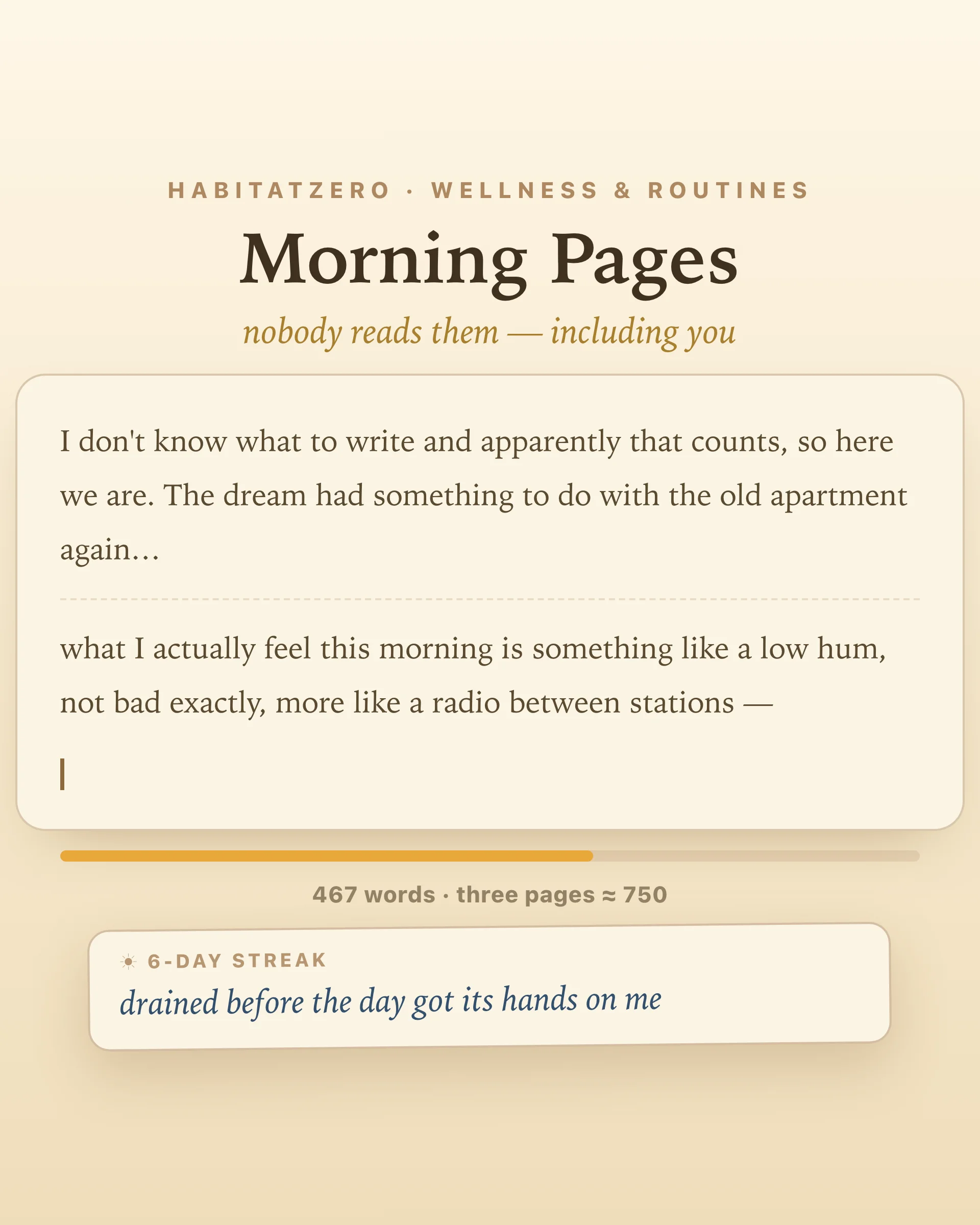
Every morning, your mind boots up with sediment in it: the half-worry from yesterday, the rehearsed argument, the list fragment, the low hum of should. Most of us carry that sediment straight into the day — into the first meeting, the first email, the first attempt at real thought — and wonder why the good attention doesn't show up until noon.
Morning pages are the drain. Three pages of unfiltered, stream-of-consciousness writing, first thing, popularized by Julia Cameron in The Artist's Way and practiced by several decades of writers, founders, and ordinary tired people since. There is no wrong way to do them, no quality bar, no audience — the point isn't to write anything. The point is to have written out whatever was going to leak into your morning anyway.
This is the digital version that keeps the rules that matter.
Open, and just start. A full-screen page, a cursor, nothing else. Write whatever crosses the mind — complaints count, fragments count, "I have nothing to write" written eleven ways counts famously well. No rereading (the page gently discourages scrolling back), no editing, no topic.
Three pages, measured honestly. Longhand's "three pages" is roughly 750 words, and a quiet progress line fills toward it as you go. Treat it as a horizon, not a grade — fifteen honest minutes that land at 400 words beat 750 padded ones. When you're done, tap finish.
And then they're gone. This is the feature that makes the whole thing work: by default, nothing you write is kept. Not saved, not synced, not recoverable — the page keeps only your word count and your streak. Cameron's classic rule is that nobody reads the pages, not even you; this tool enforces it with architecture instead of willpower. The honesty that produces — the things you'll say to a page that shreds itself — is the entire active ingredient. (Wrote a line worth keeping? Copy it out before you finish. Deliberately, as an exception.)
Morning pages sit on two bodies of evidence. The general one: research on expressive writing — Pennebaker's long line of studies — found that putting inner experience into words, unfiltered and private, has measurable effects on mood and even health markers. The specific one is humbler and you can run it yourself in a week: a mind that has already said its worries out loud holds them more loosely for the rest of the day. The pages don't solve anything. They just get the noise to state its business before it can spend the whole morning whispering.
Note what the pages are not: not a journal (journals are for the record; pages are for the drain), not writing practice (quality is explicitly nobody's business), and not a gratitude ritual (that lives in the Gratitude Jar, and the two pair beautifully — drain first, then notice).
The ritual survives on two anchors. First thing — before feeds, before email, ideally while still slightly too asleep to self-censor; the sediment is most drainable before the day compacts it. And streak, gently — the tool counts consecutive days, but a missed morning just means the streak restarts, not that anything is owed. Cameron's own advice is decades of "just show up tomorrow."
If mornings are already a scramble, give the pages a slot in your ADHD Routine Builder — fifteen minutes, anchored right after the coffee step. And if what surfaced on the page was one specific thought with hooks in it, hand it to Leaves on a Stream — the pages found it; the stream can take it from there.
Three pages. Nobody reads them. Watch what your mornings do with the space.
Three pages of longhand, stream-of-consciousness writing done first thing in the morning, popularized by Julia Cameron in The Artist's Way. There is no wrong way to do them: they're not journaling for the record, not writing practice, not a gratitude list — just the sediment of the morning mind, drained onto a page so the day starts clearer.
Roughly 750 words — three sides of longhand at a typical hand. This tool counts your words toward that mark with a gentle progress line, but treat it as a horizon, not a grade: fifteen honest minutes that fall short of 750 beat a padded word count every time.
Cameron advocates longhand, and there's a real case for it — the slowness itself is part of the drain. But typed pages done daily beat handwritten pages done never. This tool keeps the parts of the ritual that matter most: first thing, no editing, no audience, and gone when you're done.
The classic rule is that nobody reads them — not even you, at least for weeks. This tool takes the rule seriously: by default nothing you write is saved or sent anywhere, and the page is unrecoverable once you finish. Knowing that is what unlocks the honesty the exercise runs on. If you write something mid-page you want to keep, copy it out before you finish — deliberately.
A journal is for the record; morning pages are for the drain. Journaling curates — you write for a future reader, even if it's you. Morning pages refuse curation: unfiltered, unread, discarded. Research on expressive writing suggests putting inner experience into words has real effects, but the pages' daily job is humbler — they get the noise out first so the signal has the day.
Yes — free, full-screen in your browser, no signup. Your words are never stored or transmitted; only the word count and streak persist, and in the Fabulous app the streak syncs so the ritual survives travel.
By the team behind Fabulous, the science-based self-care app used by over 30 million people.