Leaves on a StreamEmotional Fitness · ~3 min
About this template · Updated July 2026
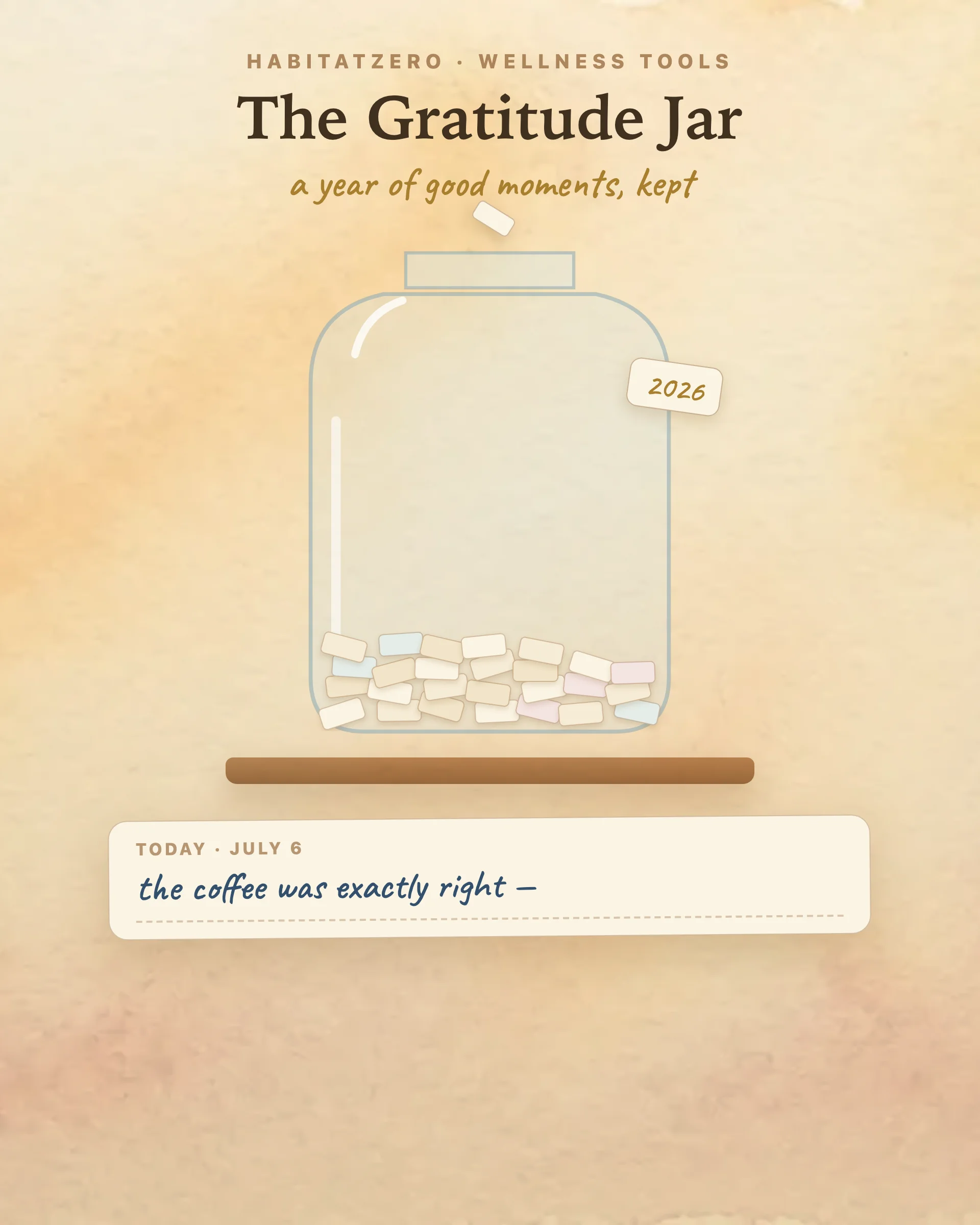
Some practices work because they're clever. The gratitude jar works because it's physical. You notice something good, you write it on a slip of paper, you drop it in — and the jar quietly does the rest, filling through the year with evidence that your life contains more good moments than your memory admits.
This is that jar, made interactive — and made a little bit magical.
Something good happens. The coffee is exactly right, a stranger is kind, the difficult email lands well. You open the jar, write one or two lines on the paper slip — the date stamps itself — and press fold it into the jar. The slip lifts off the desk, folds itself in half, arcs through the air, and drops onto the pile with a soft paper flutter. A little sparkle rises from the mouth of the jar. The count ticks up: 44 moments since January.
That tiny ceremony is not decoration. The fold-and-drop is the ritual — the moment of deliberately keeping something. A gratitude thought lasts four seconds; a gratitude slip lasts as long as the jar does.
Three things make the jar version of gratitude stick where journals stall:
It's visible. The slips pile up behind the glass. A journal hides your streak inside a drawer; the jar shows it to you every time you pass — thirty slips of proof, at a glance, that the year has been kinder than it felt.
It trains attention. Once you're carrying a jar, you start scanning the day for slip-worthy moments. That search is the actual intervention: you're teaching your attention to notice what's working instead of filtering only for problems. Regularly noting what you're grateful for is one of the better-supported small practices for mood and life satisfaction (Emmons & McCullough, 2003) — the jar just makes it a game you keep playing.
It compounds. Every slip you add makes the future payoff bigger — which brings us to the two ways this jar pays you back.
Tap the jar, any time, and it hands you back a random slip — unfolding it into the light: March 14 — you wrote: the almond croissant, still warm, and nowhere to be. A note from a better day, in your own handwriting, chosen by chance. On a low evening, three of those in a row is stronger medicine than it has any right to be. Tap another as many times as you need. Then put them back; they keep.
This jar is built for the year-in-a-jar tradition: fill it from January, and on New Year's Eve, empty it. Read the year replays every slip, one by one, oldest first — a slideshow of your year told entirely in moments you chose to keep. It ends with a count — 87 moments. What a year. — and one more gift: ask the jar what ran through this year? and it will reflect back the threads it noticed — the people who kept appearing, the small rituals that kept working, the things that clearly matter to you.
Then you put them all back, and the jar starts listening for next year.
The only rule: small and specific. "My health" is a category; "walked to work in the first warm sun of March" is a moment. If you want a daily rhythm to feed the jar, the three gratitude lines in Tend Your Day make perfect slip material — and if you're starting the year with intentions, seal them first in My Promise to Myself, then let the jar collect the evidence.
A simple practice: whenever something good happens, you write it on a small slip and drop it in a jar. Over months the jar fills with proof of good moments — a collection you can hold, revisit, and reread.
Small and specific beats big and vague. 'Lea saved me the last croissant' will move you in December far more than 'my friends.' If it made the day one degree warmer, it belongs in the jar.
Gratitude noting is one of the better-supported small wellbeing practices — and the jar makes it sticky. Looking for slip-worthy moments trains your attention toward the good, and the visibly filling jar keeps the habit alive.
You fill the jar from January to December, then read every slip in one sitting — many people do it on New Year's Eve. This jar makes that a ceremony: the slips replay one by one, ending with the threads that ran through your year.
By the team behind Fabulous, the science-based self-care app used by over 30 million people.