Leaves on a StreamEmotional Fitness · ~3 min
About this template · Updated July 2026
Some decisions are hard because the options are bad. But most are hard for the opposite reason: everything on the table is something you care about. Take the better-paying job or keep the short commute? Say the honest thing or keep the peace? When every option honors one of your values, and you've never decided which values outrank which, every choice becomes a coin flip with a stomachache.
Values clarification is the old, unglamorous fix: figure out — on a calm day, in advance — which five things get a vote. This worksheet does it in three moves, and ends with the ACT Bull's-Eye: a picture of how close your actual weeks are to the values you just chose.
Gather. Below the fold is a bank of 66 values — honesty, adventure, security, humor, craftsmanship, solitude, all the usual suspects and a few that will surprise you by tugging. Tap everything that pulls. Don't filter, don't perform; nobody is watching, and "impressive" is not a value.
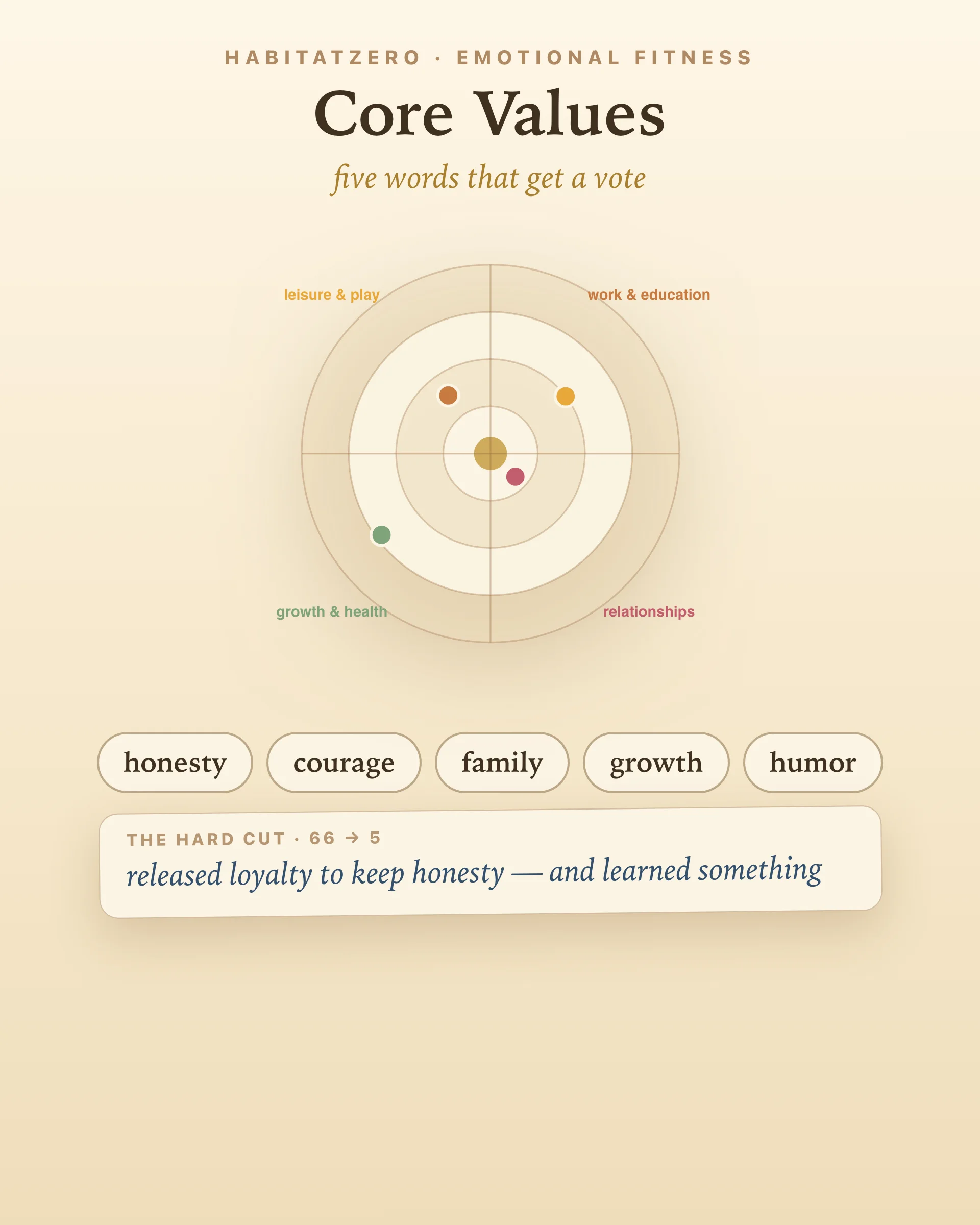
The hard cut. Now release them, one at a time, until five remain. This stage is supposed to hurt a little — that's the mechanism, not a bug. A value only starts working for you once it has beaten other things you also genuinely care about. Releasing loyalty to keep honesty teaches you something no list-reading ever will.
The bullseye. Four life domains on a dartboard — work & education, relationships, personal growth & health, leisure. Tap each quadrant: dead center means "I'm living my values fully here," the outer rim means "far from it." Four dots later you're looking at the honest picture: where your five values are alive, and where they're on hold. The furthest domain gets one prompt — one value, one small step, this week — and a line to write it down.
Then download the card, or let it save. Five words and a dartboard: that's a complete operating manual.
Long values lists feel rich and change nothing — a list of twelve values can justify any decision, so it decides none. The forced cut is where clarity comes from, and the research backs the mechanism: reflecting on and affirming a small set of personally chosen values — the kind of exercise psychologists call values affirmation — has measurable effects on how people handle stress, threat, and difficult feedback. Brené Brown's leadership research uses the same discipline: her values exercise famously insists on cutting the list to exactly two before it counts.
The bullseye half comes from Acceptance and Commitment Therapy — Tobias Lundgren's Bull's-Eye exercise, a standard tool in ACT practice — and it earns its place by converting values from nouns into distances. "I value health" is a sentiment. "My personal-growth dot is on the outer rim" is a fact you can do something about by Thursday.
One reframe makes the whole exercise kinder: values aren't goals. A goal can be completed and crossed off; a value is a direction you travel in — you can head toward honesty today and again tomorrow, and you're never done. That's why the bullseye asks how you're living, not what you've achieved. On a bad week your dots drift outward. That's not failure; that's the gauge doing its job.
Come back quarterly. The five rarely change; the dots always do.
Your values become useful the moment they touch a real decision. If one of your five needs to become a daily behavior, give it a square on the 30-Day Habit Tracker. If it needs to become a commitment with teeth, write it into My Promise to Myself — a self-contract is just a value with a signature. And if the sorting stirred up more feeling than you expected, The Feelings Wheel will help you name it before you file it.
Five words, honestly ranked, beat any resolution you'll write this year.
A structured way to find out what actually matters to you, rather than what should. You start from a broad list of values, narrow it through forced choices, and end with a handful of words specific enough to steer real decisions. This worksheet adds the ACT Bull's-Eye step, which checks how closely your current life matches the values you chose.
Instinct first, narrowing second. Scan a long values list and collect every word that tugs at you without judging it; then force the cut to five by releasing values one at a time. The releases are the method — a value becomes core when it survives against other things you genuinely care about. Memories help too: think of a moment you were proudest of, and ask which value was being honored.
Three to five. More than that and they stop functioning — a list of twelve values can justify anything, so it decides nothing. This worksheet forces the cut to five on purpose; if that feels brutal, it's working. The released values don't stop mattering, they just don't get a vote in tie-breaks.
A goal can be finished; a value can only be lived. 'Run a marathon' is a goal — one day it's done. 'Health' is a value — it shows up in today's choices and tomorrow's, forever. Goals are how values become visible. If a goal keeps stalling, it's often serving a value that didn't actually make your five.
An Acceptance and Commitment Therapy exercise, developed by Tobias Lundgren, that turns values into a picture. A dartboard is split into four life domains — work and education, relationships, personal growth and health, leisure — and you mark each one: the closer to the center, the more fully you're living your values in that domain. The gap between your marks and the center is where the work is.
Yes — free, in your browser, no email gate. The full 66-value list is on this page and readable like the classic printable lists, and when you finish you can download a summary card with your five values and your bullseye. In the Fabulous app your five are saved, so future check-ins start where you left off.
This page is that worksheet, and it prints cleanly - print to PDF from the browser and the controls drop away, leaving the deck and your final picks. Identification here means narrowing in rounds until the essentials remain; nothing is scored, because values are chosen rather than measured.
By the team behind Fabulous, the science-based self-care app used by over 30 million people.