The Overwhelm Recovery ProtocolWellness & Routines · ~5 min
About this template · Updated July 2026
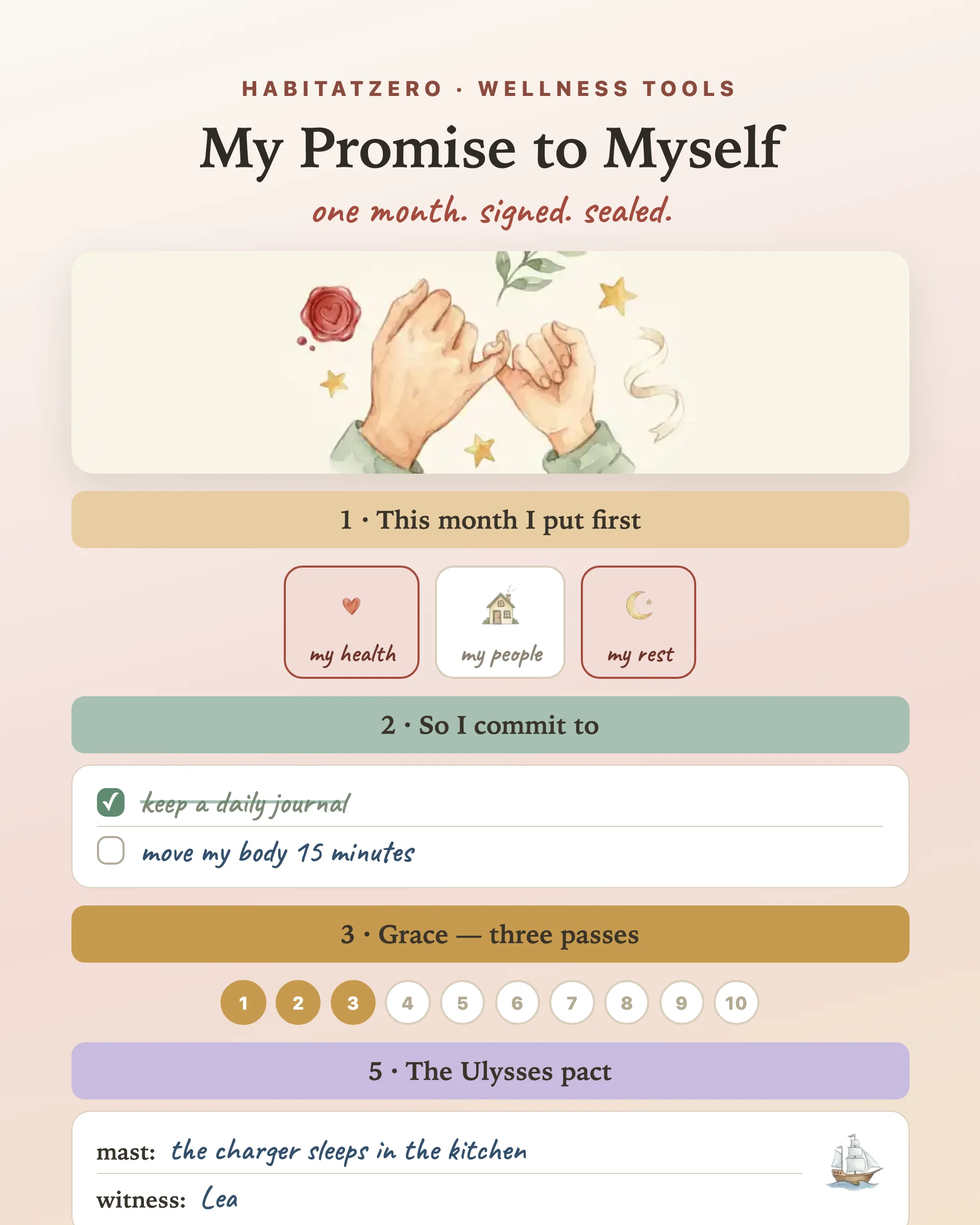
Promises to other people come with machinery: someone remembers, someone is disappointed, someone asks how it went. Promises to yourself come with none of that — which is why they're the easiest promises in the world to break, and why breaking them costs more than we admit. Each quiet abandonment teaches you to trust your own word a little less.
This worksheet rebuilds the machinery. It turns "this month I'll do better" into a small contract with terms, grace, stakes, a witness, and a seal.
The contract starts by making you choose. One or two priorities — health, people, money, work, learning, rest — not all six. A promise to everything is a promise to nothing.
Then come the commitments, and the rule here is actions, not outcomes. "Lose three kilos" is a hope; "move my body fifteen minutes a day" is a thing a person can do on an ordinary Tuesday. Outcomes depend on the world. Actions depend on you, which is the only party this contract can bind.
The cleverest clause in the original Fabulous version of this template is the passes line, and it survives here in full: I am giving myself __ passes.
Perfectionism kills more monthly promises than laziness ever has. One missed day reads as failure, failure reads as proof, and the whole month gets abandoned by the 9th. Passes flip that script: you decide in advance that a certain number of slips are already forgiven. Spending a pass is part of the plan, not a breach of it. Most people do well with three.
A promise with no consequences is a suggestion. The stake section asks what breaking the pact costs — the classic is a donation to a cause you actively don't support, painful enough to feel, small enough to be fair.
But the strongest clause is the one borrowed from Odysseus. He didn't out-willpower the sirens; he had himself tied to the mast before they sang. That's a Ulysses pact: instead of trusting your future self at the moment of temptation, you act now, while you're strong. Name the siren (what will tempt you), set the mast (what you make harder today — the charger sleeps in the kitchen, the app comes off the phone, the money is scheduled to send), and name a witness — because a promise someone else knows about counts double.
If you suspect you've left yourself an exit, ask the built-in pact-checker to read your contract like a friendly lawyer: it names your biggest loophole and one way to close it.
The bottom of the page is a signature line, a renewal date, and a red wax seal that waits, gray and unpressed, until you tap it. The ceremony is not decoration — writing your name and pressing the seal is the moment the mood becomes a decision. There's a reason contracts have been sealed for four thousand years.
And note the renewal date: this pact runs for one month, then you renegotiate. Promises with an end date get kept; promises without one get outlived. When the month closes, come back, read what you wrote, and decide — same terms, new terms, or a well-earned discharge.
Pair it with the 30-Day Habit Tracker to give the daily commitment a place to be stamped, or start the day it begins with Tend Your Day.
Vague intentions fail quietly because they have no terms. A contract forces the terms into the open: what exactly you'll do, how many slips are covered, what breaking it costs, and when it ends. Signing it turns a mood into a decision.
A number of slips — you choose it, from one to ten — that are forgiven in advance. They protect the promise from perfectionism: missing one day stops being a reason to abandon the month.
A pre-commitment, named after Odysseus, who had himself tied to the mast before the sirens sang. Instead of trusting future willpower, you make the tempting choice harder right now — delete the app, move the charger, hand the treat to a friend — and tell a witness.
Something you would genuinely feel but that isn't cruel: a donation to a cause you don't support, a week without your favorite treat. The stake's job is to make breaking the promise a decision instead of a drift.
By the team behind Fabulous, the science-based self-care app used by over 30 million people.