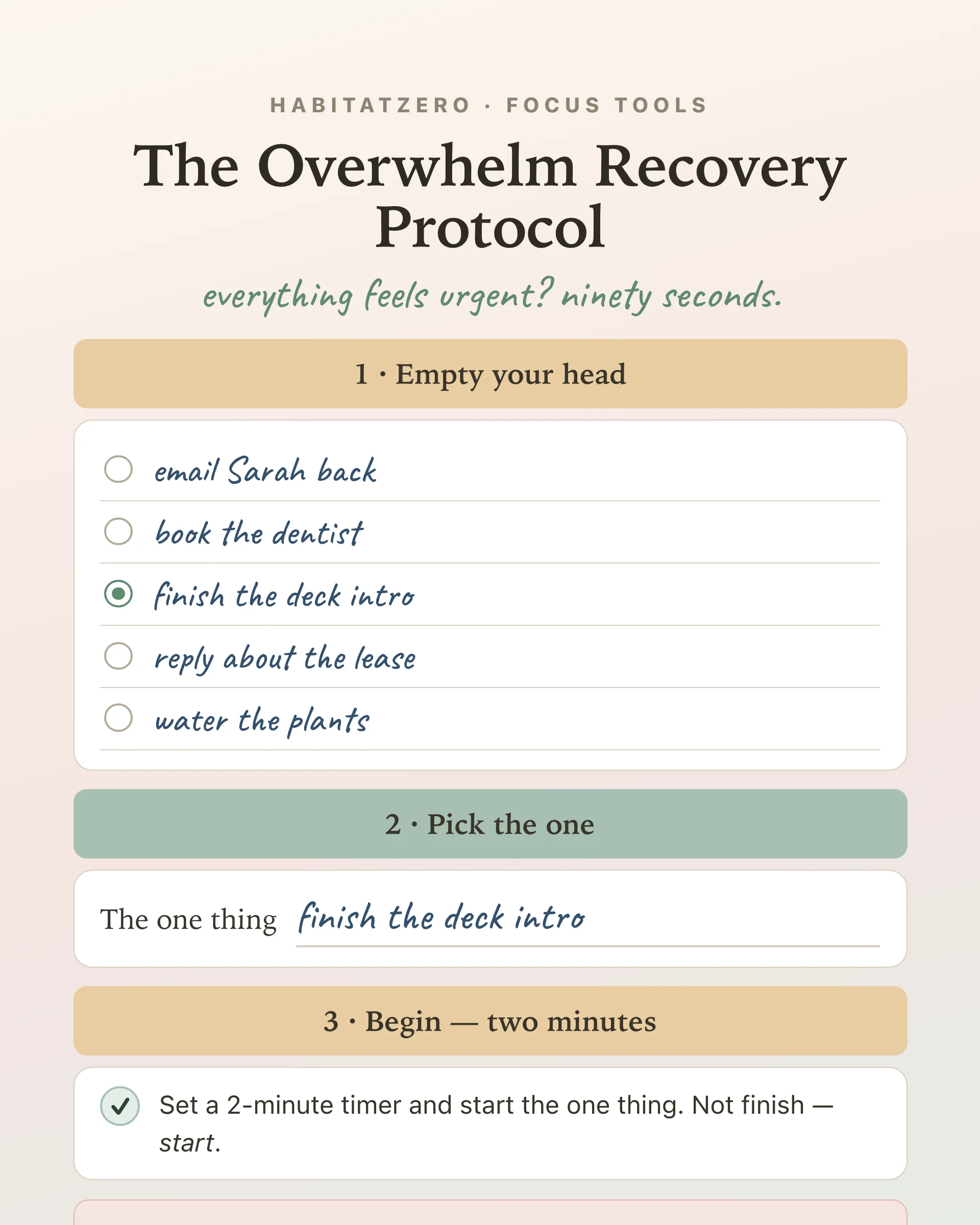
The Overwhelm Recovery ProtocolWellness & Routines · ~5 min
About this template · Updated July 2026
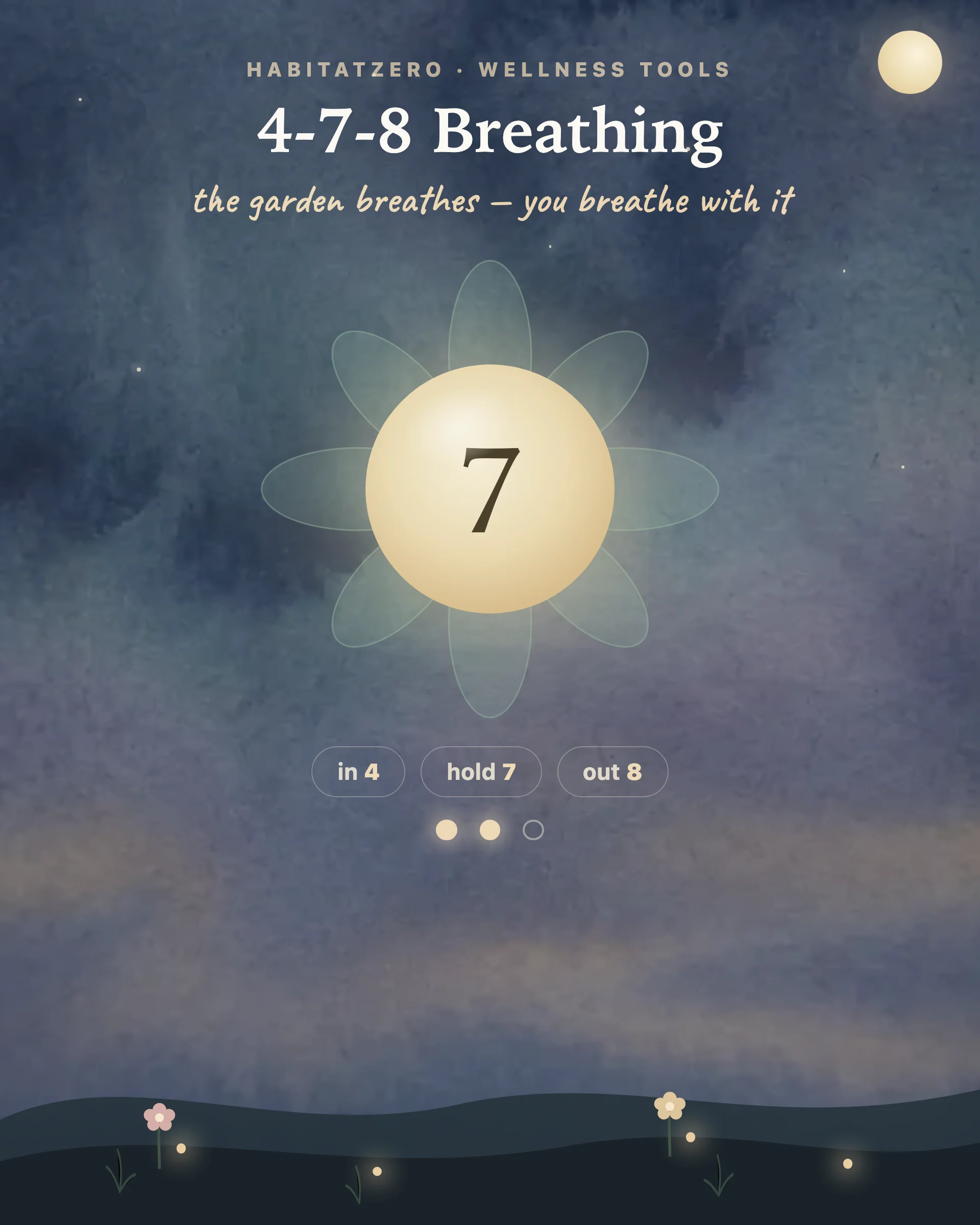
Every calming technique in the world competes with one problem: in the moment you need it, you have no patience for instructions. A tight chest does not want to read bullet points. That's why this version of 4-7-8 breathing doesn't describe the practice — it performs it with you.
Press begin and the page becomes a garden at dusk. A pale bloom sits at the center, and it breathes: it opens for four counts while you breathe in, holds itself still and shimmering for seven, then settles, slowly, for eight, while you empty your lungs through your mouth. Fireflies drift over the grass. Each finished round lights another band of stars, and a small seed below turns gold. After three rounds — about a minute — the sky is full and the garden goes quiet.
The pattern — in for 4, hold for 7, out for 8 — was popularized by Dr. Andrew Weil, but the mechanism is older than any of us: the exhale is the body's natural brake. Breathing out slowly stimulates the parasympathetic nervous system, the rest-and-digest half of your wiring. An exhale twice as long as the inhale is the simplest, most portable way to send the signal the emergency is over.
The hold matters too, in a quieter way. Seven counts of stillness with full lungs is long enough that your attention has to come back from wherever it was and mind the breath. That's not a side effect — that's the practice smuggling in a moment of meditation.
The classic failure mode of breathing exercises is bookkeeping: was that six or seven? Am I doing it right? The garden takes the arithmetic away. The numeral in the bloom counts each phase down; the handwritten cue under it tells you what the phase wants ("softly — no clenching"); a thin ring of light traces the whole round. Your only job is to follow something beautiful with your eyes and let your lungs copy it.
Three details are doing quiet work here:
The garden also remembers. Every round you complete, tonight or any night, joins your lifetime count — a slow, private tally of every time you chose to stop and breathe.
Before the conversation you're dreading. In the car, before going back inside. Mid-afternoon, when the day has too many tabs open. And especially at the edge of sleep — 4-7-8 was designed as a bedtime practice, and the long exhale works best when there's nothing after it but a pillow.
If your mind is too loud for even a minute of stillness, empty it first with The Overwhelm Recovery Protocol, then come back. And if you want the practice to take root, put a stamp on it every day with the 30-Day Habit Tracker.
You don't have to fix anything right now. You just have to breathe.
A slow breathing pattern — inhale for four counts, hold for seven, exhale for eight — popularized by Dr. Andrew Weil. The long exhale is the point: it nudges the nervous system toward its calmer, rest-and-digest mode.
Three rounds is plenty, especially at first. The practice takes about a minute. If you're new to breath holds, it's normal to feel a little light-headed — sit down, and let the counts be approximate.
Before a hard conversation, in the middle of an overwhelmed moment, or as a landing ritual before sleep. It's a portable reset — the interactive garden just makes the counting effortless.
A slow exhale gently activates the body's natural braking system. Making the out-breath twice as long as the in-breath is the simplest reliable way to tell your body the emergency is over.
By the team behind Fabulous, the science-based self-care app used by over 30 million people.