Leaves on a StreamEmotional Fitness · ~3 min
About this template · Updated July 2026
There's a particular kind of stuck that happens before the feeling has a name. Something is off — you can feel it in your shoulders, in the way you reread the same sentence four times — but when someone asks, the best you can produce is "fine," "stressed," or "I don't know, just… off."
That gap has a cost. An unnamed feeling gets to steer: it picks the snappy reply, the third coffee, the evening spent doomscrolling sideways. A named feeling becomes something you're having rather than something you're inside.
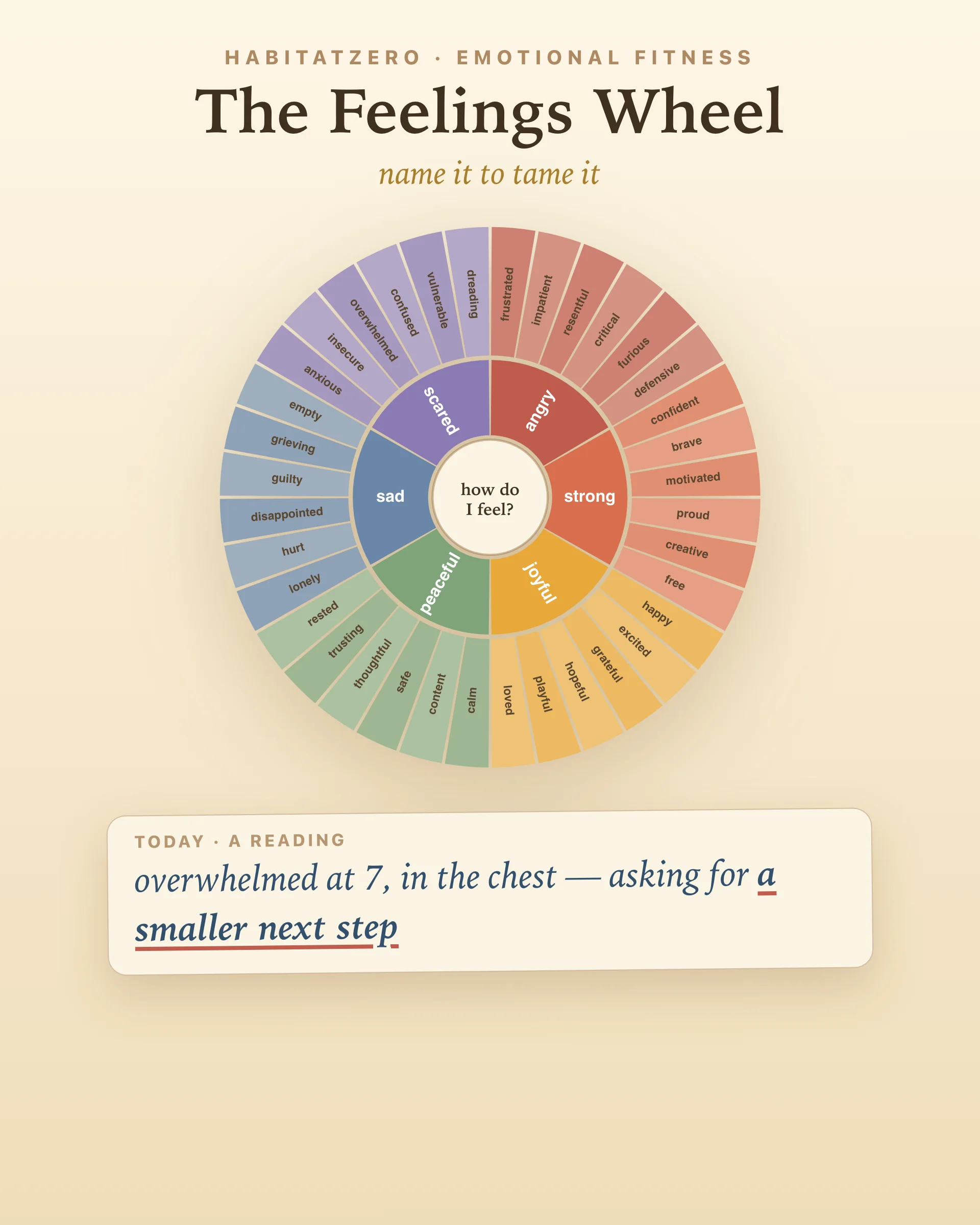
This is a feelings wheel — the classic tool for closing that gap — rebuilt as something you can actually turn.
The wheel starts with six core feelings: angry, strong, joyful, peaceful, sad, scared. Tap the one that's roughly true — a coarse guess is exactly how it's supposed to work. The wheel fans open into six more precise words for that family, each with a plain-language definition, and most of those offer two sharper words still. Three taps take you from "bad" to resentful, or from "fine, I guess" to rested.
When a word lands — you'll know, it's the one that makes your shoulders drop a centimeter — tap this is it. The word drops into your log with its trail (angry → frustrated → stuck), and you can add one line about what's underneath. You can also download the moment as a card, or just close the page. Naming was the exercise; everything after is optional.
If even the first tap feels impossible, the full wheel is laid out as a browsable list below — 114 feelings, every one defined. Sometimes the right word is found by reading, not deciding.
The wheel's ancestor is therapist Gloria Willcox's Feeling Wheel, published in the Transactional Analysis Journal in 1982 — six core feelings in the middle, sharper ones radiating outward, designed so anyone could "learn to identify and express feelings" without a therapist's vocabulary.
The science that grew up around it is some of the most practical in emotion research. The skill the wheel trains is called emotional granularity — the difference between "I feel bad" and "I feel left out." People who name emotions with more precision tend to cope better under stress: a precisely named feeling comes with more precise options. "Left out" suggests texting a friend; "bad" suggests nothing at all.
Naming isn't the same as fixing, and it doesn't need to be. It's the step that turns weather into a forecast.
The two names get used interchangeably, but they usually point at two different tools. The Willcox-style feelings wheel — what you're using here — is a naming aid: layered rings, from coarse to precise. Robert Plutchik's emotion wheel is a theory model: eight primary emotions arranged like a color wheel, with opposites (joy–sadness, trust–disgust) and intensities (annoyance → anger → rage).
Plutchik's is a beautiful map of how emotions relate. Willcox's is the one you reach for at 4pm on a bad Tuesday. This wheel follows Willcox's structure with an updated, plain-English vocabulary — and if you want the theory, the definitions in the list below note where families sit close to each other.
The wheel has a simple mode — cores and one ring only, bigger targets — which is the version to hand to a child (or to yourself on a day when 114 words is 100 too many). Feelings vocabulary is learnable at any age; the wheel just makes the lesson a game of warmer/colder.
And if you're a print person: the snapshot card downloads as an image, and the full word list below reads like the classic printable chart. The interactive version's advantage is honest, though — definitions on tap, a trail of how you got there, and a log that remembers what you found.
Before answering the message that spiked you. After the meeting that left a residue. At the end of a day that was "a lot" — name which kind of a lot. If the word you land on has hooks in you — a thought that won't let go — send it down Leaves on a Stream. If naming the day is a ritual you want to keep, Tend Your Day is the two-minute evening version.
One word, honestly chosen, is a complete practice.
The feelings wheel helps you move from a vague mood to a precise word. Psychologists call the skill emotional granularity — people who name emotions specifically tend to regulate them better. The wheel does the work of a bigger vocabulary: start with a rough core feeling, then follow the rings outward until a word actually fits.
Start at the center and pick the core feeling that's roughly right — don't overthink it. Then move outward: each ring offers more specific words for that family. Stop at whichever layer fits. In this interactive version, every word shows a plain-language definition, and you can log the word you land on.
Therapist Gloria Willcox published the original Feeling Wheel in 1982 in the Transactional Analysis Journal, with six core feelings that branch into more specific ones. A related but different tool is Robert Plutchik's wheel of emotions, which arranges eight primary emotions by intensity and opposites. This wheel follows Willcox's layered structure with an updated vocabulary.
People use the names interchangeably, but they usually point to two different tools. The Willcox feelings wheel is a naming aid: core feelings in the middle, sharper words as you move outward. Plutchik's emotion wheel is a theory model: eight primary emotions arranged as opposites that blend and vary in intensity. For finding the word for what you feel right now, the layered Willcox style — used here — is the practical one.
This wheel holds 114 feelings: six core families, each opening into six more precise words, each of those offering two sharper ones. Willcox's 1982 original had 72 across three rings. The exact count matters less than the layering — each ring is one step from 'bad' toward the word that actually fits.
Yes — the wheel is free, runs in your browser, and needs no signup. When you name a feeling you can download it as an image, and the full 114-word list with definitions is on this page if you'd rather read it like a chart. Prefer it on your phone with your history saved? The Fabulous app keeps your wheel and your log together.
By the team behind Fabulous, the science-based self-care app used by over 30 million people.