The Gratitude JarEmotional Fitness · ~1 min
About this template · Updated July 2026
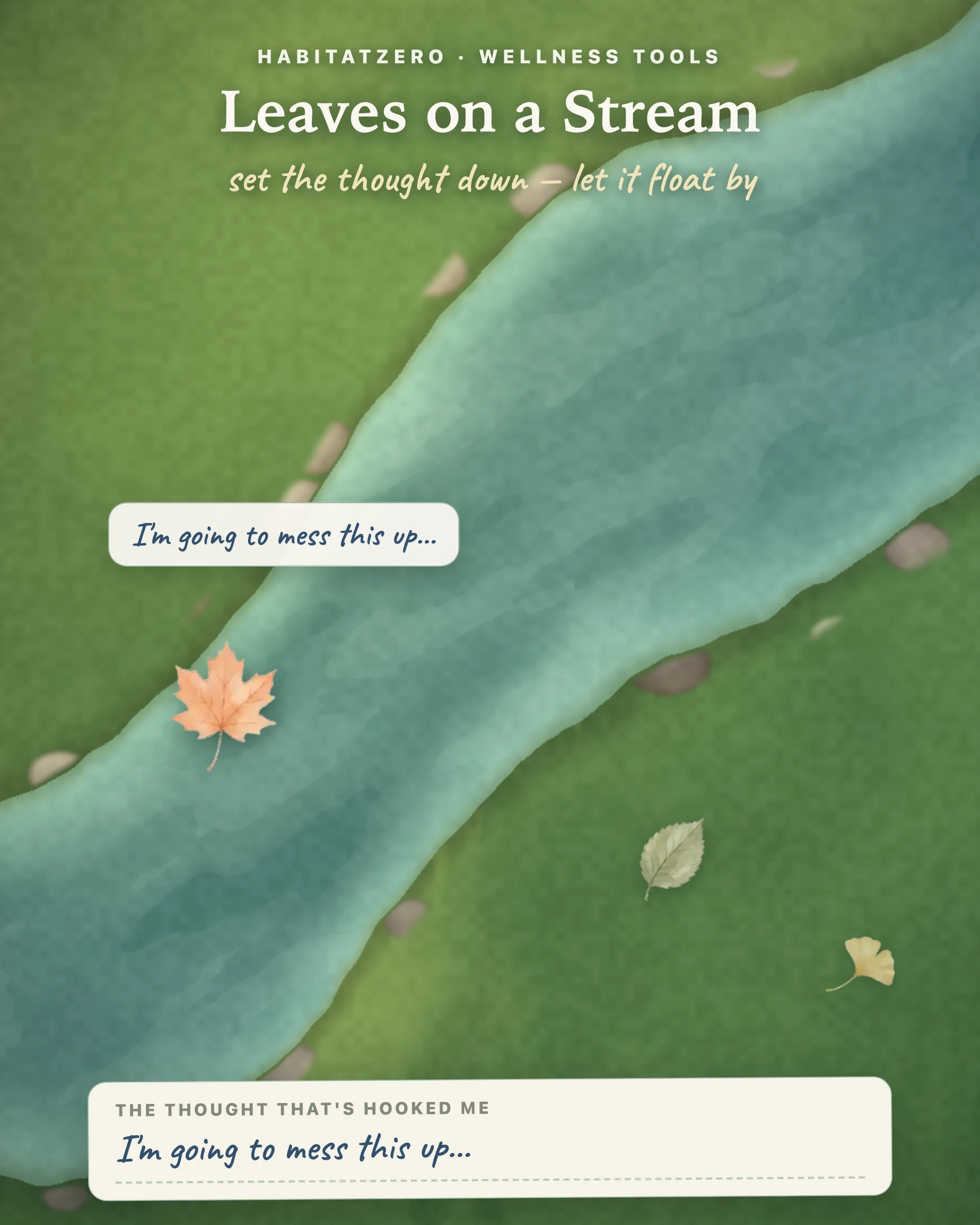
There's a moment everyone knows: a thought gets its hooks in. I'm going to mess this up. They're upset with me. I should have said something else. You argue with it, push it away, or obey it — and every one of those moves pulls the hook deeper.
Acceptance and Commitment Therapy (ACT) offers a different move entirely, and it comes with a picture: sit beside a stream, put each thought on a leaf, and watch the water carry it away. Not because the thought is banished — because you've changed seats. You were inside the thought; now you're on the bank, watching it float by.
This is that exercise, with a real stream.
Press sit by the stream and the bank is yours: a watercolor stream in dappled light, water glinting, the sound of a real brook (gentle, optional). The water is really there, too — brush a fingertip across it and ripples spread, collide, and fade, because the page simulates the water's surface rather than playing a canned animation. At the bottom, a paper slip asks for the thought that's hooked me. Write it in a few words.
Then set it on a leaf.
A watercolor leaf drifts down from the bank, lands with a splash that sends real waves across the water, and takes your words aboard. The current pulls it toward the bend. Partway across, the words dissolve — the leaf carries on without them, smaller and smaller, until it slips past the rocks and out of sight. A quiet count ticks up: 31 thoughts sent downstream.
Another thought will arrive. That's not failure — that's what minds are for. Give it its own leaf.
One design choice matters more than any animation: released thoughts are never saved. Not in your notes, not anywhere. Writing the thought down gives it enough shape to set it on the leaf — and then it's genuinely gone. The only things the stream remembers are how many leaves you've released and how your head tends to feel before and after. This is the rare page where forgetting is the feature.
The technical name for what the leaf does is cognitive defusion. A fused thought is one you're looking from — it feels like reality. A defused thought is one you're looking at — a sentence your mind produced, floating on a leaf, observably separate from the person watching it.
The wording shift is small but real: "I'm going to fail" versus "I'm having the thought that I'm going to fail." If you can't find that distance on a hard day, tap help me loosen it and the page will offer the defused wording for your exact thought, ready to place on the leaf.
Two things this practice is not: it's not a delete button (the same thought may need many leaves, and that's the practice working, not failing), and it's not a substitute for professional support when the water is genuinely dangerous. It's a bank to sit on — a way to spend three minutes being the stream's witness instead of its cargo.
Before sleep, when the day replays itself. Before the conversation you've rehearsed too many times. In the gap after a mistake, when the commentary is loudest. Pair it with 4-7-8 Breathing — a few slow breaths first makes the bank easier to find — and if what's hooked you is a whole tangled pile rather than one thought, empty the pile first with The Overwhelm Recovery Protocol and bring the survivors here, one leaf at a time.
You are the stream, not the leaves. Sit down and watch a few go by.
A classic practice from Acceptance and Commitment Therapy (ACT): you imagine placing each thought on a leaf and watching a stream carry it away. The point isn't to get rid of thoughts — it's to change your relationship with them, from being inside the thought to watching it pass.
Defusion means stepping back from a thought so you can see it as a thought — a few words your mind produced — rather than a fact or a command. 'I'm going to fail' feels different from 'I'm having the thought that I'm going to fail.' The leaf is that step back, made visible.
No. The stream keeps nothing — released thoughts are never stored. The only thing remembered is a count of how many leaves you've sent downstream, and how the practice tends to leave your head feeling.
Completely normal, and part of the practice. Minds repeat themselves; the exercise isn't a delete button. Give the thought another leaf, as many times as it visits. It's the watching that does the work, not the disappearing.
By the team behind Fabulous, the science-based self-care app used by over 30 million people.