Leaves on a StreamEmotional Fitness · ~3 min
About this template · Updated July 2026
Let's deal with the poster problem first. You've seen the affirmations — I am limitless. I attract abundance. I am completely confident. — and if they've ever made you feel slightly worse, you're not broken: you're consistent with the research. A well-known study on positive self-statements found that grand claims can backfire for exactly the people who reach for them — when the gap between the sentence and your actual belief is too wide, the mind doesn't absorb the sentence; it files a counterargument.
So this worksheet takes the other road: affirmations written to be believable. Progress claims, effort claims, track-record claims — sentences that pass the internal fact-check. The kind you can say on a bad Tuesday without your own eyebrows going up.
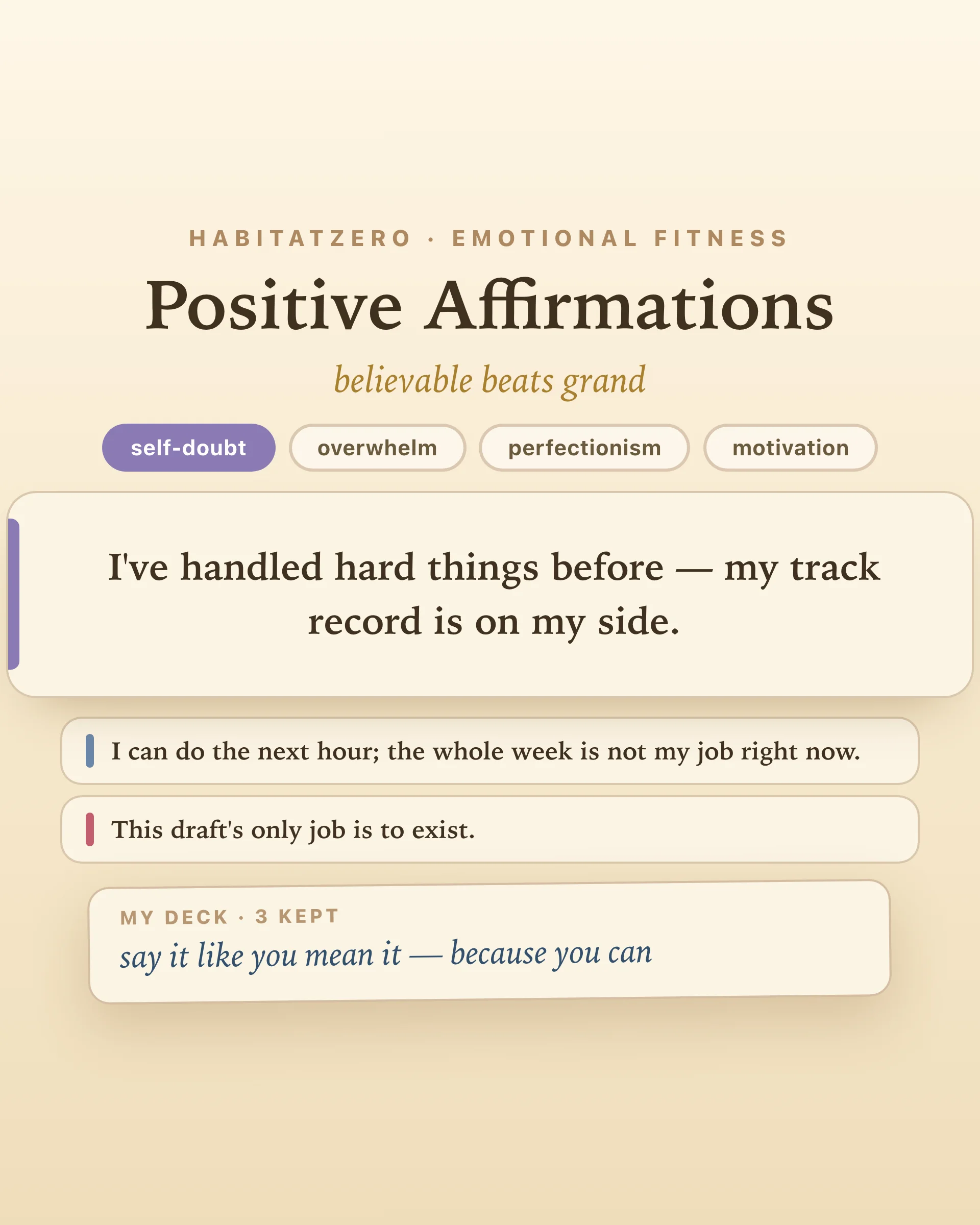
Pick what's loud. Eight struggles: self-doubt, overwhelm, perfectionism, body & energy, work & worth, relationships, motivation, change. The right affirmation for the wrong problem is just a nice sentence, so the deck starts by asking what today is actually about.
Flip until one lands. Each struggle holds a handful of cards. You'll recognize the right one by a specific small sensation — an internal "…okay, that's true." That's the signal the sentence cleared the believability bar. Tap keep and it joins your personal deck; download any card as a clean image for the mirror, the monitor, or the lock screen.
Write your own. The strongest affirmation is one in your voice. The worksheet's formula keeps you on the believable side of the line: present tense + true direction + no lies. "I am learning to leave work at work" will survive a hard week; "I have perfect balance" won't survive Thursday.
The research that survives scrutiny in this territory is about self-affirmation in the psychologist's sense — reflecting on what you value and who you've managed to be — which has measurable effects on how people handle stress, threat, and hard feedback. Notice what that research is not about: chanting a wish. It's about reconnecting to true things that the hostile inner narrator has stopped mentioning.
That's the design brief for every card here. "I've handled hard things before — my track record is on my side" isn't optimism; it's evidence the narrator omitted. An affirmation, done right, is less like a spell and more like a character witness.
Repetition beats ceremony. One sentence, met daily at the same small moment — the mirror while brushing, the first red light of the commute, the laptop opening — quietly becomes part of the default script within a few weeks. Pick one card, not seven; the deck is a menu, and a rotation dilutes the groove.
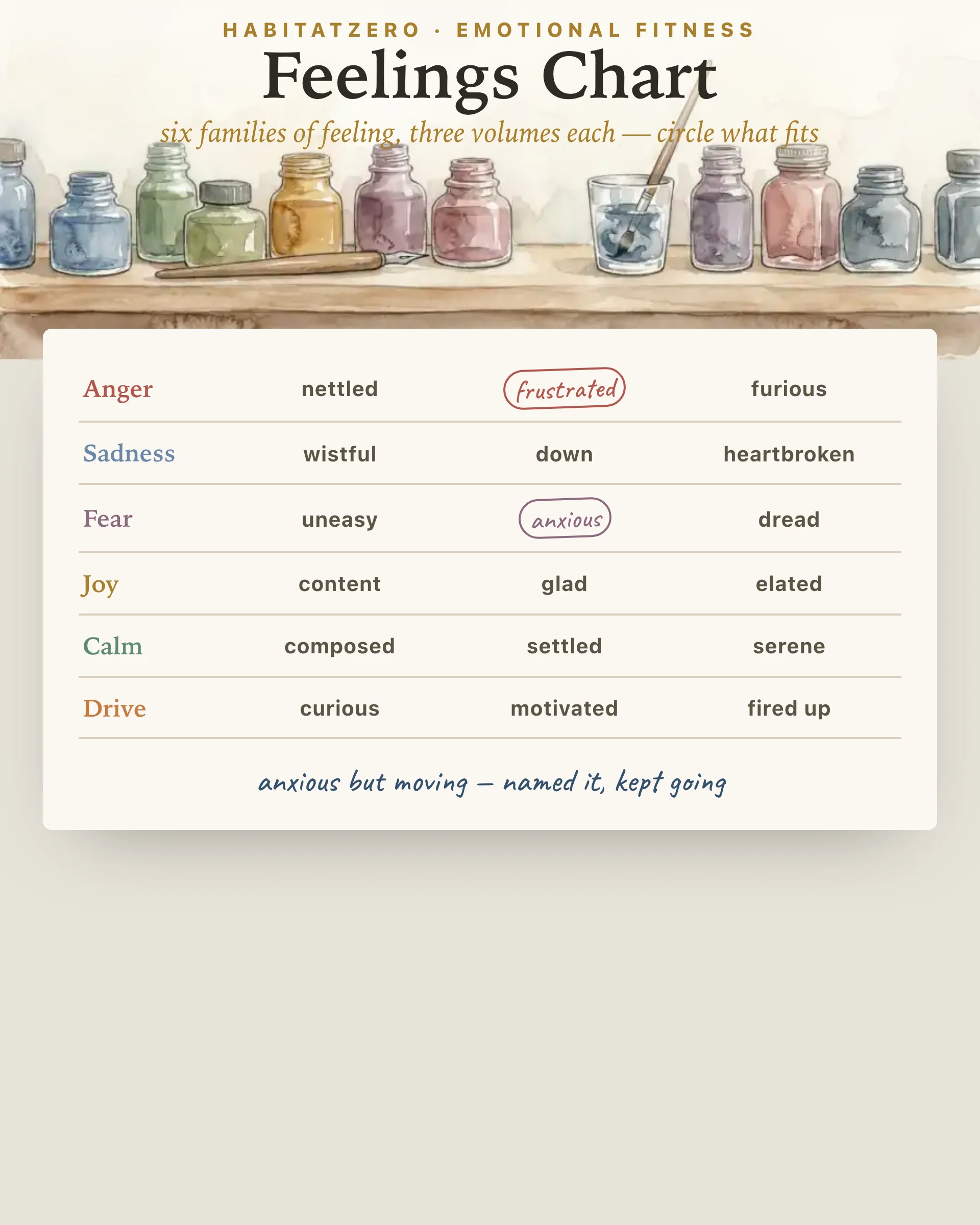
And match the tool to the moment: an affirmation is for the hostile-narrator problem. If what's actually happening is a feeling you can't name, spin The Feelings Wheel first — naming beats reframing when the signal is still fuzzy. If the sentence you keep needs to become behavior, anchor it to a value from your Core Values Worksheet. And if the thought you're countering has real hooks in you, give it the full treatment at Leaves on a Stream before asking a sentence to out-shout it.
One believable line, said daily, in your own voice. That's the entire practice — and unlike the poster, you'll actually buy it.
The honest answer: it depends on the sentence. Research found that grand self-statements like 'I am completely lovable' can backfire for the people who need them most — the gap between the claim and the belief just highlights the doubt. What holds up better are believable, values-anchored statements: progress claims, effort claims, and track-record claims. Every card in this deck is written on that side of the line.
Three rules. Present tense, so it describes now rather than a fantasy future. A true direction rather than a finished state — 'I am learning to speak up' survives contact with a hard day; 'I am confident' may not. And your own words: an affirmation you'd actually say out loud beats a poster phrase. The worksheet's write-your-own section uses exactly this formula.
Believable ones sound like: 'I have handled hard things before — my track record is on my side.' 'I can do the next hour; the whole week is not my job right now.' 'Done and imperfect has served me better than perfect and unstarted.' The deck holds cards like these across eight struggles, from self-doubt to change — pick the struggle and flip.
At the moment the inner narrator turns hostile — before the hard conversation, mid-overwhelm, after the mistake replay starts. Many people also anchor one to a daily moment like the morning mirror or the commute. Repetition matters more than ceremony: one believable sentence, met daily, quietly rewrites the default script.
You can download any card — curated or your own — as a clean image to print, set as a wallpaper, or stick on the monitor. The full affirmations list is also readable on this page. In the Fabulous app, your kept deck saves and syncs.
By the team behind Fabulous, the science-based self-care app used by over 30 million people.