ADHD Daily Task OrganizerFocus & ADHD · ~10 min
About this template · Updated July 2026
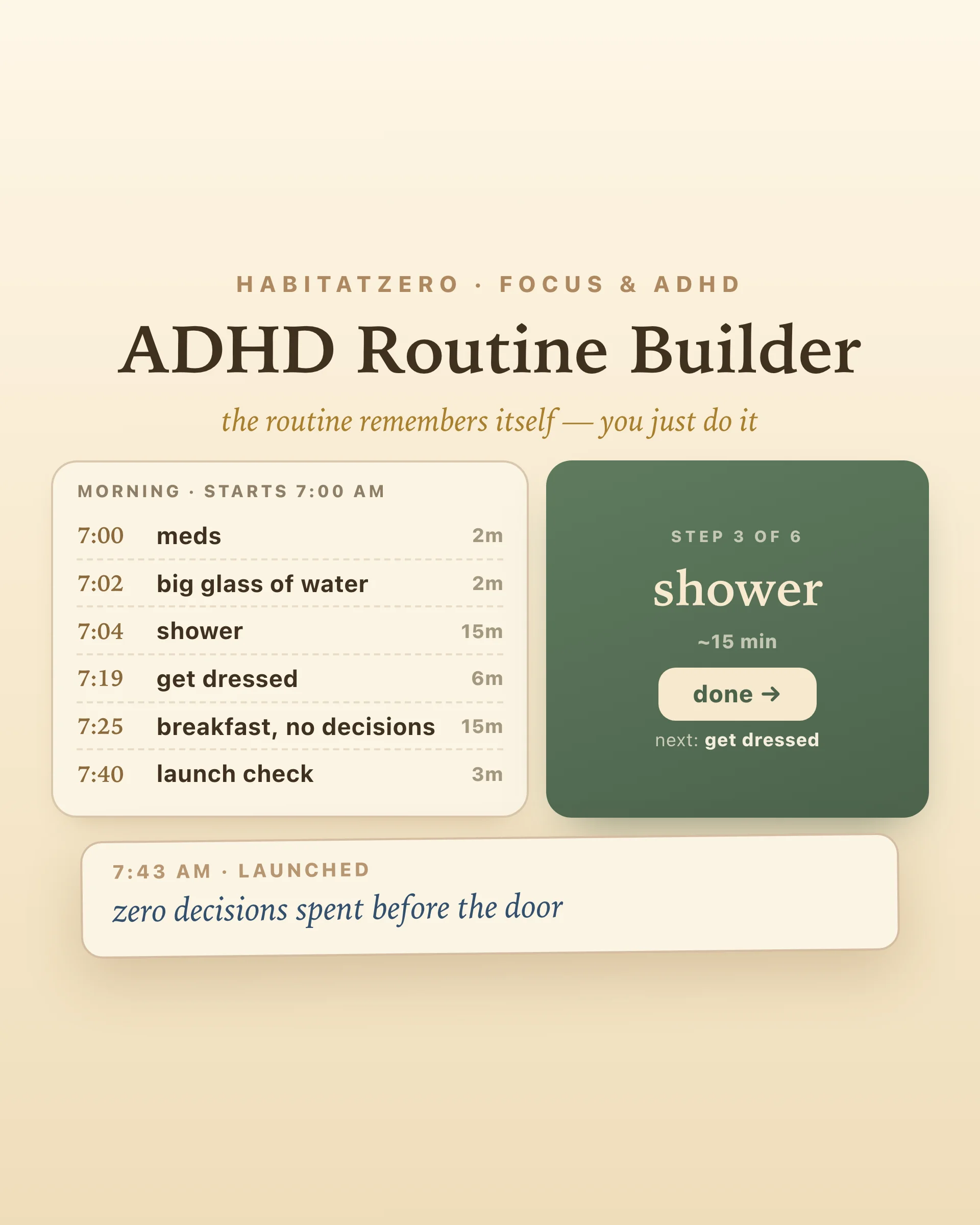
Here is what a morning actually costs with ADHD — and it isn't the shower or the breakfast. It's the deciding. What now? Was I doing something? Where did I put — okay, phone first, no wait. Every step of an unstructured morning bills a small executive-function fee, and ADHD pays that fee at a premium. By the time you're out the door, you've made forty micro-decisions and you're already tired.
Neurotypical advice says "just build a routine," and the internet is wall-to-wall articles agreeing. What none of them hand you is a routine that runs itself. This builder does: stack the steps once, and from then on the routine remembers itself — one step at a time — so you only have to do it.
Build the one that keeps dissolving. Morning, workday start, or evening — pick the routine currently costing you the most. Stack steps from the library (meds, water, shoes by the door, launch check) or write your own, each with honest minutes. Tap the arrows to reorder until the sequence matches what your body actually does — not what looks disciplined on paper. Set the anchor time and every step gets its own clock time.
Then run it. This is the part the printable charts can't do. Run mode shows exactly one step — big, unmissable — with the next one waiting quietly underneath. Tap done; the next step slides up. No scanning a list to find your place, no deciding what counts as next, no chart on the fridge that turned invisible in week two. On a foggy Tuesday, the difference between "a routine I have" and "a routine that runs" is the whole game.
Build all three routines if you like — the builder keeps each one, and the morning chart downloads as an image for the fridge crowd (we see you; the fridge can be a backup).
The research frame here is executive function — the self-management system that handles sequencing, working memory, and task initiation, and that ADHD taxes hardest. A routine held in your head draws on exactly the resources that are scarce; a routine held outside your head — visible, ordered, one-step-at-a-time — barely draws on them at all. That's not a workaround; it's the correct engineering.
The one-step design isn't cosmetic either. Studies of if-then planning with ADHD found that pre-deciding when X happens, I do Y substantially improves follow-through — the decision is made once, in advance, and execution stops requiring willpower. Run mode is if-then planning with a user interface: the if is "I tapped done," and the then is already on screen.
Short spine first. Five to eight steps. The fifteen-step aspirational morning is a resolution, not a routine — it dies by Thursday and takes your confidence with it. Get a short spine running for two weeks, then add one improvement at a time.
Anchor to a trigger, not a time-ish. "After the alarm" and "when the coffee finishes" survive; "around 7" doesn't. ADHD routines live and die on anchors.
Expect the derail, plan the re-entry. You will get pulled off mid-routine — that's not failure, that's the condition. The re-entry move is opening run mode again: it still knows exactly where you were, which is precisely what your working memory couldn't hold.
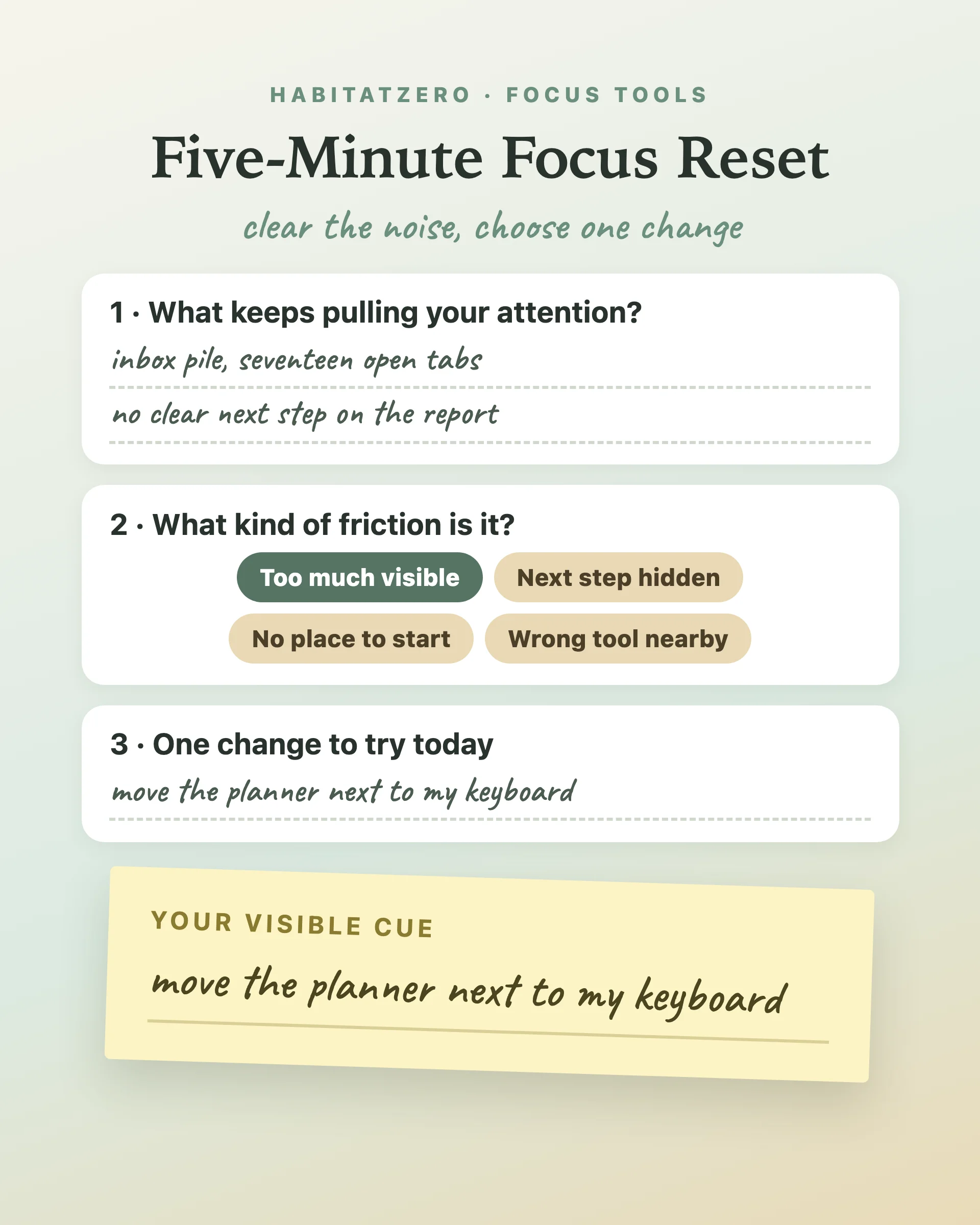
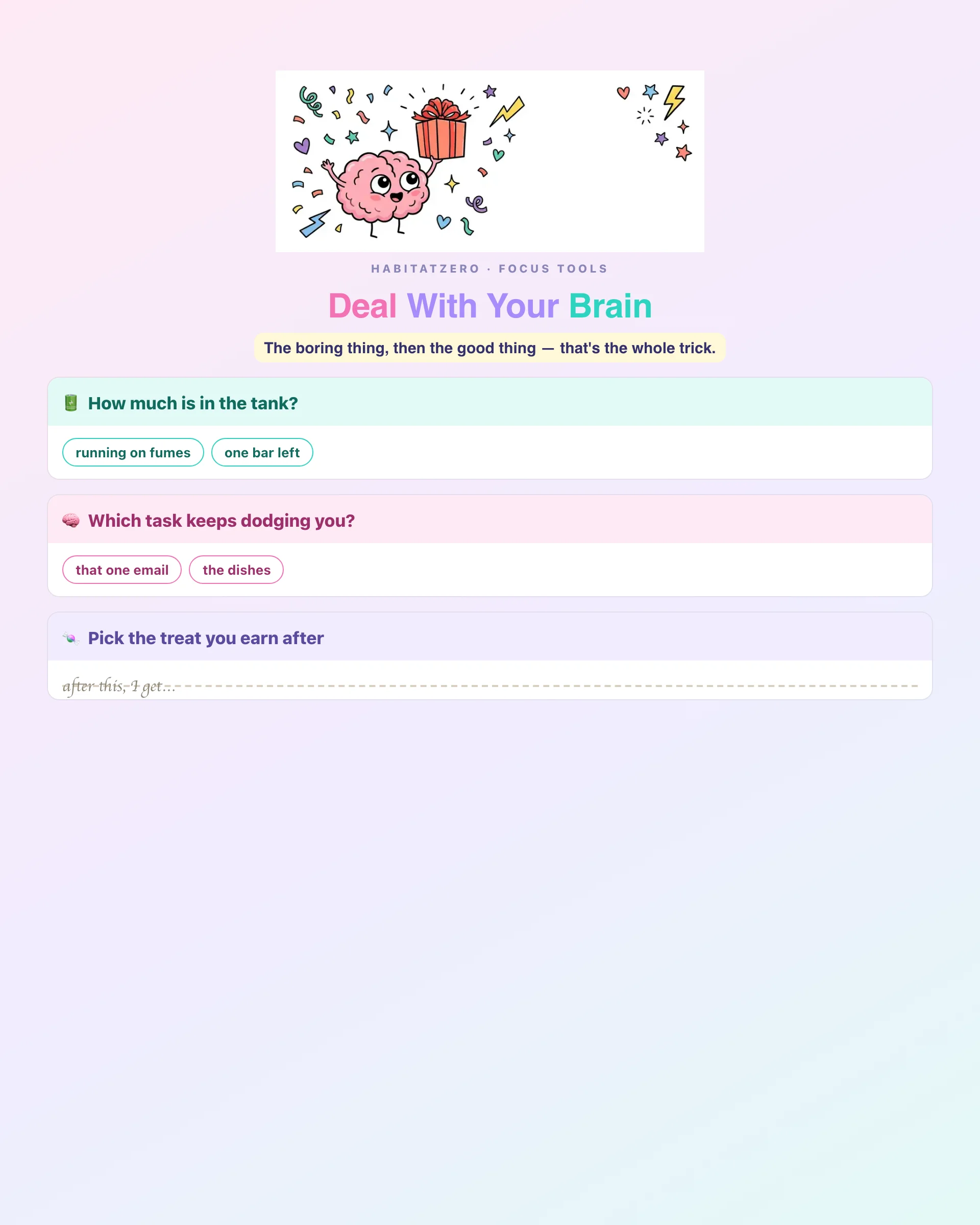
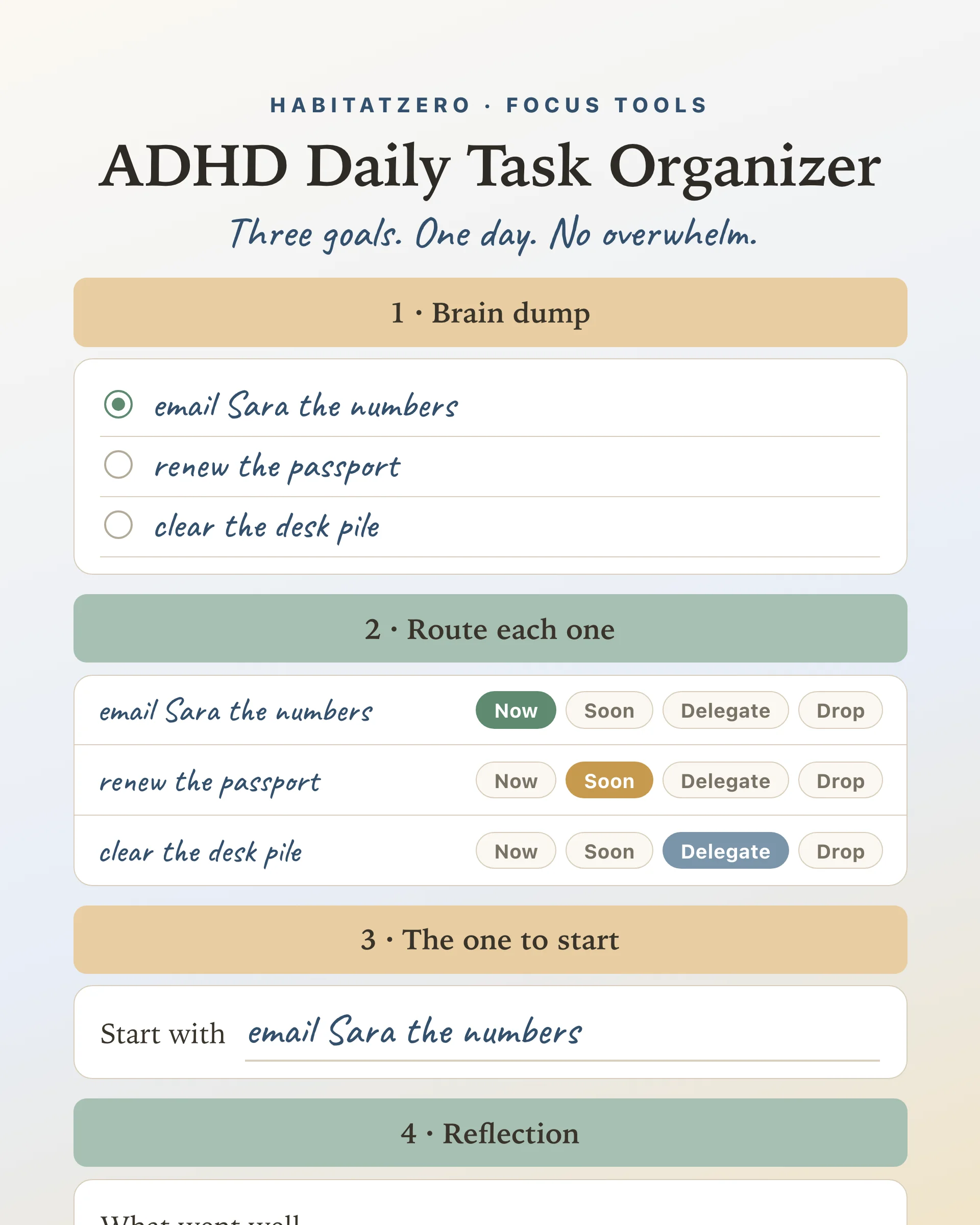
The builder launches the day; other tools carry it. If starting any step is the wall, Deal With Your Brain is the task-initiation tool for exactly that freeze. Once launched, the day's tasks live in the ADHD Daily Task Organizer, and the evening version of this problem — winding down instead of launching — already has its own builder in the Wind-Down Routine Builder.
Build it once. Anchor it. Run it one step at a time — and let the chart do the remembering your morning was never going to.
Because a routine is really a chain of tiny decisions, and decisions are exactly what ADHD executive function makes expensive. Each step costs a what-now, a where-was-I, and a transition — and by step four the chain has quietly dissolved into the phone. Externalizing the sequence removes the deciding: the routine remembers itself so you only have to do it.
Three rules that respect how ADHD attention works. Keep it short — five to eight steps beats fifteen. Order it by what your body actually does, not what looks disciplined on paper. And anchor it to a fixed trigger — an alarm, the coffee finishing — because ADHD routines survive on anchors, not intentions. Research on if-then planning shows that pre-deciding when and what dramatically improves follow-through for ADHD brains specifically.
Less than you think, in a fixed order: meds if prescribed, water, food that requires no decisions, clothes chosen the night before, one launch-check (keys, wallet, bag), out. The routine's job isn't self-improvement — it's getting launched without the 40 minutes of ambient deciding. Improvements can be added one at a time after the spine holds for two weeks.
Run mode turns your routine chart into a guided sequence: one step fills the screen, the next waits underneath, and tapping done advances. It works because it deletes the two ADHD failure points — scanning a list to find where you were, and deciding what counts as next. The chart plans the routine; run mode is what actually executes it on a foggy Tuesday.
Yes — free, in your browser, no signup. Build the routine, download it as a chart if you want it on paper, and in the Fabulous app it saves and syncs so run mode is one tap away every morning.
By the team behind Fabulous, the science-based self-care app used by over 30 million people.