Dream JournalSleep & Evenings · ~3 min
About this template · Updated July 2026
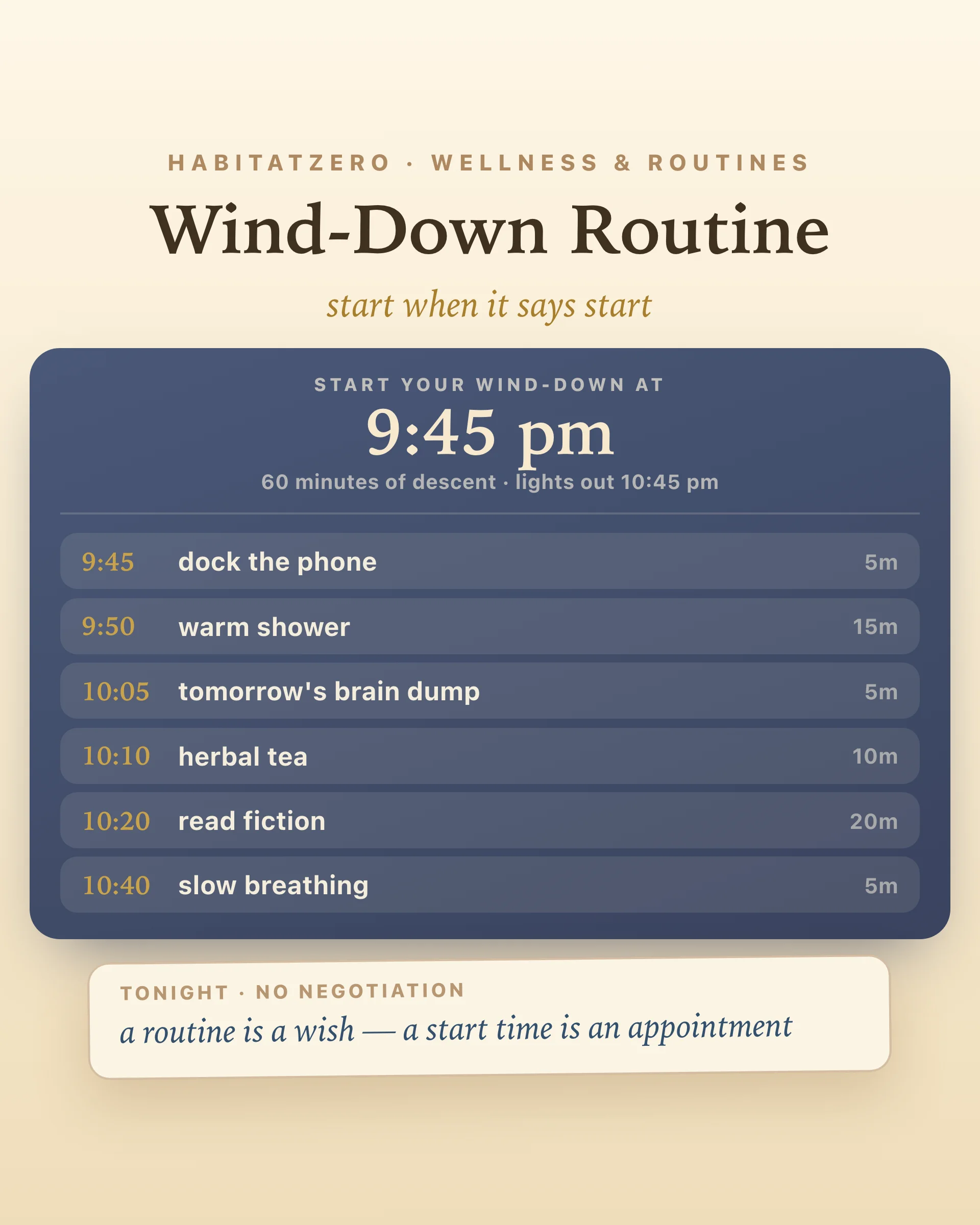
No pilot lands a plane from cruising altitude with no descent. Yet most of us attempt it nightly: Slack until ten, one-more-episode until eleven-forty, then lights out and a sincere expectation that a mind doing 100 will simply… stop. It doesn't stop. It circles the runway for an hour, replaying the day and pre-playing tomorrow.
A wind-down routine is the descent path. And the reason most people don't have one isn't ignorance — everyone knows tea and a book beat a feed — it's that a routine without a start time loses to one-more-episode every single night. This builder's whole job is that number: stack your steps, set your bedtime, and it tells you the exact minute to begin.
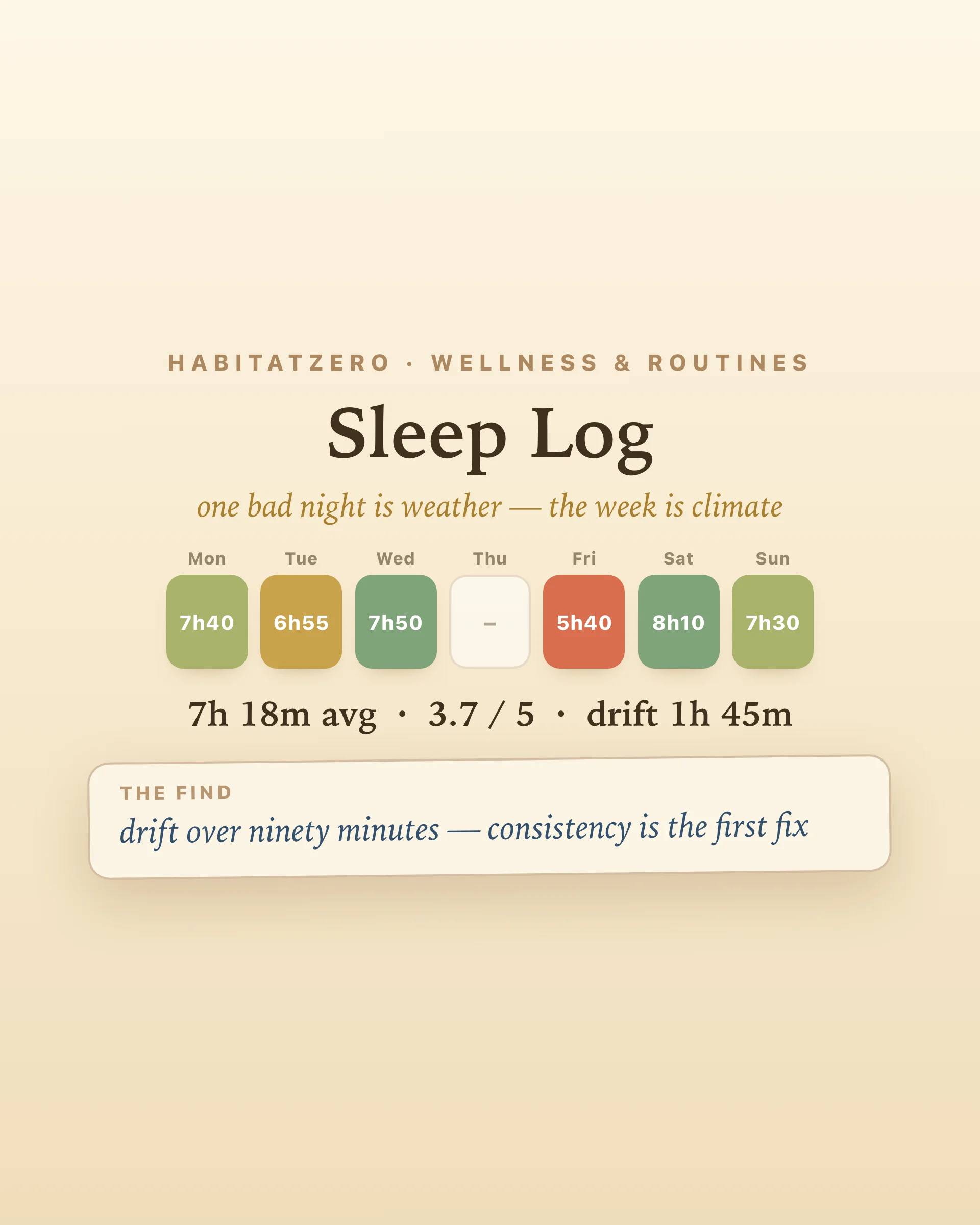
Set the real bedtime. Not the aspirational one — the time the lights actually go out.
Stack the steps. Tap activities into your routine from the library: dim the lights, dock the phone, warm shower, tomorrow's brain dump, stretch, tea, a chapter of fiction, slow breathing. Reorder them into a sequence that descends — brighter to dimmer, busier to quieter. Adjust the minutes on each; add your own steps if your descent includes a dog or a skincare shelf.
Start when it says start. The builder totals your steps and computes backward from bedtime: start your wind-down at 9:47pm. Every step gets its own clock time — shower at 9:52, phone docked at 10:07, book at 10:22. The times are the product. A routine is a wish; a start time is an appointment.
If your stack tops ninety minutes, the builder will gently say so: a beautiful long ritual survives about four days. The routine you'd still do tired is the one that compounds.
The order is the mechanism. Bodies learn approach patterns. Doing roughly the same steps in roughly the same sequence, nightly, turns the routine itself into a sleep cue — by step three, the system knows where this is heading. That's why the builder is a sequence, not a checklist.
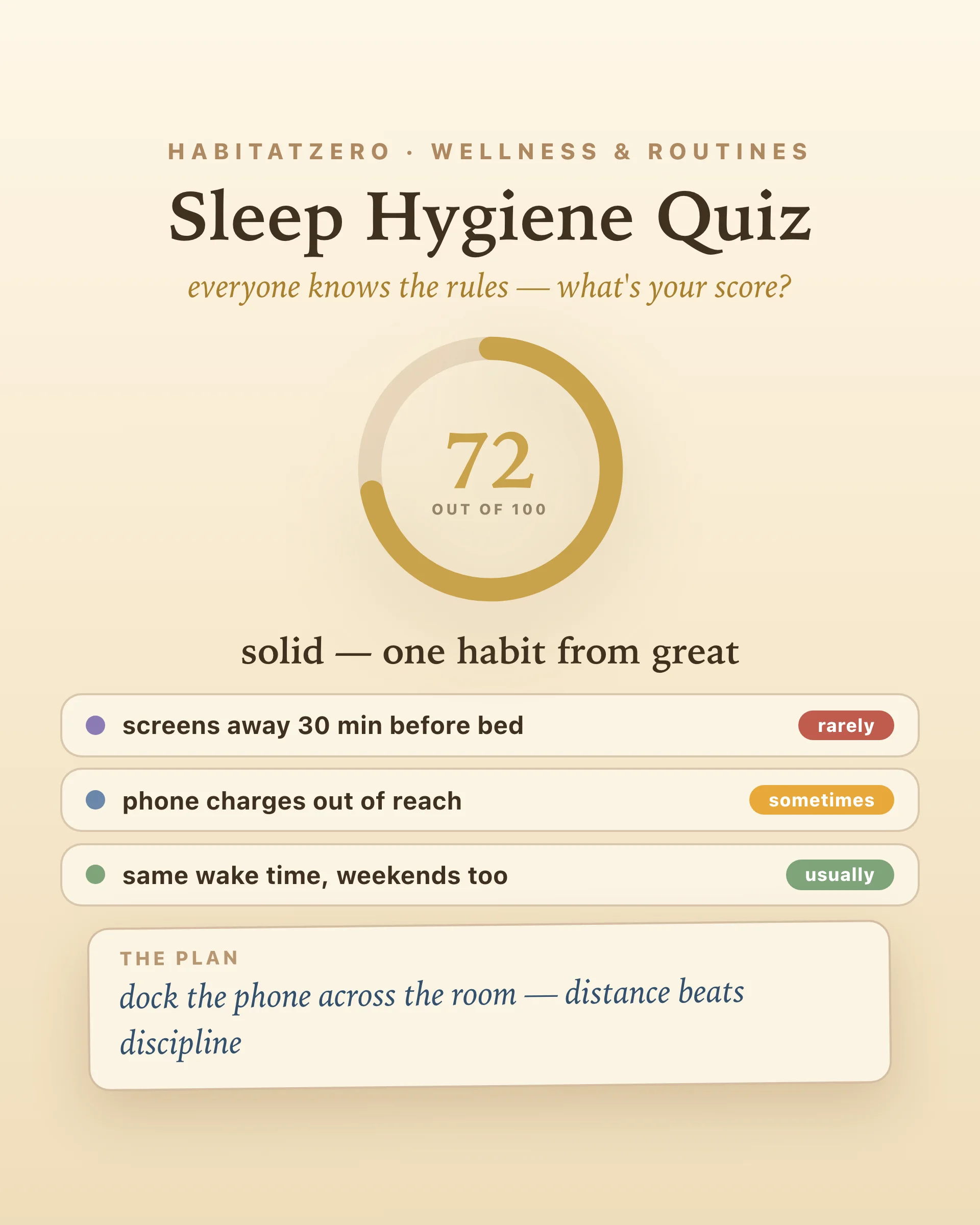
The phone-dock step earns its place. The best-known finding in evening-screen research: light-emitting screens before bed suppress melatonin and push the body clock later — readers using backlit devices took longer to fall asleep and were groggier the next morning than paper readers, same book, same bedtime. Docking the phone isn't a virtue signal; it's the single highest-leverage minute in the stack.
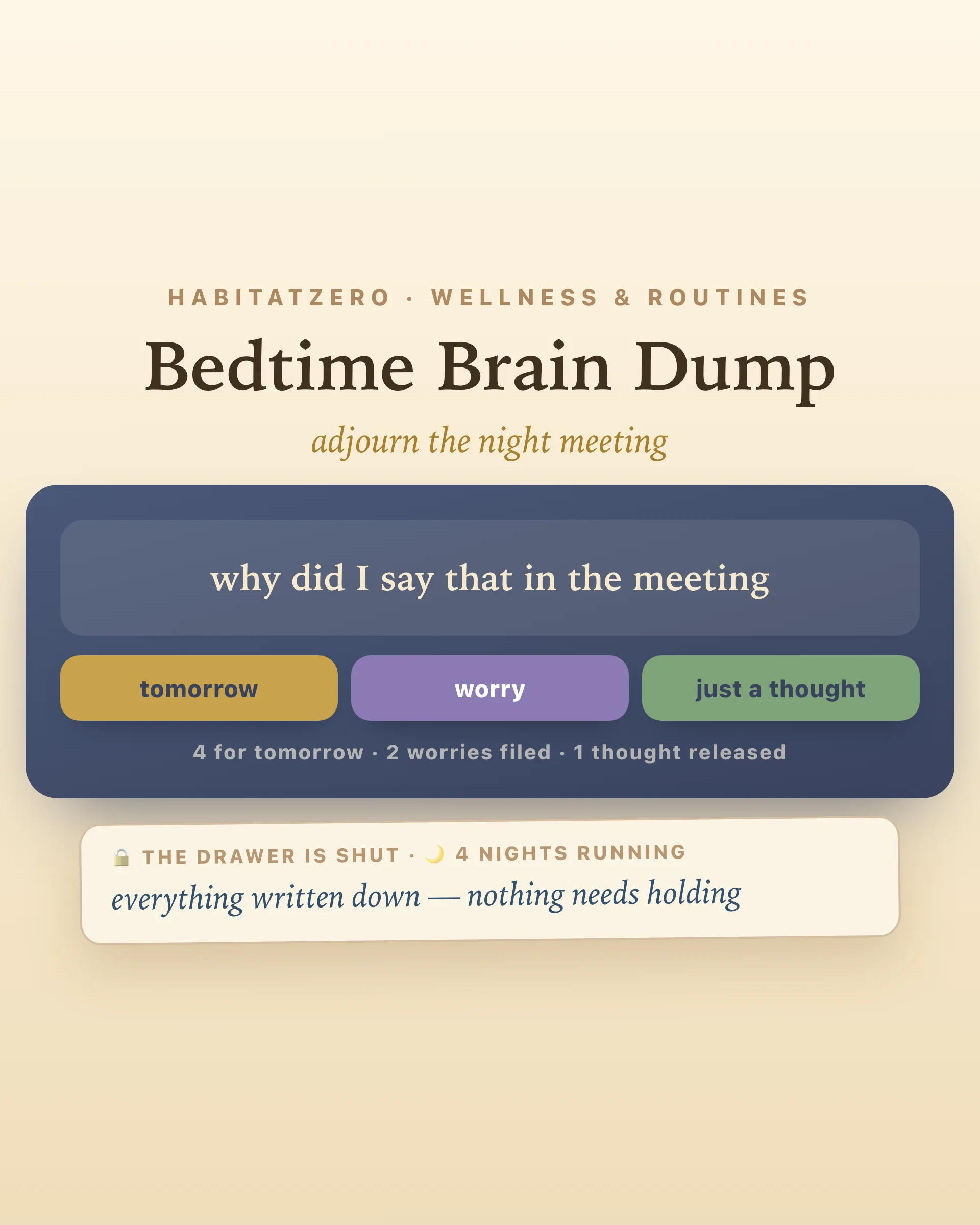
Offload tomorrow. Half of what circles at midnight is unfinished planning. A five-minute brain dump — tomorrow's three tasks, out of your head and onto a page — gives the circling somewhere to land before your head does. The basics the CDC lists for better sleep — consistency, dim and cool, screens out of the bedroom — are all descent mechanics; the routine is how they become automatic instead of aspirational.
Under twenty minutes is a lane change, not a descent. Past ninety, the routine starts taxing the evening it's supposed to protect. Thirty to sixty is the honest range for adults — and "most nights" beats "every night," because a routine that survives being skipped on Fridays is a routine that still exists in March.
Three steps make a strong spine: one for the body (shower, stretch, tea), one for the head (brain dump, one journal line), one for the landing (paper book, slow breathing, quiet music). If the head step is the one you need most, Tend Your Day is a complete two-minute closing ritual you can slot in whole. For the landing, 4-7-8 Breathing is the classic final step — ninety seconds, lights already off. And if one specific thought still won't let go of you at the end of the descent, set it on a leaf at Leaves on a Stream and let the water take it.
Set the bedtime. Stack three steps. Start when it says start — tonight.
One that descends: brighter to dimmer, louder to quieter, screens to paper. A solid template is dim the lights, dock the phone, a warm shower, tomorrow's to-dos out of your head and onto a page, then something calm and analog — reading, stretching, slow breathing. The exact steps matter less than doing roughly the same ones in roughly the same order, so your body learns the approach pattern.
Thirty to sixty minutes covers most people. Under twenty minutes is a lane change, not a descent; past ninety the routine starts costing your evening and gets skipped. This builder totals your steps and computes the start time automatically — most people are surprised to learn their chosen routine needs them to start at 9:40, not 10:55.
Anything that runs on paper, water, or breath. Reading fiction, a warm shower, light stretching, herbal tea, journaling one honest line, prepping tomorrow's clothes, a few minutes of slow breathing. Research on light-emitting screens found evening use pushes melatonin and the body clock later — the phone-docking step earns its place in the routine more than any other.
Usually one of two reasons. The routine is too long — a 90-minute ritual survives about four days — or it has no start time, so it waits politely behind one-more-episode forever. Fix both here: trim to under an hour, and let the builder hand you the exact minute to begin. A routine with a start time is an appointment; without one it's a wish.
Paper reading is one of the best-loved wind-down steps for a reason: it occupies the mind enough to crowd out planning and replaying, without the light and the feeds. Fiction works better than work-adjacent nonfiction, and a chapter beats an open-ended scroll because it has an ending. Keep the backlight off the menu — that's what the research keeps flagging.
Yes — build it, then download it as an image with every step and its clock time, ready for the nightstand. In the Fabulous app your routine saves and syncs, and the start time is always one glance away.
By the team behind Fabulous, the science-based self-care app used by over 30 million people.