Wind-Down Routine BuilderSleep & Evenings · ~4 min
About this template · Updated July 2026
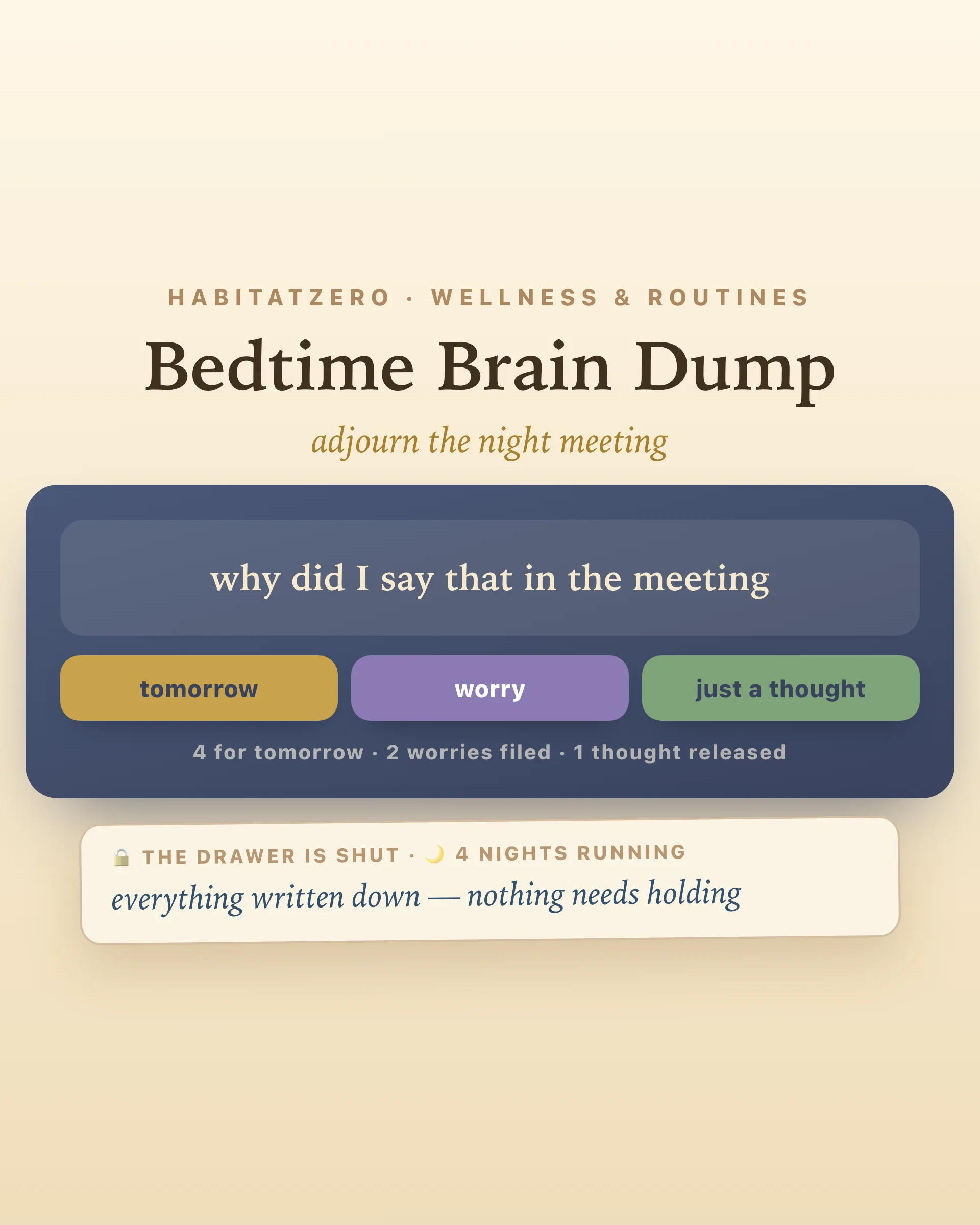
The head hits the pillow, the lights go out, and somewhere in your skull a conference room lights up. Tomorrow's presentation takes the floor. The unsent email raises a hand. A worry from 2019 has somehow gotten onto the agenda. This is the night staff meeting, and it convenes for one reason: your brain doesn't trust you to remember, so it rehearses — item by item, lap after lap — precisely when you can do nothing about any of it.
The brain dump is how you adjourn the meeting. Everything out of the head and onto a page, five minutes, before lights out. This version adds the two touches that make it work as a nightly ritual: a one-tap sort, because a filed thought quiets faster than a puddled one — and a lock, because the ceremony of closing the drawer is the signal your brain has been waiting for.
Empty. One line at a time: the task, the worry, the idea, the thing you almost forgot. No organizing while you empty — the head goes quiet in the order things leave it, not in the order they'd look nice.
Sort, one tap each. Every line gets a home:
Lock the drawer. One tap closes the dump: tomorrow's list is kept for the morning; worries and thoughts are deliberately let go — written to be released, not archived. The drawer-shutting is theatrical on purpose. Rituals end things; that's what they're for.
Next morning, the tool opens on your tomorrow list — the one artifact of the night that deserved to survive it.
Most sleep-adjacent advice leans on general principles; this one has its own experiment. Researchers at Baylor had people spend five minutes at bedtime writing either a to-do list for tomorrow or a list of tasks already completed. The to-do list writers fell asleep significantly faster — and the more specifically they wrote their lists, the faster they dropped off. Completed-task writers, if anything, drifted the other way.
That result is the whole mechanism in miniature: the mind rehearses what it fears forgetting — the well-documented tendency of unfinished tasks to stay mentally active — and a written, specific list makes the rehearsal redundant. Custody transferred, meeting adjourned. Note the detail worth copying: specific beats vague. "Email Sam re: the Friday deadline" releases more than "deal with work stuff."
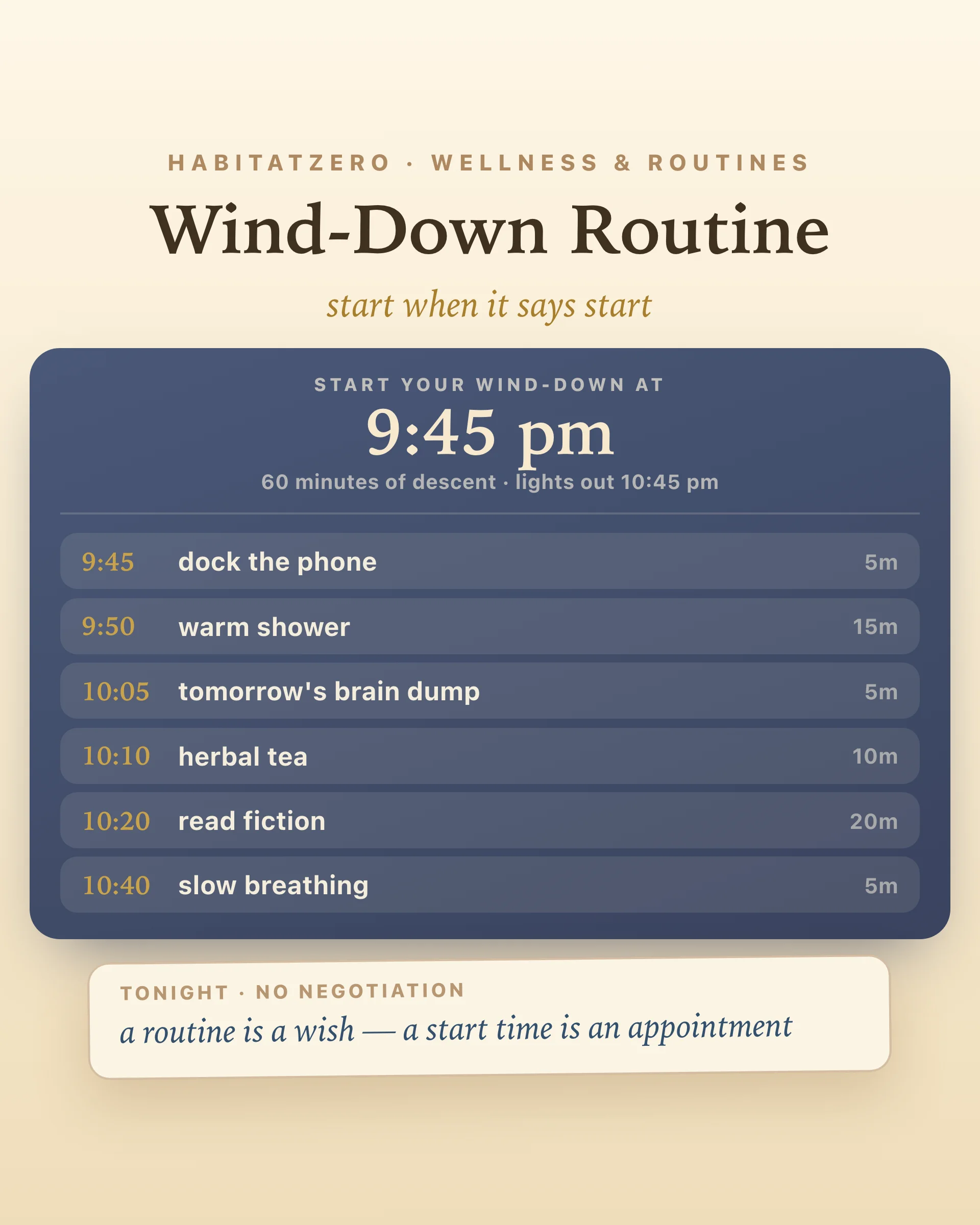
It's the head-emptying step of a wind-down — most people slot it right after the phone gets docked. If you've built a descent in the Wind-Down Routine Builder, the dump is the classic five-minute middle step. If a sorted worry refuses to stay in its drawer — one specific thought with real hooks — give it the full treatment at Leaves on a Stream. And that morning list the drawer kept? It flows naturally into the day's plan — the top item deserves the first slot in your ADHD Daily Task Organizer or the first painted block of the day.
Five minutes. Everything out. One tap per line, one lock, lights off — and the conference room stays dark until a civilized hour.
Five minutes of emptying your head onto a page before lights out — every task, worry, and stray idea, written one line at a time. The mind treats unwritten items as things it must keep rehearsing; writing them down transfers custody. This version adds a sort — tomorrow, worry, or thought — because a filed item quiets the mind more than a puddled one.
There is direct evidence: a study that had people write to-do lists versus completed-task lists at bedtime found the to-do list writers fell asleep measurably faster — and the more specific the list, the faster the sleep. The mechanism is offloading: your brain rehearses what it fears forgetting, and a written list makes the rehearsal redundant.
File them as worries — that's the whole move at 11pm. A worry sorted into its own drawer has been acknowledged without being engaged, which is what the hour calls for; most look smaller in daylight, and the ones that don't can be handled by morning-you, who is frankly better at it. If one specific worry keeps its hooks in, the leaves-on-a-stream exercise is the dedicated tool.
Tomorrow's items survive — they're waiting as a morning list the next time you open the tool. Worries and stray thoughts are deliberately let go when the drawer locks: they were written to be released, not archived. Only the tomorrow list and your dump streak persist.
Yes — free, in your browser, no signup. Tomorrow's list saves; in the Fabulous app it syncs, so the list you locked at night is on your phone with the morning coffee.
By the team behind Fabulous, the science-based self-care app used by over 30 million people.