Wind-Down Routine BuilderSleep & Evenings · ~4 min
About this template · Updated July 2026
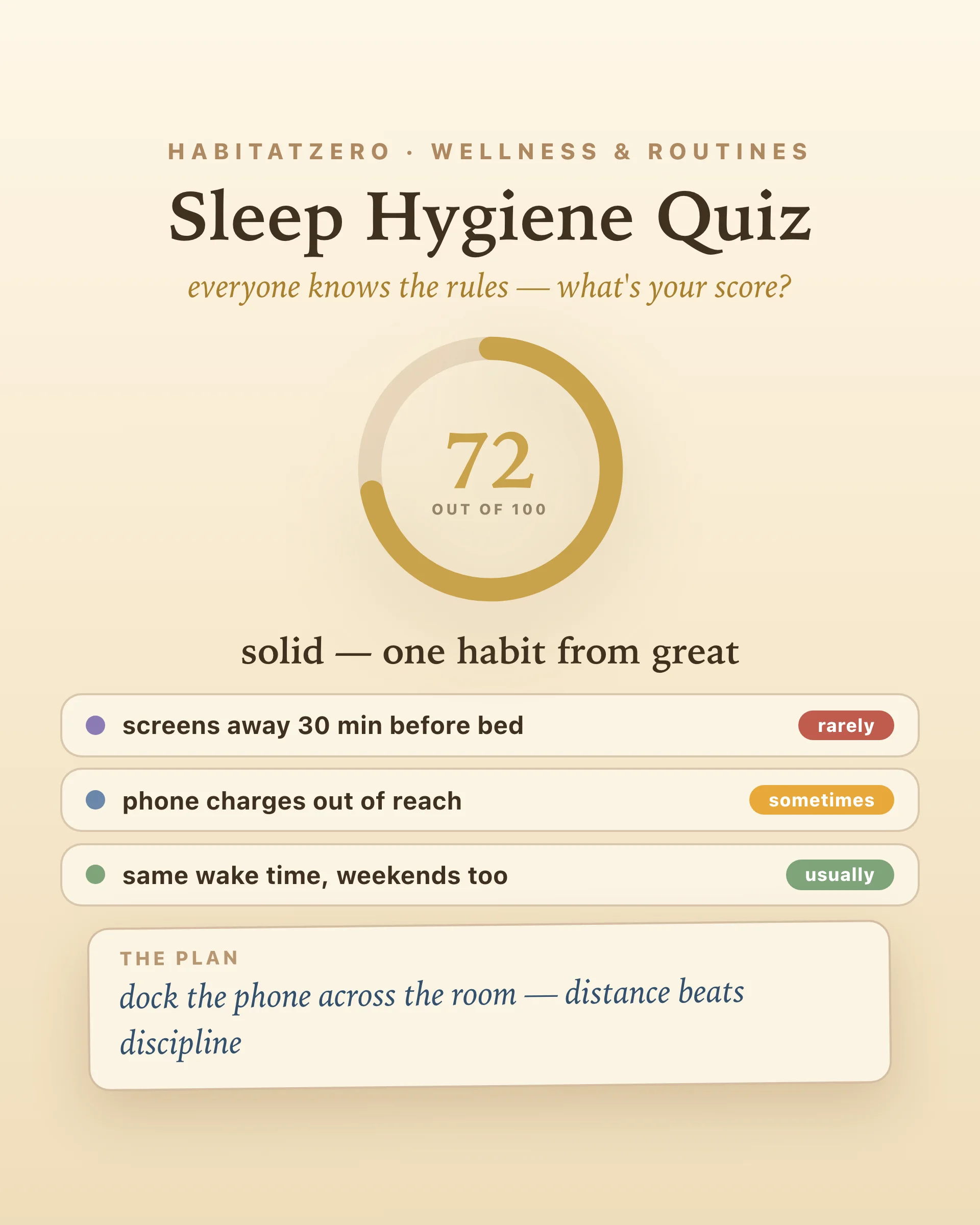
Ask anyone the rules of good sleep and they'll recite them: consistent bedtime, no screens late, easy on the caffeine, cool dark room. Ask the same person how their own habits actually score and you get a shrug. Sleep hygiene is the rare health topic where knowledge is nearly universal and measurement is nearly nonexistent — which is how a person can follow "most of the rules" and still leak an hour of sleep quality every night through the two rules they don't.
This quiz is the measurement. Fifteen honest statements, a 0–100 score, and an action plan built from your weakest answers.
Answer the fifteen. Each statement — my wake time is steady, weekends included; screens are away half an hour before bed; caffeine stops by mid-afternoon — gets one of three taps: rarely, sometimes, usually. Answer for your actual last two weeks, not your intentions; the quiz can't tell the difference, but your score's usefulness can.
Read your band. The score lands with a plain verdict — from well-tended, protect it down to lots of easy wins ahead (which is genuinely the optimistic band: habit fixes are the cheap kind). Most people score lower than they guessed. That gap between knowing and living is the entire reason to measure.
Fix the lowest two. The action plan surfaces your weakest habits, each with one concrete micro-fix — not "improve your sleep schedule" but set one alarm for winding down, not just waking up. Change two habits, retake in two weeks; your score history keeps the trend.
The habits in this quiz come from the standard sleep-hygiene canon — the same fundamentals the CDC's sleep guidance lists: regularity, light, temperature, caffeine timing, and a screens-out wind-down. A major review of sleep hygiene research supports each element's link to sleep quality in the general population — with an honest caveat this page keeps: hygiene is prevention and maintenance, not treatment. If your habits score 90 and sleep is still broken, the checklist has done its job by ruling itself out; persistent sleep trouble belongs with a professional, not a worksheet.
Within its lane, though, the leverage is real — and lopsided. The heavy hitters are consistency (a steady wake time anchors the clock everything else runs on), evening light (bright screens at 11pm tell your body it's noon), and caffeine timing (its half-life means the 4pm cup is still half-arguing with you at 10). The quiz weights nothing — every habit scores the same — but your action plan will almost always start in one of those three neighborhoods.
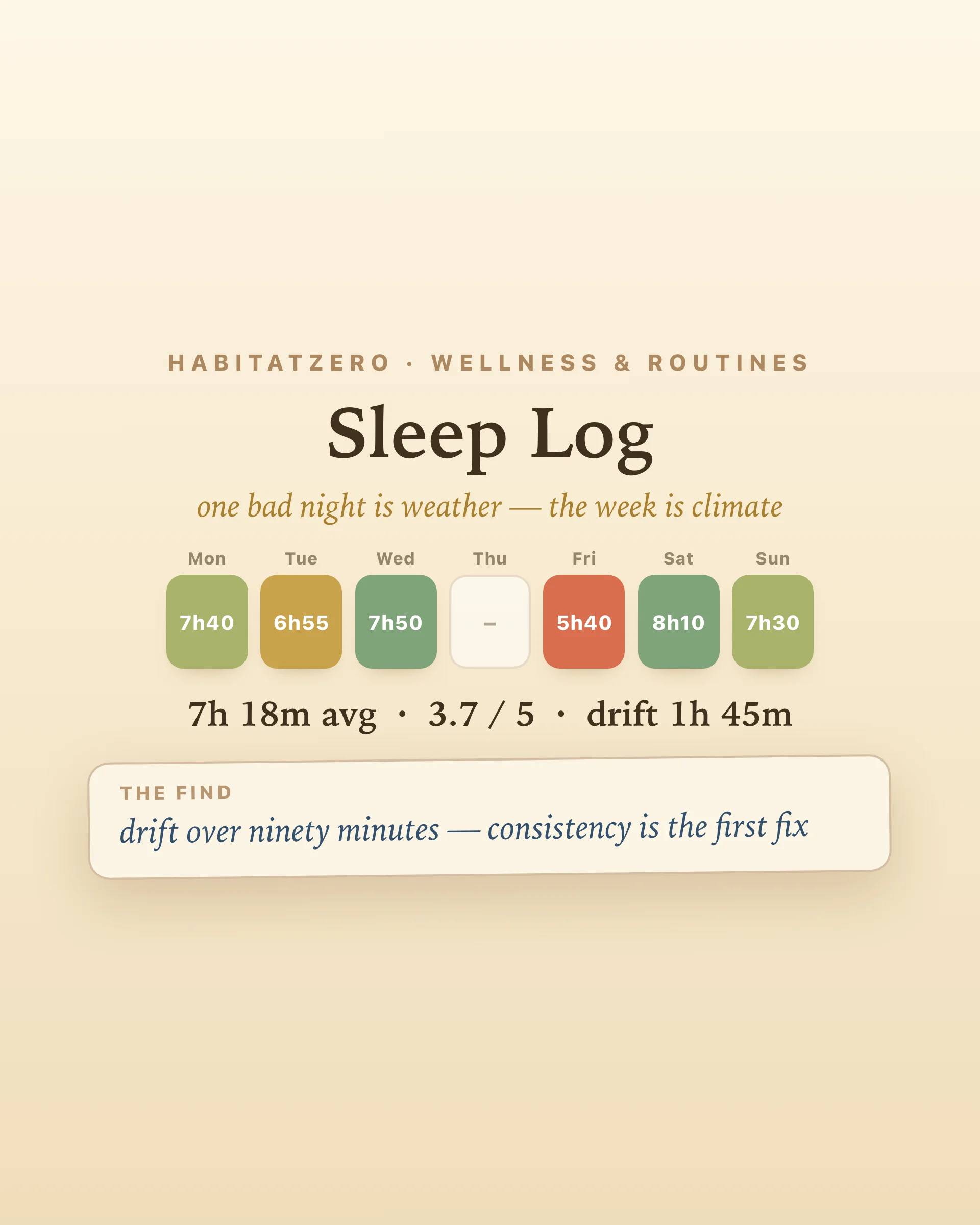
A sleep-hygiene score behaves like a garden, not a grade: it drifts. Travel, deadlines, and one plausible-sounding "just tonight" can move a 85 to a 60 in a month — which is why the retake rhythm matters more than the first number. Every two weeks while you're fixing things, monthly after that. The history line under your score exists precisely so you can watch a bad month coming before it arrives at 3am.
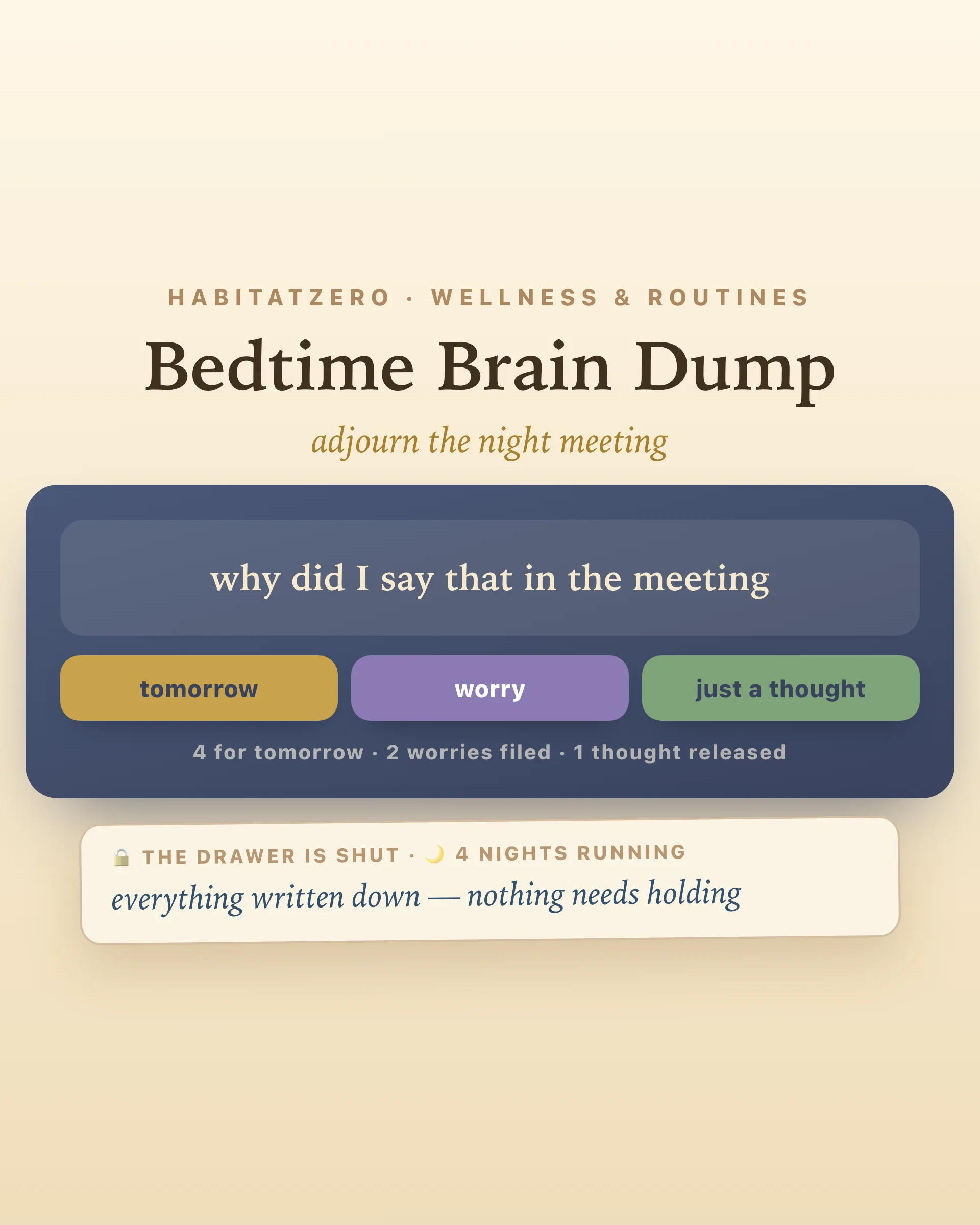
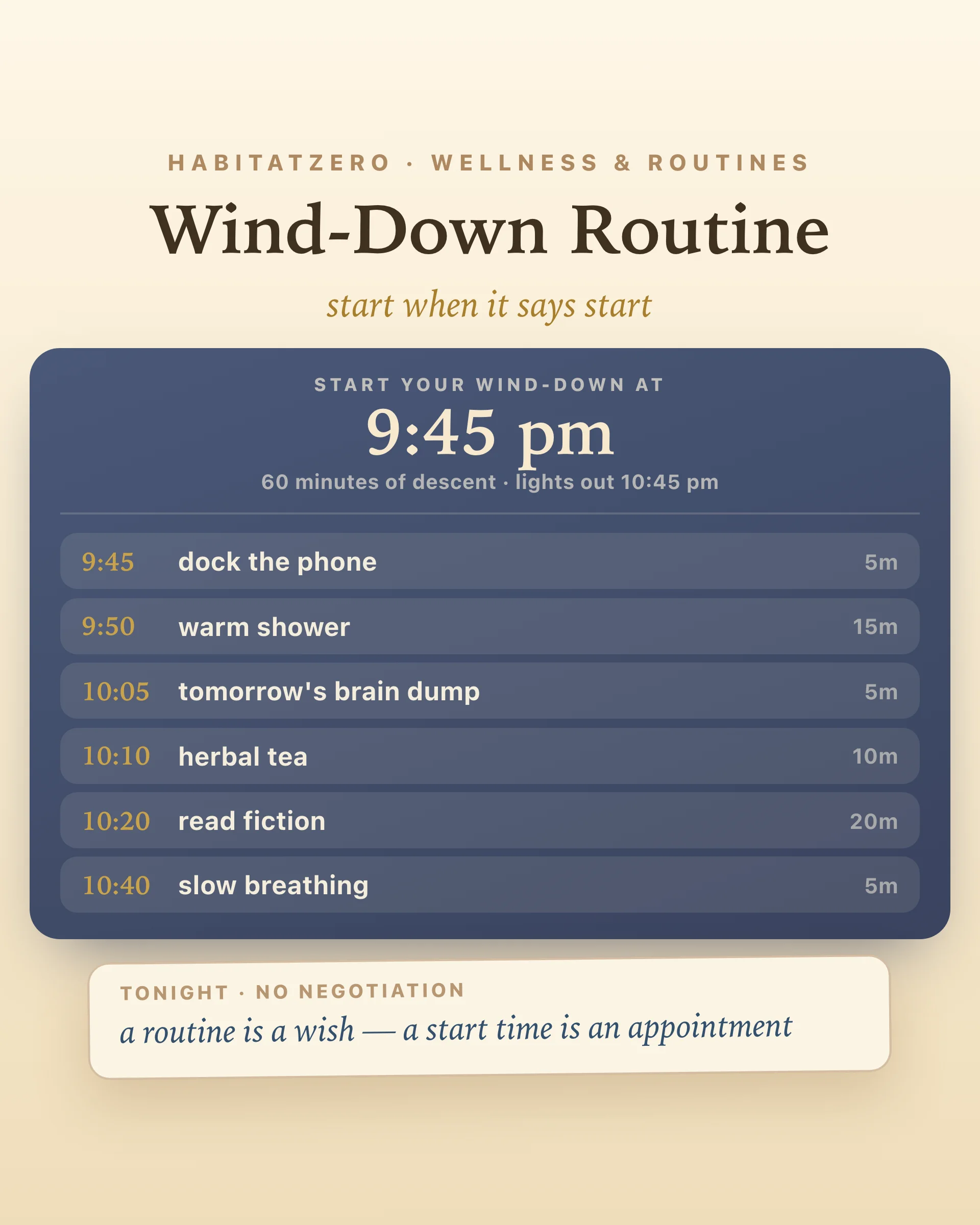
Most action-plan items on this quiz have the same root fix: evenings with a shape. That's what the Wind-Down Routine Builder is for — it turns "screens away, lights dimmer, head emptied" into a sequence with a start time. If the head-emptying is your leak, Tend Your Day closes the day in two minutes. And for the nights when you're in bed on time and still wired, 4-7-8 Breathing is the lights-already-off tool.
Three minutes to a score. Two habits to fix. Two weeks to prove it moved.
The set of daily habits and bedroom conditions that make good sleep likely: consistent bed and wake times, dimmer evenings and screen distance before bed, caffeine timed away from night, a cool dark room, and a repeatable wind-down. None of it is exotic — which is exactly why a score helps. Everyone knows the rules; the checklist measures whether you're living them.
On this quiz, 85 and above means your habits are well-tended and worth protecting; 65 to 84 is solid with one habit standing between you and great; 40 to 64 means real leaks worth fixing, starting with the action plan; below 40 means lots of easy wins ahead — which is genuinely good news, because habit fixes are the cheap kind.
Consistency. A steady wake time — weekends included — anchors the body clock that every other habit depends on. If you only fix one thing from your action plan, fix the schedule; reviews of sleep hygiene research consistently put regularity and the pre-bed light environment at the top of the list.
Every two weeks while you're changing habits, then monthly as a check-in. Two weeks is long enough for a fix to become real and short enough to stay honest. The quiz keeps your score history, so the trend — not any single number — tells the story.
No. This is a habit check, not a diagnostic tool — it measures the conditions around your sleep, not a disorder. If your sleep stays poor despite well-tended habits, or daytime sleepiness is affecting your life, that's worth bringing to a doctor; habit checklists are the wrong tool for that job.
Yes — after scoring, you can download a card with your score and action plan as an image to print. The interactive version keeps your score history so retakes show the trend, and in the Fabulous app it syncs across devices.
By the team behind Fabulous, the science-based self-care app used by over 30 million people.