Wind-Down Routine BuilderSleep & Evenings · ~4 min
About this template · Updated July 2026
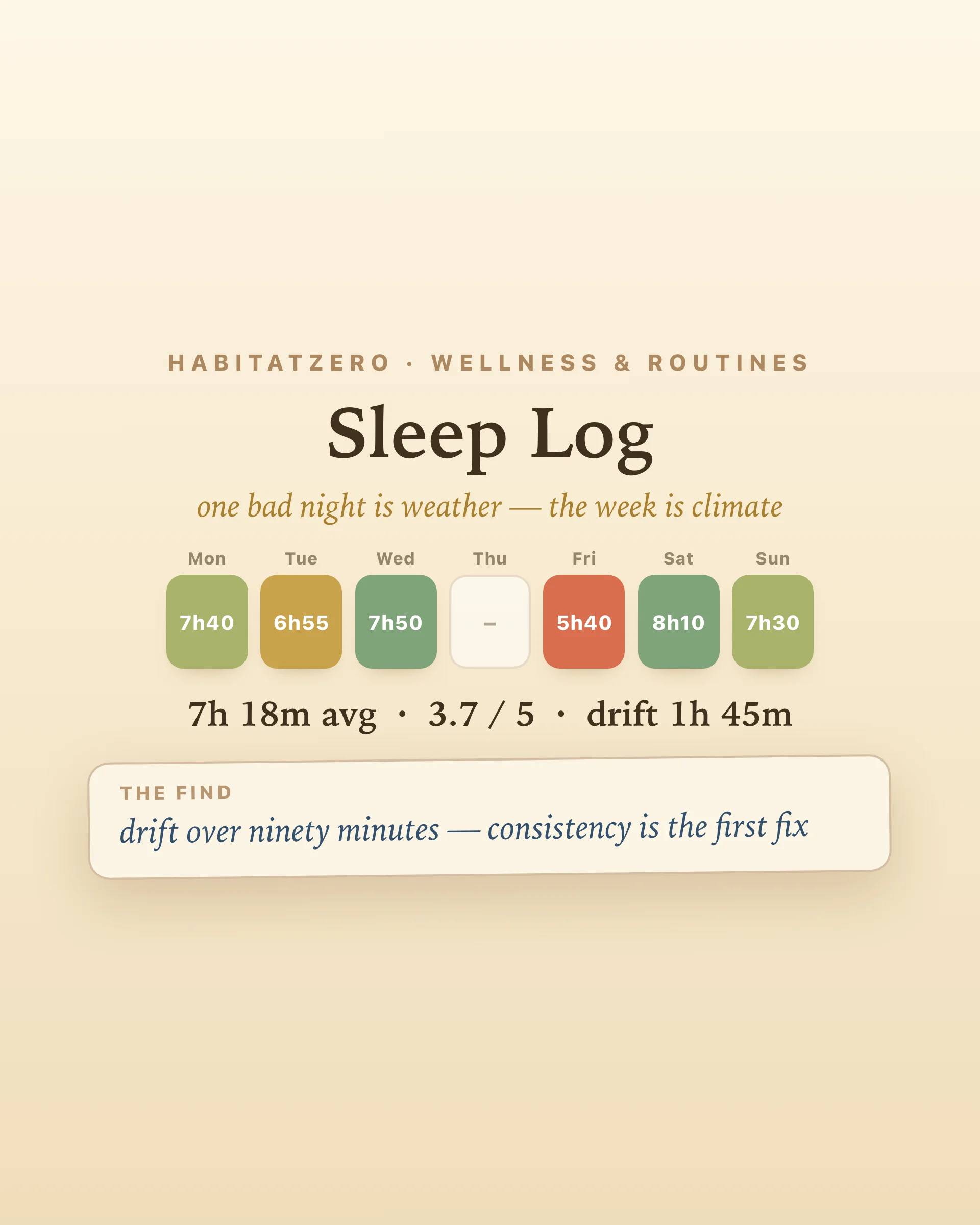
Ask yourself how you slept last week and your memory will hand you a story — "pretty badly, I think?" — assembled almost entirely from the worst night and this morning's mood. Memory is a terrible sleep historian. It forgets the two solid nights, backdates the bad one, and has no idea what time you actually went to bed on Wednesday.
A sleep log is the receipts. Twenty seconds each morning — lights-out time, wake time, how it felt — and within two weeks you're looking at data where the story used to be. Almost everyone who keeps one finds a surprise in it.
Log the night. Each morning: bedtime, wake time, and a five-moon quality rating, with an optional one-line note for context — late coffee, stressful call, hotel bed. The log does the duration math itself, midnight-crossing included, and files the night.
Read the week. The heatmap paints your last seven nights — quality as color, duration underneath. One bad night is weather; the heatmap shows climate. This is where the patterns nobody remembers become impossible to miss: the Sunday crash, the slow midweek slide, the good stretch that followed three early nights.
Watch the drift. Alongside your averages, the log computes the stat almost nothing else tracks: bedtime drift — the spread between your earliest and latest lights-out. Averages flatter; drift tells the truth. Seven hours a night on a schedule that swings from 10pm to 2am is a very different life from seven hours at a steady 11.
Sleep research never abandoned the humble diary — it standardized it. When researchers needed a common instrument, they built the Consensus Sleep Diary: bedtime, wake time, subjective quality — the same core fields this log keeps. Wearables estimate what your body did; a diary records what the night felt like and what surrounded it, and for finding habit-level patterns, that subjective layer is where the answers usually live.
There's a quieter benefit too: the twenty seconds of morning attention is itself an intervention. Logging makes you notice, and noticing is upstream of every fix. Two honest weeks is the standard window — long enough for signal, short enough to finish — and if you ever do bring persistent sleep trouble to a professional, a completed two-week log is precisely what they'll ask you for. (That's this log's lane, to be clear: it measures patterns; it doesn't diagnose anything.)
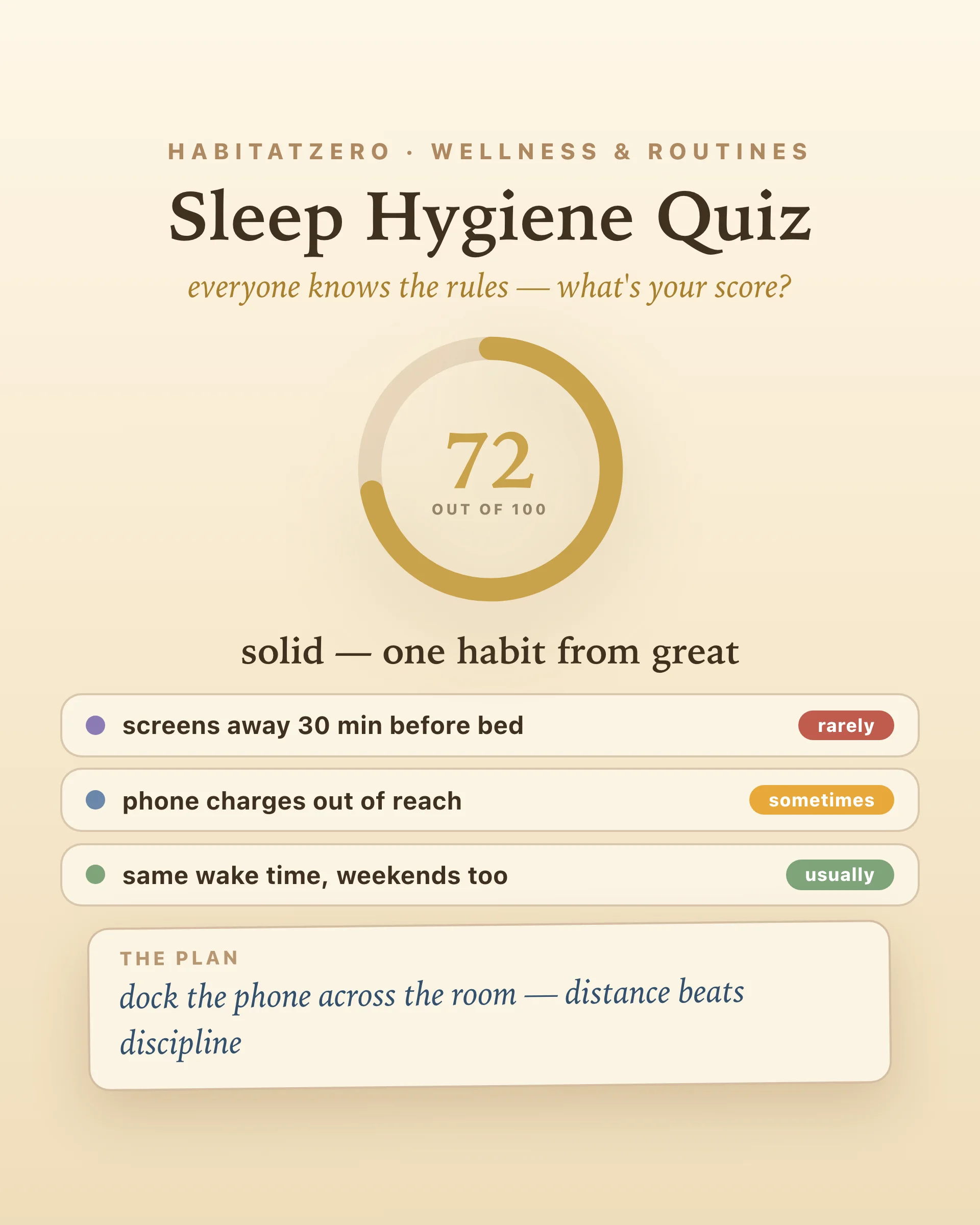
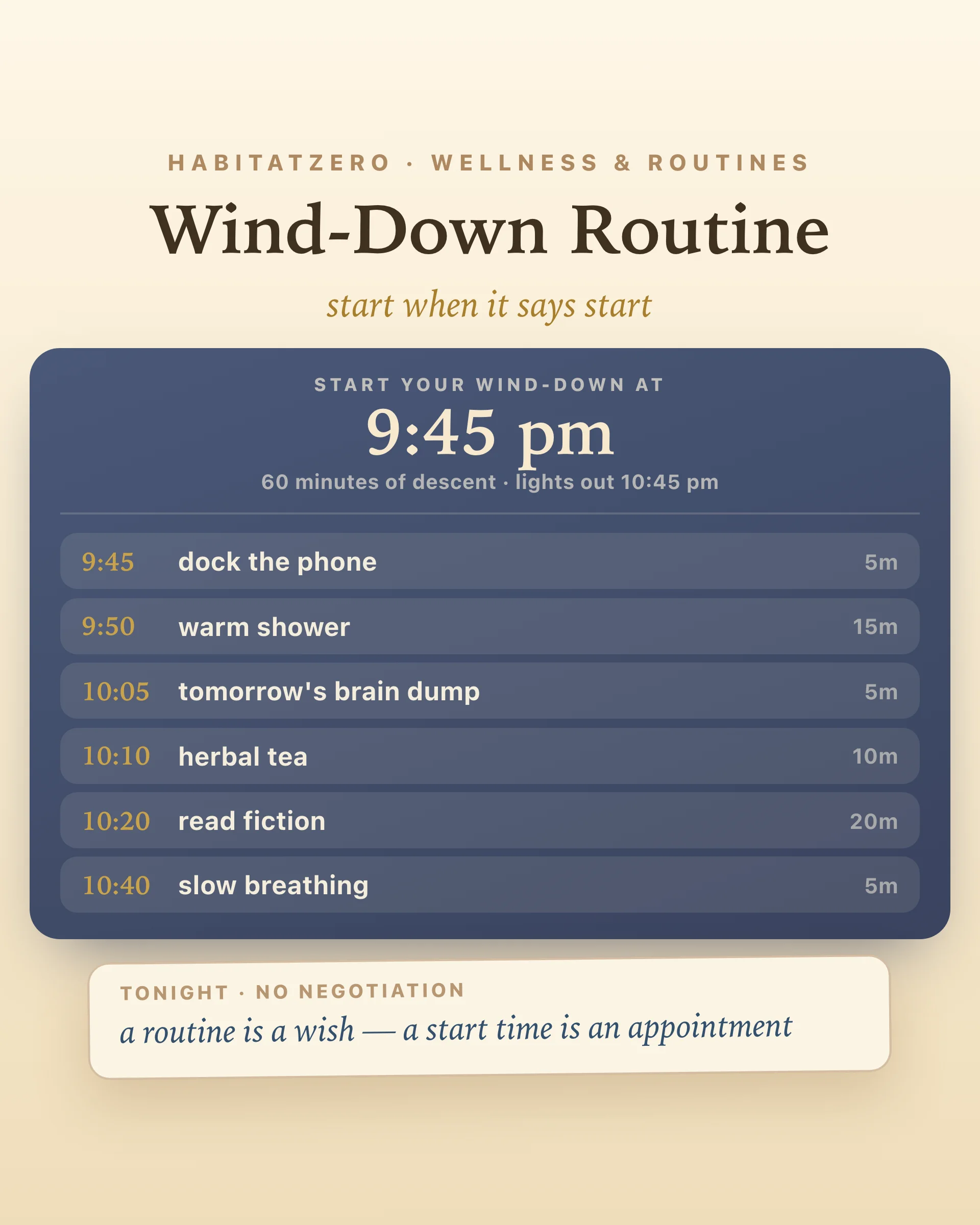
The log finds the leak; its neighbors fix it. If the drift number is the problem — and it usually is — the Wind-Down Routine Builder turns a target bedtime into a start time with a sequence behind it. If quality is low while the schedule looks clean, run the Sleep Hygiene Quiz and let the action plan name the habit. And if what you're really building is the streak — early nights as a habit with a visible chain — that's a job for the 30-Day Habit Tracker; this log keeps the numbers, the tracker keeps the yes-or-no.
Twenty seconds a morning. Two weeks of receipts. The story your memory tells about your sleep will never survive contact with them.
The essentials are bedtime, wake time, and a subjective quality rating — those three, kept honestly, reveal most patterns. This log mirrors the core fields of the consensus sleep diary that sleep researchers standardized on, plus an optional one-line note for context like caffeine, stress, or travel. More fields than that and morning-you stops filling it in.
Two weeks is the standard window — long enough for patterns to separate from noise, short enough to actually finish. It's also exactly what a sleep clinician will ask for if you ever bring sleep trouble to a professional, so a completed log does double duty.
They measure different things. A wearable estimates what your body did; a log records what the night felt like — and for spotting habit patterns, the subjective side is surprisingly powerful, which is why clinical practice still runs on diaries. The twenty seconds of morning attention is a feature, not a cost: it makes you notice.
The gap between your earliest and latest bedtime across the week. Two people can average seven hours while one sleeps 11 to 6 nightly and the other swings between 10pm and 2am — same average, very different sleep. Drift under an hour supports the body clock; past ninety minutes, consistency is usually the highest-leverage fix available.
Yes — download your week as an image and print it. The interactive version keeps the math and the history: durations compute themselves, the heatmap builds itself, and in the Fabulous app your log syncs so the phone by your bed is the log.
By the team behind Fabulous, the science-based self-care app used by over 30 million people.