
The Overwhelm Recovery ProtocolWellness & Routines · ~5 min
About this template · Updated September 2026
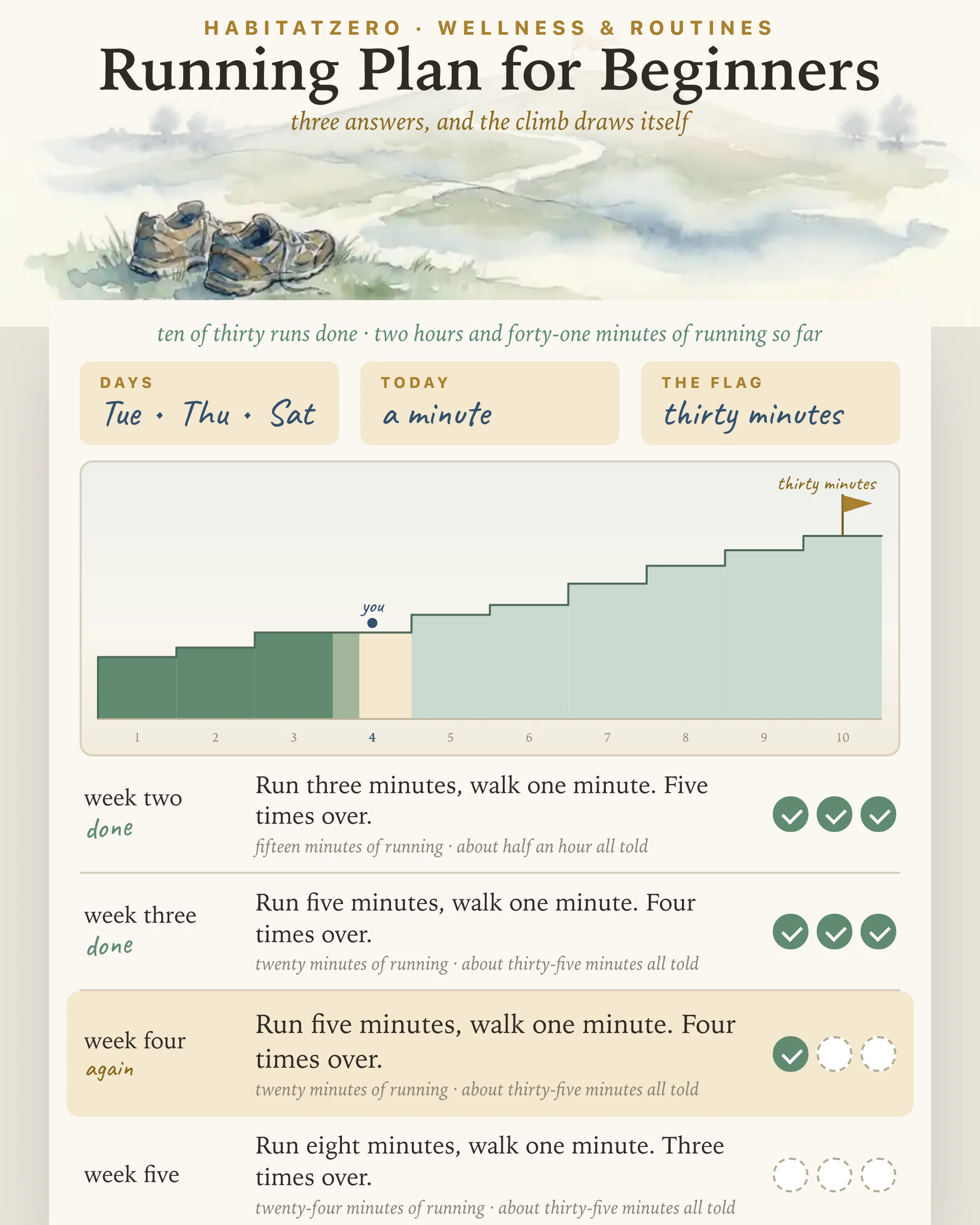
Most beginner running plans are written for a person who does not exist: someone with three free evenings, legs that have never run a step, and a race in exactly nine weeks. This page does not assume any of that. It asks three questions and draws the plan from your answers.
Which days can you run? Tap two to four. The number sets how many sessions each week holds; the names label the circles you tick. Three is the usual answer because it leaves a rest day after every run. The sheet refuses a fifth day, because a first plan should be light enough to keep.
How long can you run right now without stopping? Not yet, a minute, three, five, ten or twenty. This is the step you get on at. Someone who can already run five minutes has no business doing week one of a zero-to-anything program.
Where do you want to get to? Twenty minutes, thirty, forty-five, or an hour. Thirty minutes of steady running lands close to five kilometers for many new runners, and an hour is 10K country. A goal you have already passed goes gray, and if you raise your starting point past your flag, the flag moves up on its own and the sheet tells you so.
Under the questions the plan appears as a hill: one step per week, each step as tall as that week's longest unbroken run, a gold flag on the summit. The steps come off a fixed ladder. Its lower rungs are walk-run intervals: a minute of running with a minute and a half of walking, eight times over; then two minutes on and one off, six times; three and one, five times; then five, eight and ten. Once you can run ten minutes at a stretch the intervals stop and each week adds five minutes of unbroken running until the flag.
After each run you tap its circle; the step on the hill fills in as the week completes, and the line at the top totals the minutes you have actually run. When the week you are on felt like too much, tap run this week again. A repeat step is slotted in straight after it, marked again, and the climb gets a week longer. You can hold the same week twice, let a held week go with two taps, and the sheet stops drawing at twenty-four weeks.
New runners get hurt more often than experienced ones. A meta-analysis of thirteen studies put the rate at about eighteen injuries per thousand hours of running for novices, against under eight for recreational runners. The size of the weekly jump seems to matter, with a caveat: among 874 novices who wore GPS watches for a year, those who increased their weekly distance by more than thirty percent were more likely to pick up distance-related injuries such as shin and knee pain than those who kept the increase under ten percent, though the difference fell just short of statistical significance. That is why the ladder never jumps by more than a third once the runs are unbroken, and why holding a week counts as a move, not a failure.
It is also why this page does not promise that a gentle plan keeps you injury-free. The one randomized trial to test that idea gave 532 novices either a thirteen-week program built on the ten percent rule or a standard eight-week one, and found no difference in injury rates between them. Graded plans are sensible. They are not armour. Sharp pain, pain that gets worse as you run, or pain still there the next morning is a reason to stop and get it looked at.
The dose you are working toward is already enough to matter. In a cohort of more than fifty-five thousand adults followed for fifteen years, runners had thirty percent lower all-cause mortality than non-runners, with much the same benefit for people running under fifty-one minutes a week as for those running far more. Observational, not proof of cause, but it means the thirty-minute flag is no consolation prize.
One plain line before you begin: if you have a heart condition, are pregnant, have been told to be careful with exercise, or get chest pain or dizziness when you push yourself, talk to a clinician first.
Run the intervals slower than you think you should. The talk test is the whole rule: if you cannot get a sentence out, you are going too fast for this plan. Take the rest days; that is where the adaptation happens. And if you come back after a gap of a week or more, drop your starting point one step and let the plan redraw rather than picking up where you left off.
Set it up on the day you decide to start, and open it after each run to tick the circle. To see your runs beside the rest of your movement, the Workout Calendar keeps a month of moved-or-rested days, and the Weekly Fitness Reflection is where sleep, energy and sore spots get written down between runs. Once the flag is behind you, the 12-Week Fitness Planner is a good shape for whatever comes next.
Two to four. Three is the usual answer because it leaves a rest day after every run, which is when new legs adapt. This sheet caps the pick at four days so the first plan stays light enough to keep.
It depends where you start. Someone who cannot yet run a minute takes ten weeks on this sheet to reach thirty minutes without stopping, and someone who can already run five minutes takes seven. An hour of unbroken running is a sixteen-week climb from nothing. Holding weeks stretches any of these.
Yes, in the early weeks. Alternating short runs with walking breaks lets you spend more total minutes running than going continuous from day one would. This plan uses walk-run intervals until you can run ten minutes at a stretch, then switches to unbroken runs that grow by five minutes a week.
It is often the smartest move you can make. Novice runners get injured at roughly twice the rate per hour of recreational runners, and steep jumps in weekly load are the usual suspect. On this sheet you hold the week you are on and a repeat is slotted in straight after it, up to two holds per step.
The page shows a filled example so you can see how a plan reads once it is under way. Building your own, ticking runs off and having it remembered next time means personalizing it in HabitatZero, which costs nothing.
By the team behind Fabulous, the science-based self-care app used by over 30 million people.


