The Overwhelm Recovery ProtocolWellness & Routines · ~5 min
About this template · Updated July 2026
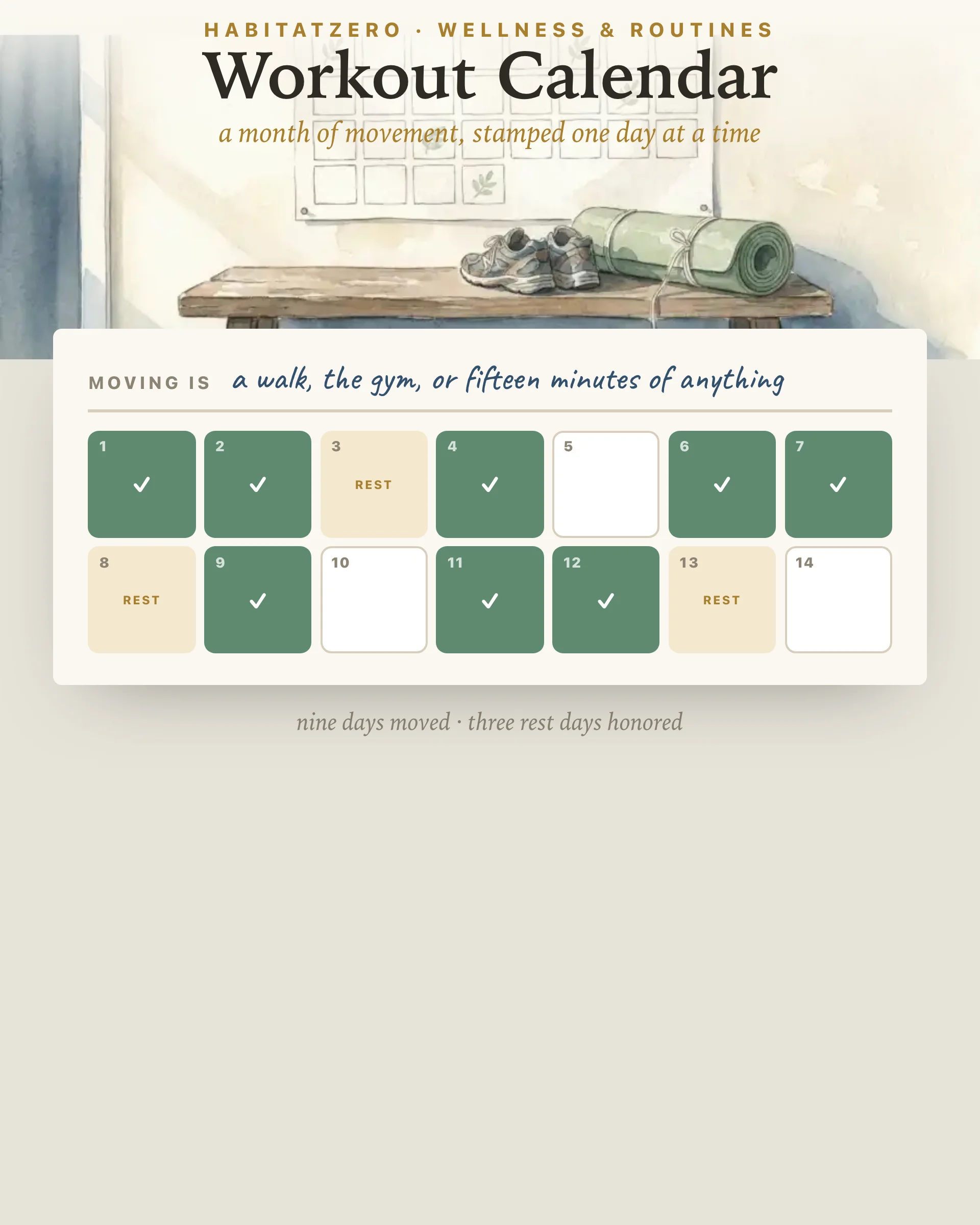
There is a reason gym walls and grandmother kitchens both keep calendars: a month you can see is a month you can answer for. A workout calendar printable does one narrow job — it turns "I've been pretty consistent lately" from a feeling into a grid of stamps that either exist or don't.
Ask anyone how often they trained last month and you will get a story. Ask their calendar and you will get a count. That gap is not a character flaw — memory smooths over blank weeks and inflates good ones for all of us — but it is exactly the gap that stalls progress, because you cannot adjust a plan you are misremembering.
This calendar holds thirty-one day cells. Tap a day once when you moved; tap twice to mark a rest day you chose on purpose. Blank days stay blank. At the end of the month the pattern is simply there: the streaks, the gaps, the week that always collapses on Thursday. No grade attached. The calendar records the month; it does not prosecute it.
The stamping matters more than it looks. A longitudinal study of new gym members found that the exercisers who became habitual were the ones who kept showing up consistently across the early weeks — frequency and repetition in a stable context predicted whether exercise became automatic, far more than how hard any single session went. Consistency is the mechanism. A month grid is consistency made visible.
Before the first stamp, the sheet asks for one line: moving is… — finished in your own words. A walk counts if you say it counts. So does the gym, a class, or fifteen minutes of stretching on the floor between meetings.
This line is doing quiet, important work. Most workout calendars fail not because people stop moving but because the calendar's hidden definition of "workout" was written for someone with a different life. When only a full session counts, a twenty-minute walk earns a blank, the blanks multiply, and the calendar gets abandoned out of shame by the 12th. Write a definition your busiest week can keep, and the grid stays honest and alive all month.
Rest days get their own stamp for the same reason. A chosen rest day is a decision; a blank is an accident. A month with deliberate wheat-colored rest stamps scattered through it is a stronger month than a wall of unbroken green — recovery is training too, and the calendar should know the difference.
Months come with something weeks don't: a built-in fresh start. Research on temporal landmarks found that people are measurably more likely to begin aspirational behavior just after a calendar boundary — a new month, a birthday, a Monday — because the boundary files the old missed days away as the previous chapter. A month grid harnesses that: whatever happened in March, April arrives as thirty blank cells and a clean slate.
Print it — this sheet is built print-first. The grid fits a fridge door, a bathroom mirror, the inside of a gym locker. Tape it somewhere your eyes already go and let the environment do the reminding. Or keep the page open and stamp digitally; your month saves as you go. Bullet-journal keepers can print the grid straight into the notebook and run it in pen — the same cells work as a hand-kept habit tracker for any single daily practice, not just training.
The last useful minute of the month is spent looking, not planning. Where do the blanks cluster? Did the rest days get chosen or did they just happen? Which definition of moving actually survived contact with your schedule?
Set next month's moving is… line from that evidence. If the grid came back half blank, the definition shrinks. If it came back nearly full, it can grow. Either way the next month starts from what happened, not from what January-you hoped.
If you want the same visible-streak mechanic for habits beyond movement, the 30-day habit tracker runs a single habit through one month, and the printable habit tracker is the pen-and-paper generalist. For planning the week's sessions before they reach the calendar, the weekly habit tracker holds the shorter loop.
Write the month at the top. Decide what moving means. Then let thirty-one small squares find out.
Because a list forgets and a grid accumulates. A month of stamped cells shows the pattern a single day never can — streaks, gaps, the week that always collapses. Research on new exercisers finds consistency, not intensity, is what turns workouts into a habit, and a calendar is consistency made visible.
Whatever you wrote on the moving-is line. The calendar deliberately does not define it for you — a walk, a class, stretching on the floor, fifteen minutes of anything all count if you said they count. Consistency grows from a definition your real week can keep.
Yes, and on purpose. Tap a day twice to mark it rest — the wheat-colored stamp means you chose recovery, which is different from a blank day where the plan just dissolved. A month with deliberate rest days in it is a stronger month, not a weaker one.
Yes to both. The grid is a plain month of thirty-one cells, so it works as a fitness calendar template for any training style, and the same tap-to-stamp mechanic makes it a calendar habit tracker for a single daily habit — bullet-journal keepers can print it straight into the notebook.
Yes. Print the blank month grid and run it in pen, or use it on the page and let your stamps save as you go. No account, no fee.
By the team behind Fabulous, the science-based self-care app used by over 30 million people.