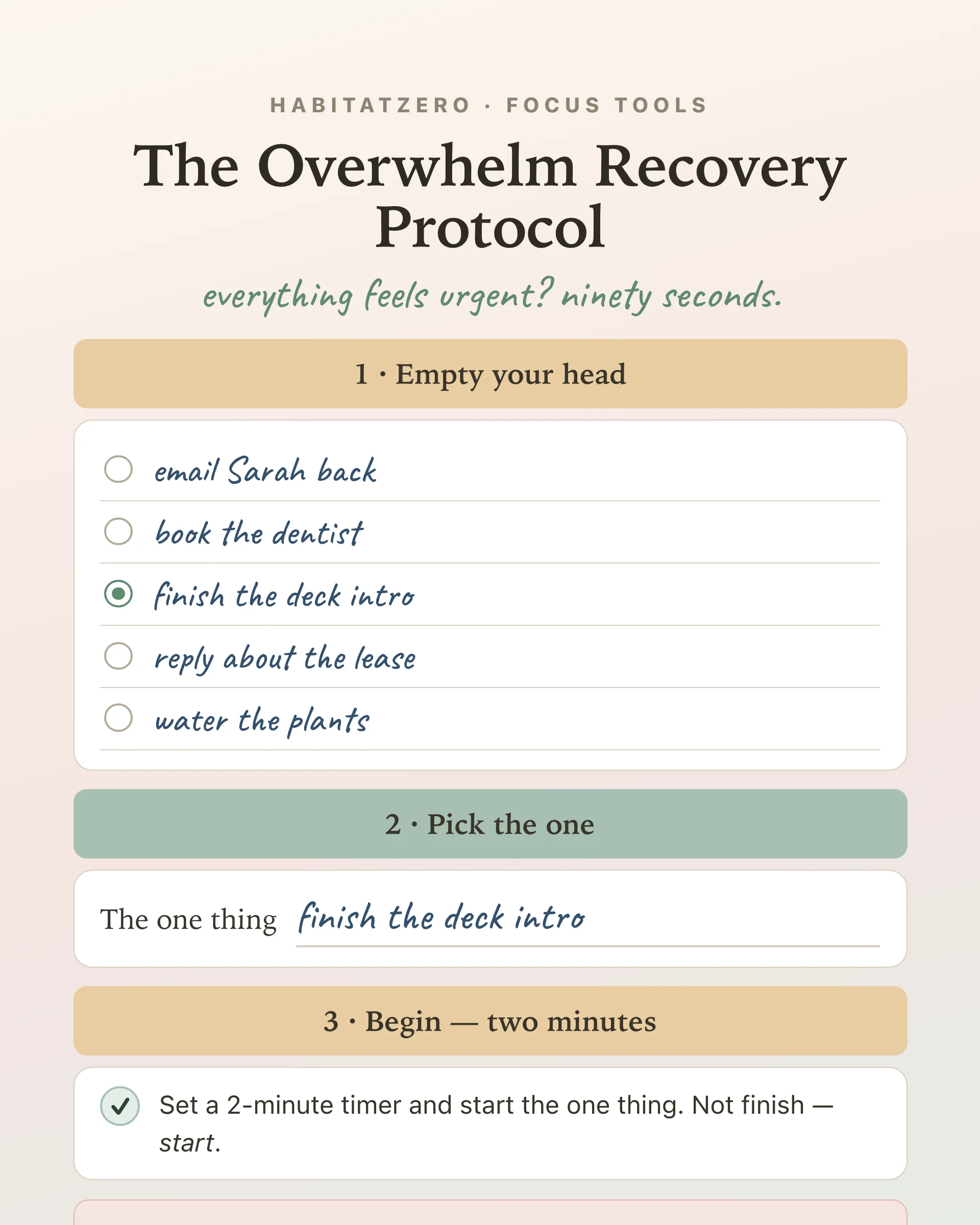
The Overwhelm Recovery ProtocolWellness & Routines · ~5 min
About this template · Updated July 2026

A workout plan tells you what should happen. A session log tells you what did. Neither tells you what it meant — whether the week worked, what it cost, and what one thing next week should do differently. That reading happens at a different altitude, once a week, in about the time the kettle takes. This page is that altitude.
The form asks for exactly five handwritten lines. How energy behaved — steady, or gone by Thursday. How sleep treated you, and whether you had a hand in it. What actually moved, roughly summed. What the body is reporting from the field: the quiet knees, the grumbling back. And then the line the whole page exists for: one adjustment for next week.
One, deliberately. A reflection that produces a five-point improvement plan has produced a fantasy; a reflection that produces one concrete change — swap Thursday to a walk, the tank is empty by then anyway — has produced next week. Framing that single change as a specific if-then is the same mechanism behind implementation intentions, whose meta-analysis across nearly a hundred studies shows a substantial lift in follow-through over goals left as intentions. The adjustment line is where the week's lesson becomes next week's behavior.
Days are noisy. A missed session reads as failure on Tuesday evening and as nothing at all from Sunday's distance — which is also how the World Health Organization frames activity itself: minutes across a week, strength work a couple of times within it, not a daily verdict. Reviewing weekly matches the unit your body and the evidence actually operate on. It is also kinder arithmetic: a week holds enough wins to notice the pattern instead of the stumble.
Each closed week joins a running record — newest first, your standing adjustment displayed at the top like a note pinned to next week's door. Twenty-six weeks fit: half a year of honest Sundays on one page.
The reflection is the third rung of a deliberately small ladder. The weekly workout planner writes the week before it starts — days, lines, rest set down on purpose. The workout journal catches each session while the chalk is still on your hands. This page reads what they gathered and hands one adjustment back to the planner. Any rung stands alone; together they make a practice that learns.
Five lines. One adjustment. The week, understood before the next one begins.
A log records sessions as they happen; a fitness journal reads the sessions together and asks what they add up to. This page works at the weekly altitude — energy, sleep, movement and how the body feels, condensed to five lines — because that is where patterns live. The set-by-set detail belongs in a session log, and pairs with this page rather than competing with it.
Enough to see the week whole and no more: how energy behaved, how sleep treated you, what actually moved and roughly how much, what the body is reporting, and the single adjustment you will carry forward. Five lines is deliberate — a reflection that takes twenty minutes stops happening by week three.
Because one adjustment gets made and five get admired. Writing next week's single change in concrete if-then terms is the same planning move that a large research literature ties to substantially better follow-through — and it keeps the reflection from becoming a weekly plan to overhaul everything, which is how journals die.
Three altitudes of the same practice. The planner writes the week before it happens. The workout journal captures each session as it lands. This reflection closes the loop after: it reads what the other two collected and turns it into one adjustment. Use any alone, or run the ladder — plan, log, reflect.
No — reflecting here in the browser is free. A HabitatZero account is what keeps your closed weeks stored between visits, lets you personalize the lines, and prints the record when paper suits the ritual better.
By the team behind Fabulous, the science-based self-care app used by over 30 million people.