The Overwhelm Recovery ProtocolWellness & Routines · ~5 min
About this template · Updated July 2026
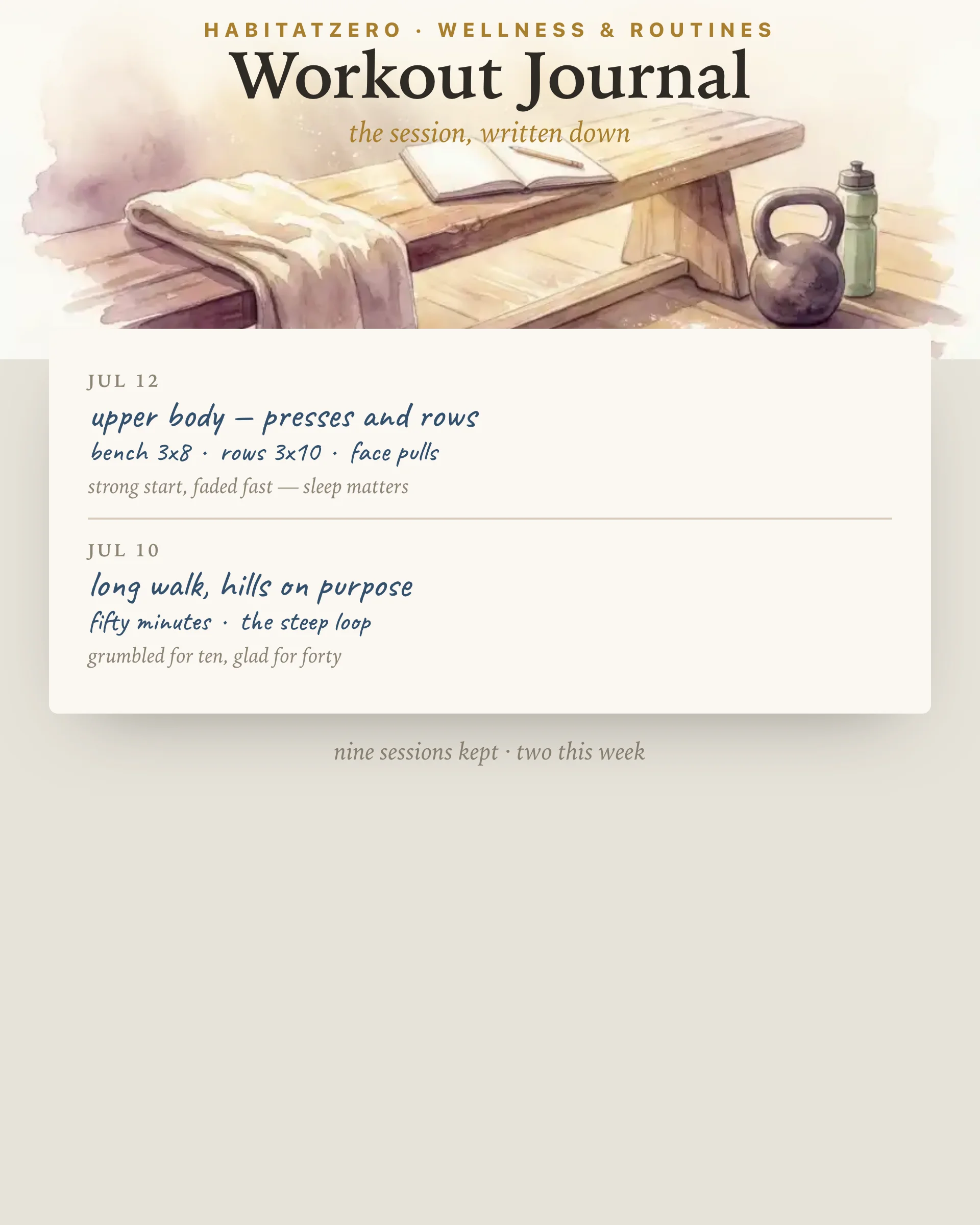
Every gym has one: the person with the battered notebook who quietly gets stronger every month. The notebook is not a coincidence. Training only progresses on purpose when something remembers the last session accurately — and memory, flushed with post-workout endorphins, is a flattering historian. This journal is the honest one: three lines per session, written in your own hand, kept newest-first.
Each entry asks for exactly what the next session needs. What moved — upper body, the long walk, legs kept honest. The work — bench 3x8, rows 3x10, fifty minutes on the steep loop. How it felt — strong start that faded fast, a grumble that turned into gratitude at minute ten.
That last line looks optional and is not. The numbers tell you what to attempt next time; the sentence tells you why it went the way it went. A month of entries surfaces the patterns no program anticipates — the Thursday sessions that always sag, the movement that aches only after poor sleep. And the act of recording is itself an intervention: self-monitoring is among the best-evidenced behavior-change techniques we have — the log changes the training before any programming decision does.
The status line above the log keeps two quiet counts: sessions kept in total, and sessions this week. Not a streak — a receipt. The World Health Organization's activity guidance describes a week, not a day: minutes of movement and a couple of strength sessions spread across it. A log that shows "two this week" by Wednesday is most of the accountability a training week needs, without a single notification.
The page holds forty entries — a full training block. When it fills, that is not an error; it is a finished chapter.
This journal deliberately does half a job. It never asks what you intend to do — that is planning, and it lives on the weekly workout planner, where the week gets written one line per day with rest set down on purpose. The two sheets pass the baton: the planner decides Tuesday is upper body, and this page records what upper body actually turned out to be. If the fragile part is showing up at all, the daily habit tracker guards that with streaks that survive being human.
What moved. The work. How it felt. The receipt that you showed up — in your own handwriting.
Three things per session: what moved (the focus), the work (movements, sets, weights or minutes), and one honest sentence about how it felt. The first two let you progress on purpose next time; the third catches the patterns numbers miss, like every bad Thursday following a short night.
Recording a behavior is one of the best-evidenced tools for changing it — self-monitoring reliably improves follow-through before any program design enters the picture. A journal also removes the guessing from progression: you lift, walk, or stretch against what the page says you did last time, not against a memory.
The planner looks forward: it holds the week you intend, day by day. This journal looks backward: it holds the sessions that actually happened, one entry at a time. They pair well — plan the week on one sheet, and let this page keep the receipts.
No — the journal rewards honesty, not completeness. Log the sessions worth remembering and let missed days stay unremarkable. A record with gaps that you keep for months beats a perfect record you abandon in week two.
The page works free in the browser, no download needed. A HabitatZero account adds the parts a paper journal cannot do alone: your entries kept between visits, personalization, and a printable copy of the log.
Yes — lifters use the work line for exactly what a bodybuilding journal needs: exercise, sets, reps, and weight, one session per entry. Progressive overload is just last entry versus this one, so scan back a page before you load the bar and let the log tell you what to add.
By the team behind Fabulous, the science-based self-care app used by over 30 million people.