The Overwhelm Recovery ProtocolWellness & Routines · ~5 min
About this template · Updated July 2026
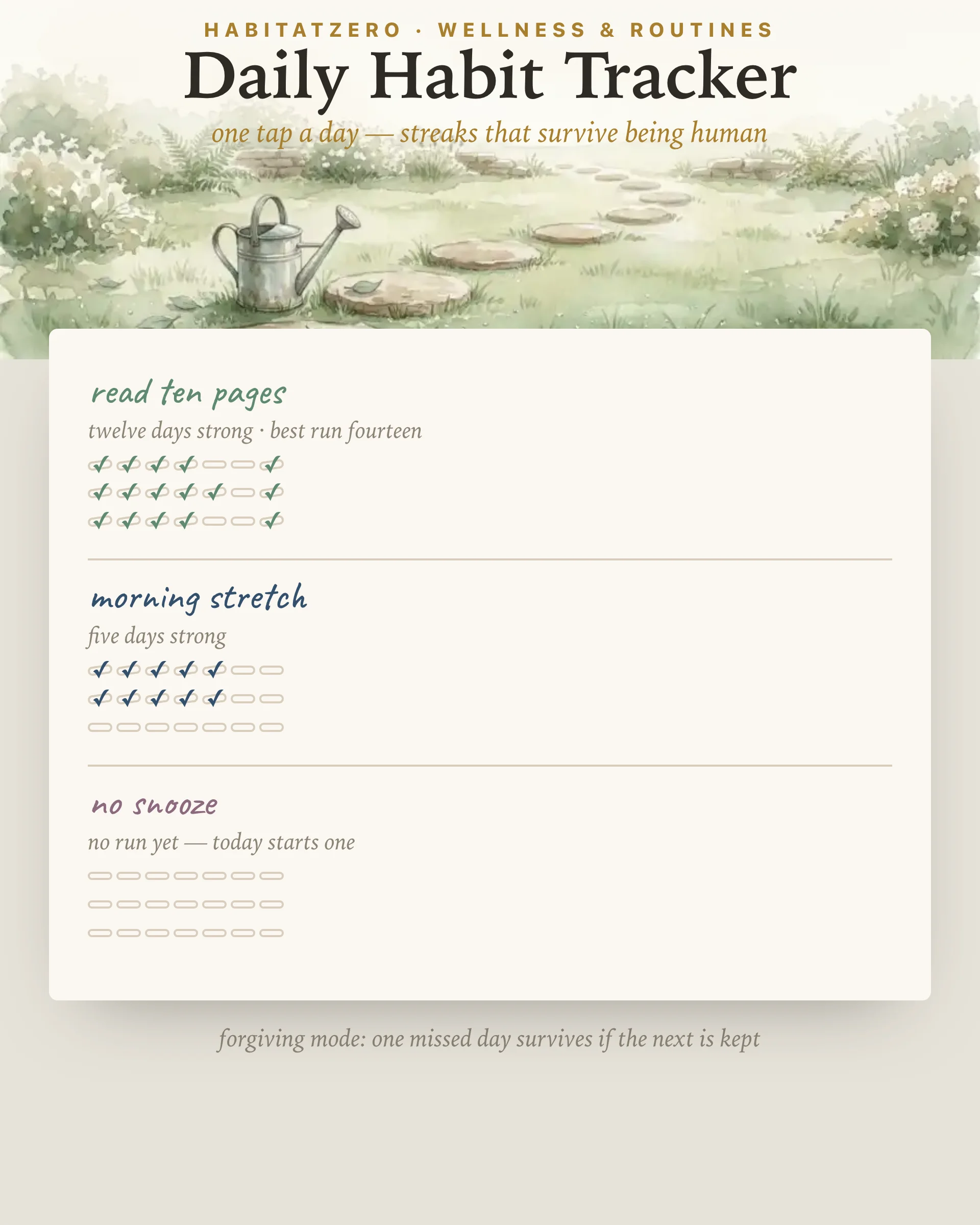
The habit-tracking world split into two camps and both have a problem. The apps are beautiful and motivating — and gated behind subscriptions, notifications, and another account. The printables are free — and static, unable to count a streak or forgive a stumble. This tracker takes the third road: the streak mechanics the apps charge for, free in the browser, with one design decision the apps mostly refuse to make. More on that below.
Add a handful of daily habits — two or three is the honest number, six is the cap. Each gets a color, a one-tap done button, and its own arithmetic: current streak, best run, and a ten-week grid that fills like a garden as the days accumulate.
Why ten weeks and not the mythical twenty-one days? Because the actual research says so: the best-known study of habit formation followed people building real habits and found automaticity arriving after about sixty-six days on average — with enormous variation on both sides. Three weeks is where the folklore ends; ten weeks is where a habit can genuinely prove itself. The grid is sized for the truth, not the myth.
And the tap itself is doing quiet work. Monitoring a behavior reliably changes it — self-tracking is one of the best-evidenced tools in behavior change, before any streak or reward enters the picture. The chain that forms in the grid ("don't break the chain," as the productivity folklore correctly puts it) is motivation layered on top of a mechanism that was already working.
Here's where this tracker deliberately parts ways with the app-store version. An all-or-nothing streak is powerful — right up until it's brittle. Miss one day at day thirty-eight and the counter resets to zero; and a dead streak doesn't just sting, it demotivates — the evidence of five good weeks evaporates, and the quiet lie "the run is over anyway" gets its opening. Apps keep hard streaks because breakage sells recovery features. You don't have that problem.
So the forgiving mode implements the rule coaches actually teach: never miss twice. With it on, a single missed day doesn't kill the streak — as long as the next day is kept. Two misses in a row, the streak honestly ends. One bad Tuesday stays one bad Tuesday instead of becoming a broken identity. (This is also what makes the tracker ADHD-friendly by design: hard streaks are precisely the mechanic that executive-function bad days shatter first.)
The grid also allows backfill — tap yesterday if you did the thing and forgot to log it. Apps forbid this to protect "integrity"; a personal tracker can trust you, because the only person you'd be cheating owns the grid.
This tracker is deliberately streak-shaped: a few habits, every day, continuity as the metric. If your habits are frequency-shaped instead — gym three times a week, call home twice — that's the weekly habit tracker's territory, with per-habit weekly targets instead of chains. Structuring the day the habits live in is the ADHD routine builder's job, and when a full month of grid deserves a verdict, the monthly reset is where the zoom-out happens.
Two or three habits. One tap a day. Ten honest weeks — with room to be human in the middle of them.
A place to record, once a day, whether each habit happened — and to watch the record accumulate into streaks and a filling grid. The tracking is not bookkeeping; it is the intervention itself. Recording a behavior reliably changes it, and the growing chain becomes a reason of its own not to stop.
They work until they become brittle. The chain — never wanting to break the run of marked days — is real motivation, but an all-or-nothing streak that dies at one miss eventually punishes you for being human, and a dead streak demotivates harder than no streak at all. That is why this tracker offers a never-miss-twice mode: a single missed day survives if the next day is kept, which keeps the chain honest and alive.
Longer than the famous twenty-one days. The best-known study of habit formation found automaticity arriving after about two months on average — sixty-six days — with enormous variation between people and habits. The practical reading: track for ten weeks, not three, and judge the habit by how automatic it feels, not by an arbitrary finish line. The grid here shows ten weeks for exactly that reason.
Fewer than enthusiasm suggests. Two or three new daily habits get honored; eight get abandoned as a set. Add the second habit after the first stops requiring willpower — the tracker caps at six, and even six is ambitious. One anchor habit done daily beats five done sometimes.
Yes — free, in your browser, no signup. Habits, taps, and streaks save as you go, the forgiving mode is a toggle away, and your streak card downloads as an image. In the Fabulous app the same tracker syncs across your devices.
Yes — pick the one healthy habit that matters most right now, write it at the top, and let the streak do the worksheet part: every marked day is a completed exercise. One habit tracked daily beats a page of ten intentions reviewed never; when the first one holds, start a second sheet.
By the team behind Fabulous, the science-based self-care app used by over 30 million people.