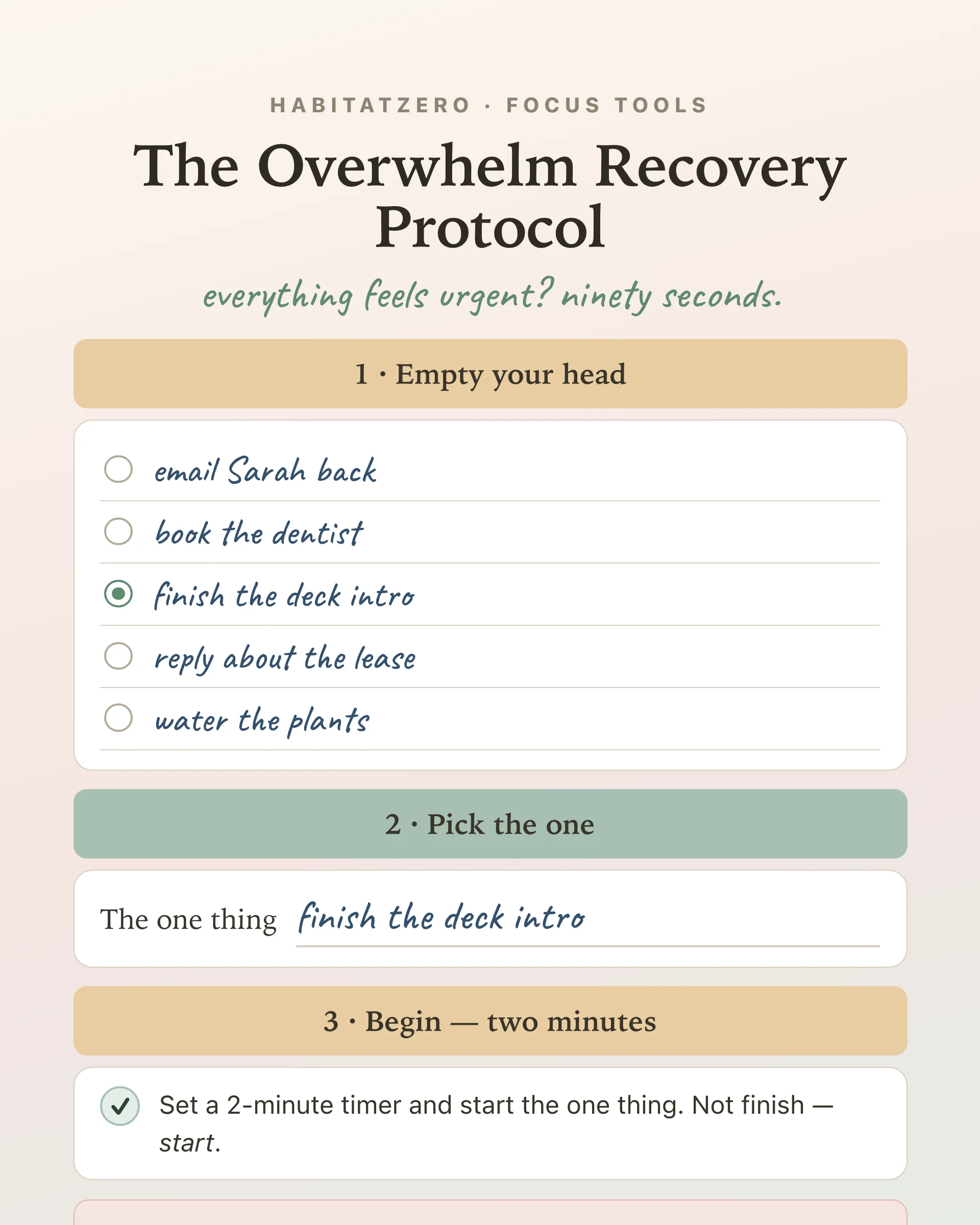
The Overwhelm Recovery ProtocolWellness & Routines · ~5 min
About this template · Updated July 2026
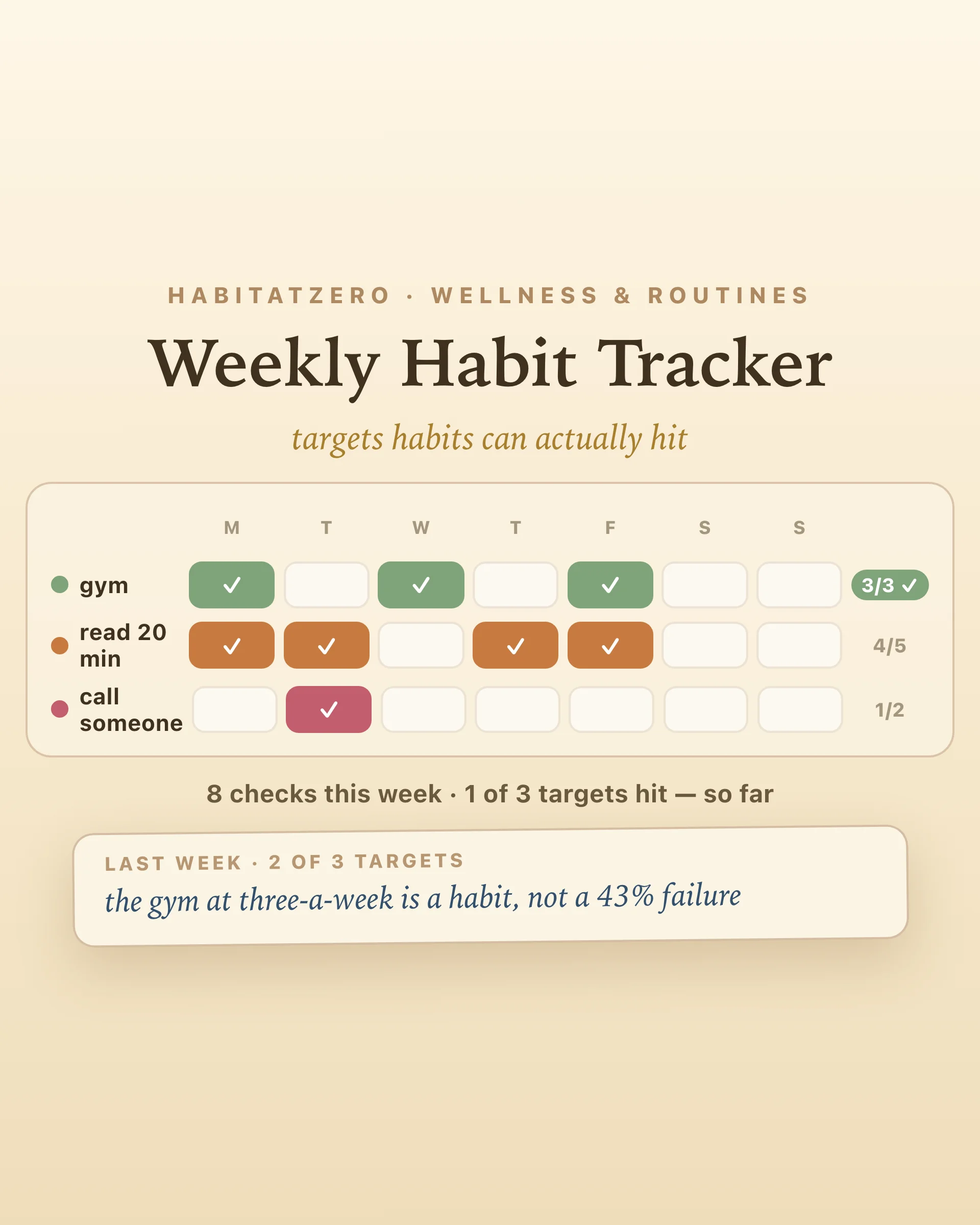
The daily habit grid has a dirty secret: it punishes the wrong people. Go to the gym three times this week — a genuinely successful week for that habit — and a daily tracker shows four misses. Call your mother on Sunday, exactly as intended, and the row shows six empty boxes and one guilty check. The grid isn't measuring your habits; it's measuring your habits against a cadence most of them were never supposed to have.
This tracker fixes the unit of account. Habits down the side, the week across the top, and — the part that matters — a target per habit. Seven for the daily ones, three for the gym, one for the call. Success gets defined before the week starts, by you, at the frequency the habit actually lives at.
List the roster. Up to eight habits, each with its own color and its own weekly target. Be honest about the number: a target you'd bet on beats a target that looks impressive, and the row that hits three-of-three teaches your brain something the row that misses four-of-seven never will.
Tap the day. Did it? Tap. The cell fills in the habit's color, the count ticks toward target, and hitting the target earns the row its ✓ — a small, felt win in a tool category that usually only knows how to frown.
Roll the week. On Monday the grid clears and last week joins the history: checks made, targets hit, week by week. Two lines of history tell you more than any single heroic Tuesday — trends are where habits actually live.
The habit-formation research is clear on what builds automaticity: consistent repetition of an action in a stable context — Lally's famous study watched habits take anywhere from 18 to 254 days to become automatic, with consistency, not intensity, doing the work. And reviews of how habit actually functions in health behavior keep landing on the same point: the cue-action loop strengthens when the action reliably follows its cue — the gym after Tuesday's workday, the call on Sunday evening — not when the calendar shows an unbroken chain.
That's the design argument for weekly targets. A three-a-week habit repeated at three-a-week for months is a strong habit. The daily grid calls it a 43% failure; this grid calls it what it is: a hit target, again.
One warning the research also supports: don't stack the roster. Every new habit draws on the same limited self-regulation while it's young. Three to five rows, one of them new at most — the rest of your ambitions can wait a month in comfort.
These two trackers are a system. The 30-Day Habit Tracker is depth: one new habit, one growing streak, the full ceremony — that's where a habit gets installed. This weekly grid is width: the established roster, maintained at realistic targets. Graduate habits from there to here: thirty days of ceremony, then a quiet row on the weekly grid with a target it can keep hitting. And if a row keeps missing its target week after week, that's not a willpower problem — it's a cue problem, and the ADHD Routine Builder or a slot in the Study Planner is usually the actual fix: habits hit targets when they have an anchor, not an intention.
Small targets, honest numbers, weeks that keep score. That's maintenance — the unglamorous half of every habit story that actually lasts.
Habits down the side, days across the top, a check where they meet. The week is the natural unit for juggling several habits at once: big enough to absorb a bad Tuesday, small enough that the grid stays honest. This one adds per-habit targets, so a three-times-a-week habit can succeed at three instead of failing at seven.
Because most real habits aren't daily. The gym three times a week is a successful habit; forcing it into a daily grid makes four missed days out of a good week. Research on habit formation shows consistency of the cue-action link matters more than raw frequency — a target the habit can actually hit builds the loop; a target it can't just builds evidence against yourself.
Three to five. Every habit you add competes for the same daily attention, and a grid of ten habits collapses into a wall of guilt by Thursday. If you're starting from zero, start with one keystone habit on this grid and let the other rows wait a month.
They answer different questions. The 30-day tracker is one habit, deep: a single streak you watch grow, ideal for installing something new. The weekly tracker is many habits, wide: the whole roster at a glance with realistic per-habit targets. Common setup: the new habit gets the 30-day treatment, the established ones live here.
Yes — download your week as an image and print it. The interactive version keeps two things paper can't: the week-over-week history with targets hit, and the sync in the Fabulous app so the grid is on your phone when the habit happens.
By the team behind Fabulous, the science-based self-care app used by over 30 million people.