Reading JournalStudy & Learning · ~4 min
About this template · Updated July 2026
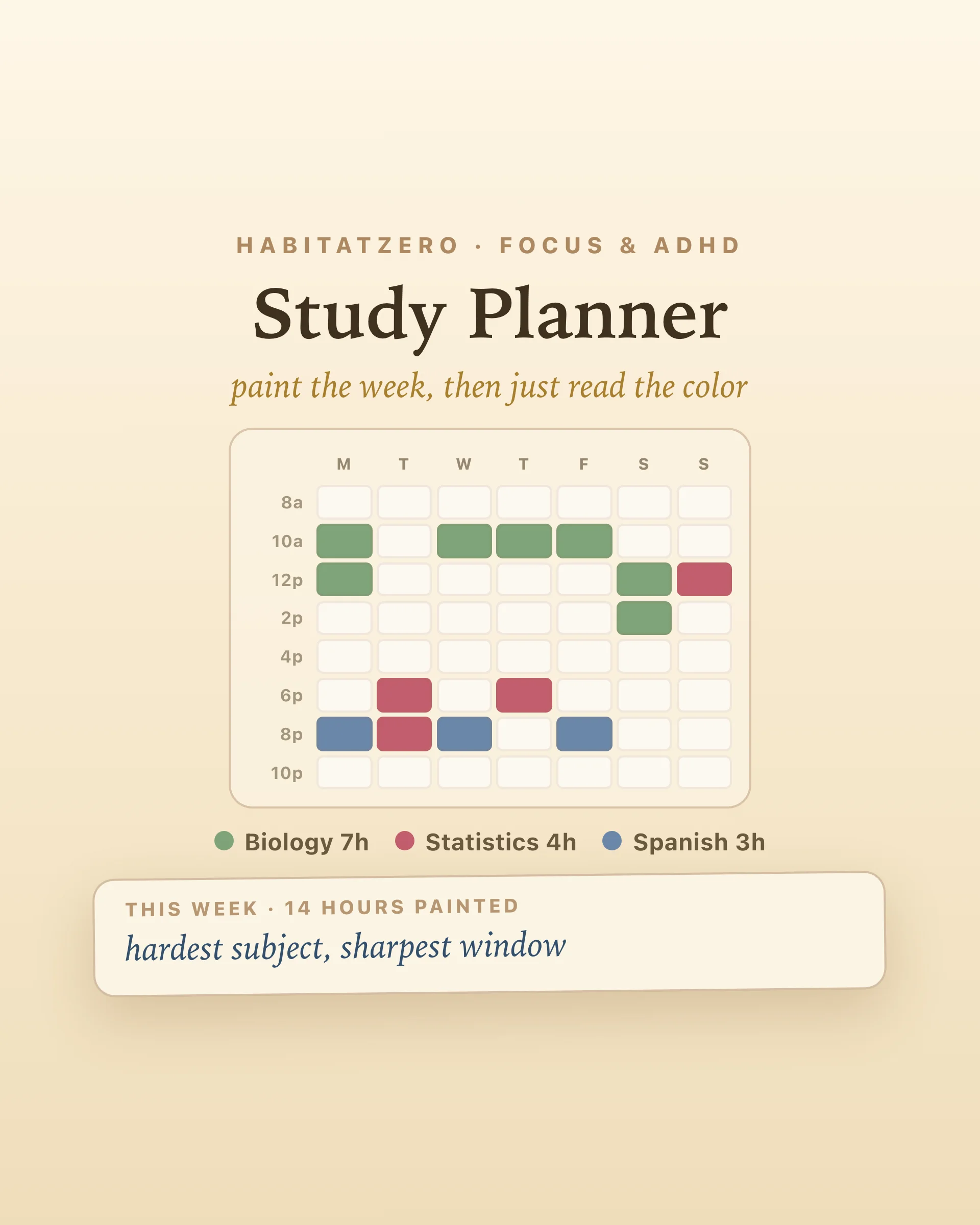
Every unplanned study week runs the same script. Monday has good intentions. Tuesday has "I'll start after dinner." By Thursday, the subject you like is three sessions ahead, the subject you fear hasn't been opened, and Sunday night is suddenly load-bearing.
None of that is a discipline problem. It's a decision problem: without a plan, every single afternoon has to re-negotiate what to study, and the negotiation is rigged — the comfortable subject always wins. A study planner's real job is to hold that negotiation once, on Sunday, while you're calm, and never again.
This one you paint.
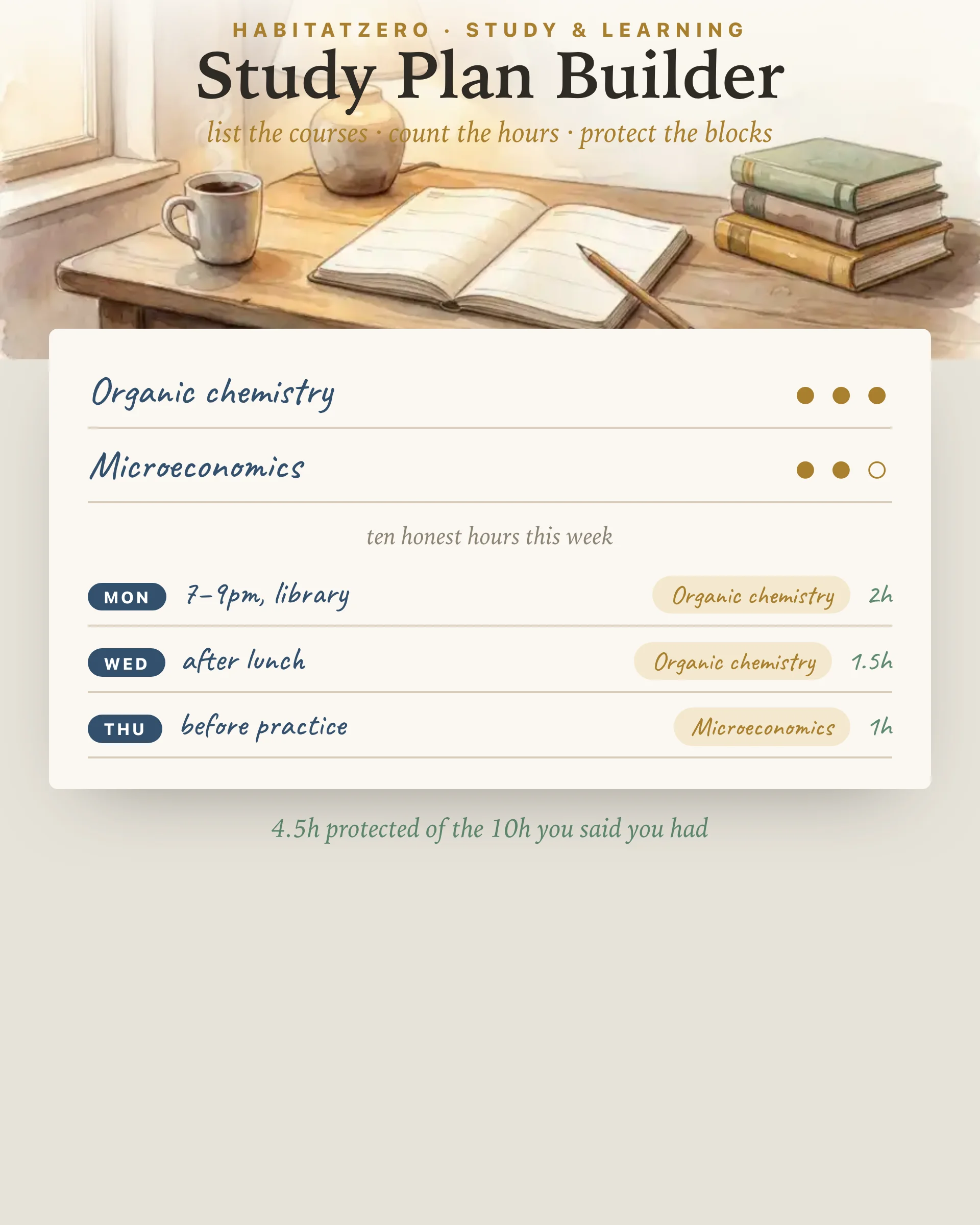
Add your subjects. Each gets a color. Three to six is a normal load; the palette holds eight.
Paint the week. Select a subject, then tap — or drag — across the hour grid to fill your study blocks. Same cell again erases. The grid runs seven days, morning to late evening, and the painting is the planning: biology in green across four short sessions, the scary statistics block in red placed inside your sharpest hours instead of the leftover ones.
Read the totals. Hours per subject count up live, plus the week's total. This is where plans get honest: a forty-hour painted week is fiction, and a grid where one color owns everything is a warning you can act on while it's still Sunday.
Download the finished week as an image — it prints like the classic timetable, math already done — and repaint whenever reality edits your plan. It will. That's not failure; Thursday-you is allowed to overrule Sunday-you with better information.
The most reliably useful finding in a century of learning research is also the least glamorous: spacing beats stacking. Reviews of hundreds of studies on the spacing effect show that the same hours produce substantially more durable learning when they're distributed across days than when they're massed into one heroic session. Cramming feels effective because recall is easy while the material is still warm — and that warmth is gone by the exam.
The practical translation, from a major review of study-technique effectiveness: distributed practice sits in the top tier of techniques; re-reading and highlighting — the things a tired brain defaults to — sit at the bottom. A weekly grid is spacing made physical. Four one-hour green blocks across the week aren't just tidier than one four-hour slab; they're measurably better learning from the same time spent.
Hardest subject, sharpest window. Everyone has one or two genuinely good hours a day. Most people spend them on the easy subject because it's more pleasant. Reverse it — the comfortable subject survives your tired hours; the hard one doesn't.
Short blocks, more of them. One or two hours per sitting per subject. Past that, painting more cells mostly plans more staring.
Leave white space. A grid painted edge to edge isn't a plan, it's a wish. Empty cells are where life happens — and a plan that survives contact with life is the only kind that compounds.
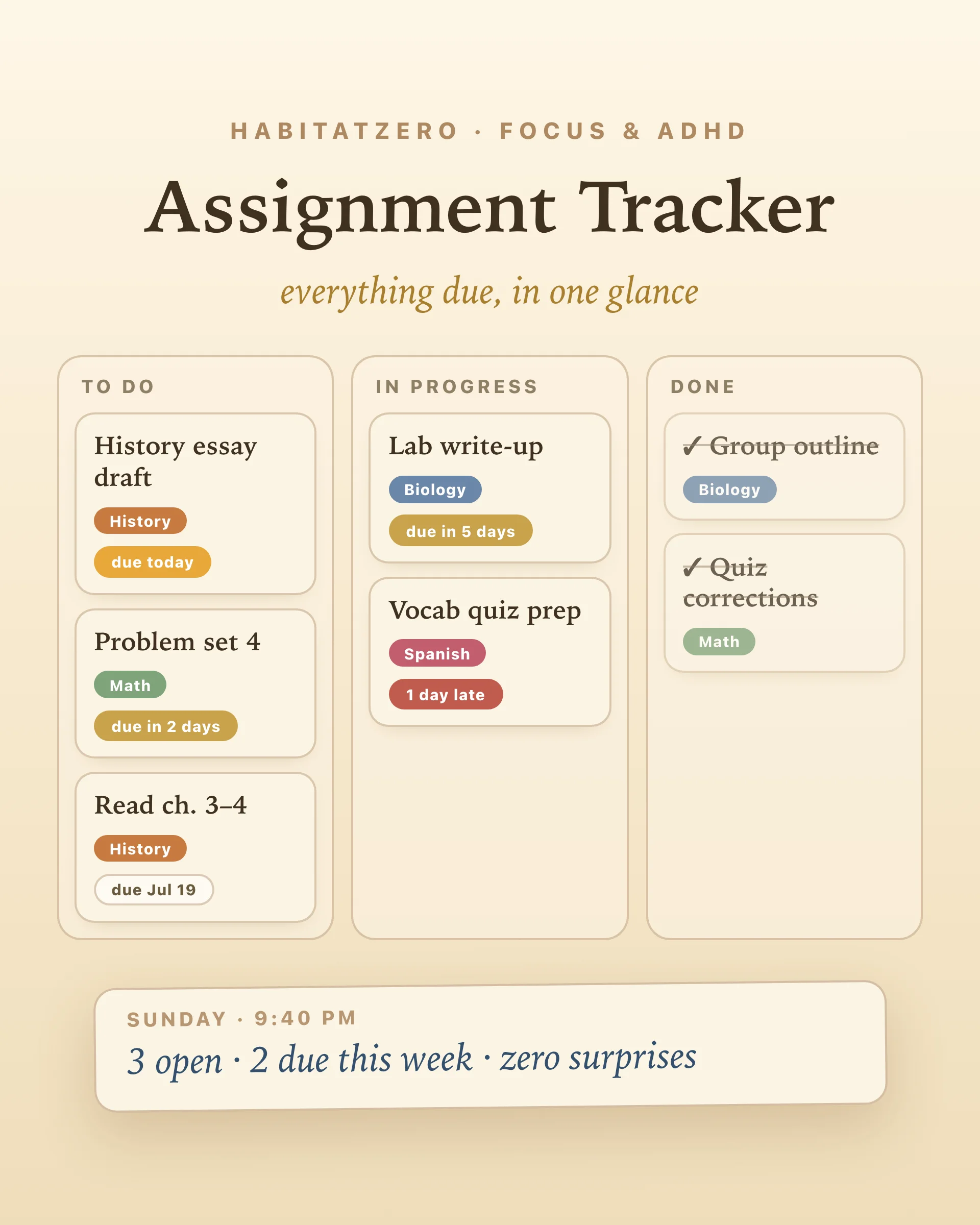
The grid decides what and when; it can't make you start. If a painted block arrives and starting feels like lifting a car, that's a different problem with its own tool — Deal With Your Brain exists for exactly that moment. For what you're studying toward, keep deadlines visible in the Assignment Tracker so the week's paint answers to real due dates. And when one heavy day needs minute-level structure, run it through the Time-Blocking Daily Planner.
Paint the week once. Let every afternoon just read the color.
Three rules cover most of it. First, decide the week in advance — a plan made Sunday beats a negotiation held daily at 4pm. Second, spread each subject across several shorter sessions instead of one long block; spaced practice is one of the most reliable findings in learning research. Third, plan around your real energy: the hardest subject goes where your focus is best, not wherever slots are left over.
Fewer than you think, more consistently than you do now. Two to four focused hours on a school day is a strong plan; past that, quality drops faster than the hour count rises. The grid's totals are there to keep you honest in both directions — a 40-hour painted week is a fantasy, and a 4-hour one is a wish.
They answer different questions. The weekly grid decides how your subjects share the week — that's where spacing and balance happen. A daily plan decides how one afternoon runs. Start weekly: paint the blocks here, and if a single heavy day needs minute-level structure, run that day through a time-blocking planner.
The best time is the one your energy already agrees with. Most people get one or two genuinely sharp windows a day — commonly mid-morning and early evening, but yours may differ. Put your hardest subject inside your sharpest window for a week and compare; the grid makes the experiment cheap to run.
Yes — paint your week, then download it as an image and print that. It reads like the classic printable timetable, except the hours-per-subject math is already done. The interactive version also saves in the Fabulous app, so next week starts from this week's shape instead of a blank grid.
Make it visible, make it realistic, and expect it to bend. A schedule you see daily gets followed; one in a drawer doesn't. If you broke the plan by Wednesday, that's data, not failure — repaint Thursday onward with what you learned. And when a painted block arrives and starting feels impossible, that's not a planning problem; that's a starting problem, and it has its own tool.
By the team behind Fabulous, the science-based self-care app used by over 30 million people.