The Overwhelm Recovery ProtocolWellness & Routines · ~5 min
About this template · Updated July 2026
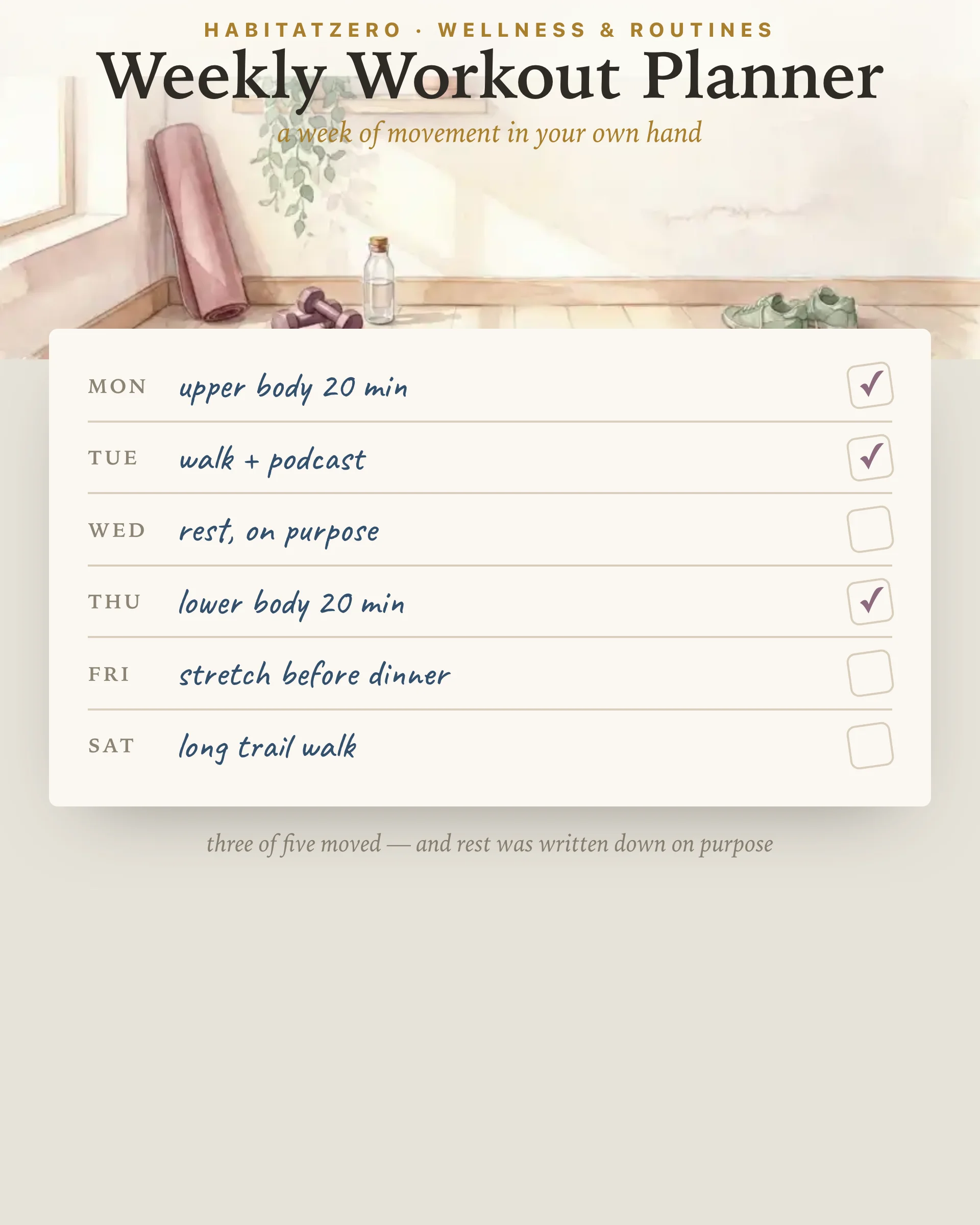
Most workout planners are written for a person with one job, no commute, and a photographer following them around. Seven training days, color-coded splits, macros in the margins. Then Tuesday happens. This planner is built the other way around: seven honest lines, your own handwriting, and a stamp for the days you actually moved — including the rest days you chose on purpose.
The top line asks what the week is for — not a program name, a reason. Feel strong for the hiking trip. Sleep better. Keep the promise. Under it, one line per day: the workout you will actually do, written the way you'd say it. "Upper body, twenty minutes." "The walk with the podcast." "Rest, on purpose."
That writing-it-down step is doing more work than it looks like. Deciding in advance when and what you'll train is a form of implementation intention, and the meta-analysis on the technique across nearly a hundred studies found a medium-to-large effect on follow-through — planning turns a vague goal into an if-then the week can actually execute. The Sunday version of you makes the decision once; the Thursday version just reads the line.
Less than the seven-day guilt machine suggests. The World Health Organization's guidance for adults lands at 150 to 300 minutes of moderate activity across the week, plus two days that strengthen muscles — which fits comfortably in three to five planned days. A brisk half-hour walk counts. The class counts. The planner deliberately holds a single line per day because a week you can read at a glance is a week you can keep.
And rest is written down, not left blank. Recovery is when training becomes strength; an unwritten rest day reads as a miss when you look back, while a written one reads as a plan that held. Here, a rest day gets its line and can even get its stamp.
Every day that happens gets a hand-drawn checkmark. By Sunday the sheet is an honest record: three of five moved. Not a grade — a picture. If the picture keeps showing the same day falling through, next week's plan gets to learn from it: move the workout, shrink it, or let that day be the rest day it clearly wants to be.
If the habit itself is the fragile part — showing up at all, rather than what to do once you're there — the daily habit tracker's streak grid is the sharper tool, and the morning routine checklist can hold the wake-up sequence that gets you out the door. This sheet is for the week-shaped question: what movement, on which days, around the life you actually have.
One line per day. Your own handwriting. Rest that counts.
Health guidance for adults lands around 150 minutes of moderate activity across the week plus two days that strengthen muscles — which fits comfortably into three to five planned days. The planner holds seven lines, but a week with deliberate rest days written in is the version of the plan that survives contact with real life.
Because deciding in the moment is where workouts go to die. Writing down when and what you will train is a form of implementation intention — the if-then planning that research links to meaningfully higher follow-through. The decision gets made once, on Sunday, by the calmest version of you.
The planner itself is for anyone who wants a week of movement written in their own hand. It is designed around the way many women actually train — weeks that mix strength, walks, classes and deliberate recovery, planned around a life rather than a bodybuilding split — but nothing about the paper checks your ID.
They are the part most plans forget to write down. Recovery is when the adaptation you trained for actually happens, and an unwritten rest day tends to read as a failure when you look back at the week. This planner treats a written rest day as a kept plan — you can even stamp it.
Yes — the planner is free to use in the browser. Sign in to HabitatZero to personalize it, keep your weeks, and print a copy for the fridge or the gym bag.
Yes — it is the weekly shape of one. Write your own program into the seven day lines, keep the focus line for the week's intent, and print as many blank weeks as your plan runs. It holds the structure; the programming stays yours.
That is what the seven day-lines are: a blank weekly schedule waiting for your sessions. Write which days train and which rest, print it if you want it on the wall, and the same sheet works as a fitness planning template for any style of week — the schedule structure stays, the contents are yours.
By the team behind Fabulous, the science-based self-care app used by over 30 million people.