The Overwhelm Recovery ProtocolWellness & Routines · ~5 min
About this template · Updated July 2026
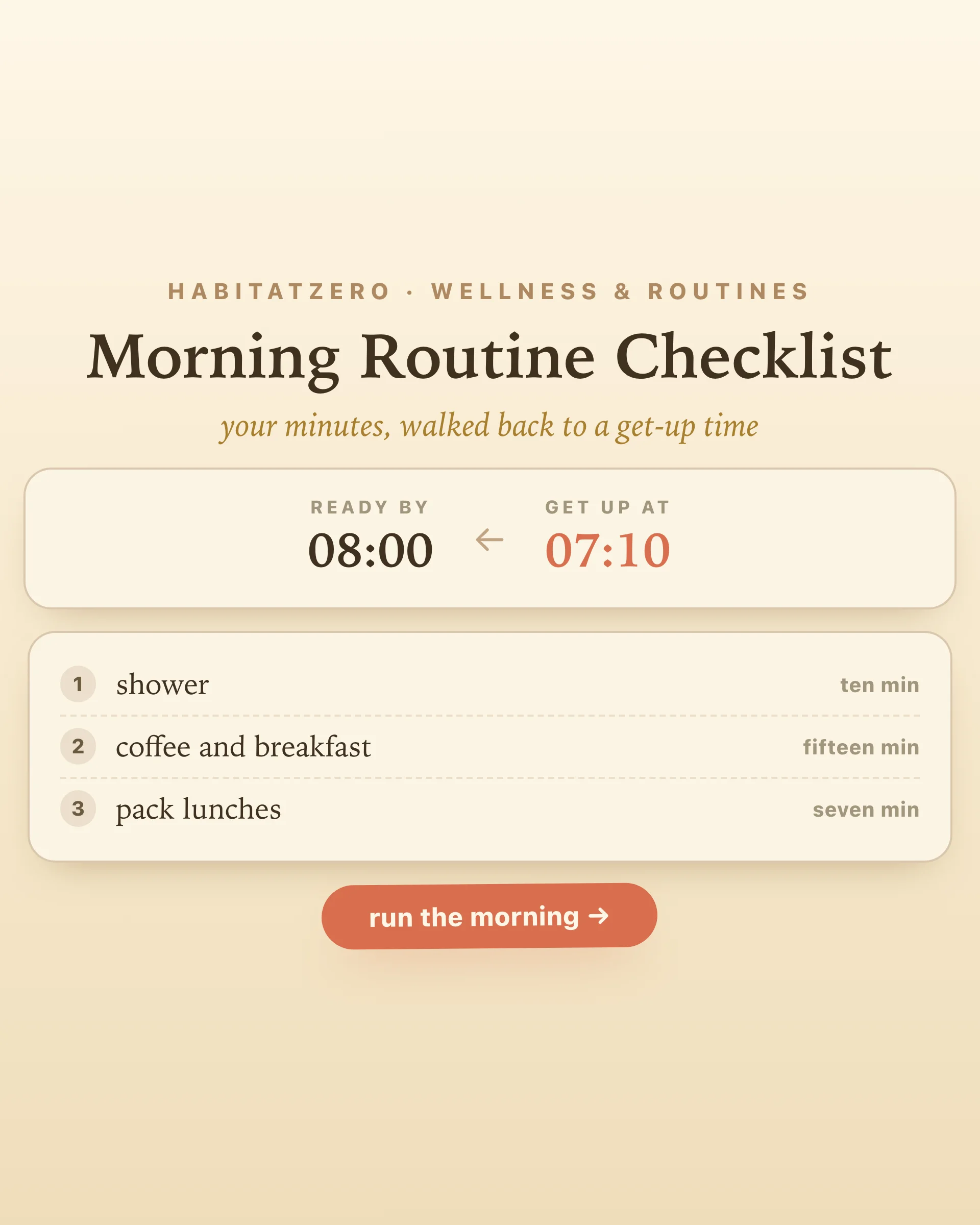
Nobody's morning falls apart at the shower. It falls apart in the gaps — the six untracked minutes between shower and coffee, the "quick" phone check that metabolizes a quarter hour, the arithmetic nobody does between the alarm and the door. A morning routine checklist closes the gaps with two boring, unreasonably effective moves: write the steps down with their honest minutes, and let the total tell you when to get up.
List what your morning actually contains, in the order your home actually flows. Shower, ten minutes. Coffee and breakfast, fifteen. Dressed, eight. Lunches packed, seven. The dog, ten. No aspirational cold plunges — the routine that works is the one that's true. There's solid psychology under this dull-looking list: spelling out the when-and-what of a behavior — what researchers call implementation intentions — reliably raises the odds it happens, because each finished step hands you the next one without a decision. And mornings are the natural home for this: repeating actions in a stable context is exactly how they become automatic, and no context is more stable than the first hour after your alarm.
Reorder with the arrows until the sequence matches reality — coffee before lunches if the machine needs warming, dog after dressing if the park is muddy. The order is half the routine.
Here's the checklist's sharpest trick: set the time you need to be ready, and it walks backwards through your minutes to the get-up time that makes the plan honest. Fifty minutes of steps and an eight-o'clock door means a seven-ten alarm — not the seven-thirty you've been setting and losing to every morning since. Add a step, and watch the get-up time move earlier; that visible cost is the best editor your routine will ever have. Most people don't need more discipline at 7am. They need the subtraction done the night before.
When the morning comes, run mode deals you one step at a time with a soft countdown. The timer is a pacing aid, not a referee: when a step's minutes run out it chimes once and waits, and nothing moves until you tap done. No auto-advance, no red flashing, no scolding — the checklist assumes you're a person mid-shower, not a process to optimize. Skip a step when life demands it; stop the run and the builder is right where you left it.
Two neighbors bracket this one. If your ideal morning includes writing before the world gets loud, morning pages is the step to add — three pages, no rules. And the get-up time this checklist computes is only as good as the bedtime behind it, which is what the wind-down routine is for.
Build the list tonight. Tomorrow, the morning has a shape before you're awake enough to negotiate with it — which is the entire point.
Everything that stands between your alarm and your door, with a real minute count attached: the shower, the coffee, breakfast, getting dressed, packing bags, the ten minutes you always spend looking for keys. The checklist takes any steps you give it — the power is not in the perfect list, it is in seeing the honest total. Most mornings fail on arithmetic, not discipline.
You set the time you need to be ready, and the checklist subtracts the total minutes of your steps to show the get-up time that actually supports it. Add a step and the get-up time moves earlier; trim a step and it moves later. It is the subtraction everyone means to do and nobody does — done live, every time the list changes.
A soft chime and a gentle time's-up note — nothing else. The step does not advance, skip, or scold; the countdown is a pacing aid, not a referee. You move on by tapping done, whenever done is true. You can also skip a step or stop the run entirely and the checklist returns to the builder.
As long as it honestly is — the checklist works the same for a twelve-minute minimalist launch and a ninety-minute slow morning. Research on habit formation suggests consistency of repetition matters far more than the size of the routine, so the winning version is the one you can run on a Tuesday, not the aspirational one.
Yes — free, in your browser, no signup. Your steps, minutes, ready-by time, and run progress save as you go. In the Fabulous app the same worksheet syncs across devices.
By the team behind Fabulous, the science-based self-care app used by over 30 million people.