The Overwhelm Recovery ProtocolWellness & Routines · ~5 min
About this template · Updated July 2026
A week is too short to get anywhere and a year is too long to believe in. Twelve weeks sits in the useful middle: long enough for a body to actually adapt, short enough that week one can picture week twelve. That is the whole argument for a 12 week fitness planner — not more discipline, just a container shaped like the thing you are trying to do.
Most fitness planning fails at the altitude problem. Plan one week at a time and every week looks the same: same three workouts, same hopes, no direction. Plan the whole year and the plan dissolves into wish. Training researchers have spent decades on the middle layer — periodization, the practice of dividing training into blocks that each do one job. Vladimir Issurin's review of block periodization describes why concentrated phases with distinct purposes outperform trying to train everything at once, all the time: adaptation compounds when the work changes character on a schedule.
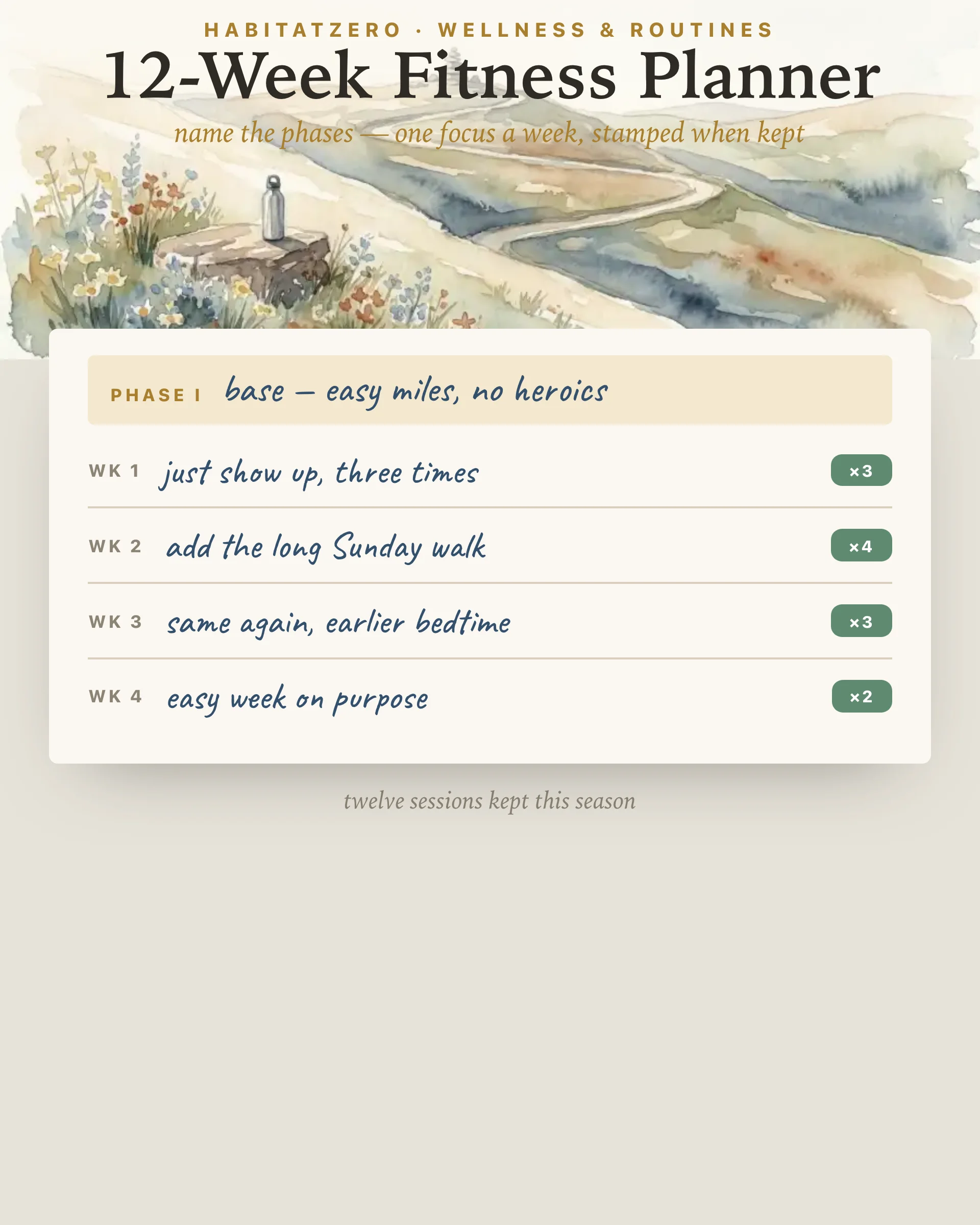
You do not need an exercise-science degree to borrow the shape. Three phases of four weeks. The first month earns the right to train — easy volume, showing up, nothing heroic. The second month adds load. The third sharpens toward whatever week twelve is for: a race, a test, or just the quiet check of repeating week one's workout and noticing it got easier.
This planner holds that shape and nothing else. Three phase bands you name yourself, twelve week-lines, one focus per line, and a stamp that counts the sessions you actually kept.
The temptation with a twelve-week sheet is to write the whole program into it — sets, reps, paces, the works. Resist. A program that detailed is out of date by week three, and the sheet becomes a monument to the person you were on planning day.
A focus line survives contact with real life. Add the long Sunday walk. First hill repeats. Easy week on purpose. Each line is a decision made once, when you were thinking clearly, so the week itself only has to execute. This is also why the planner works alongside whatever program you already follow: the program lives in an app or a coach's head; the season's shape lives here.
Write all twelve lines on day one if you like the view from the top. Or write four and let the second month be drafted by what the first month teaches. Both are legitimate — the phases hold the intent either way.
Every week carries a kept-sessions stamp. Tap it when a session happens — any session: the run, the lifting, the long walk, the stretching you finally started. By week twelve the sheet holds a number no memory can argue with.
That record matters more than the plan. Phillippa Lally's habit-formation study followed people building new daily behaviors and found the road to automaticity was measured in weeks, not days — about ten weeks at the median, with wide variation and, notably, no catastrophe attached to missing once. A twelve-week season is almost exactly the distance at which showing up stops being a negotiation. The stamps let you watch that happen.
And when a week reads zero, the sheet stays kind. A blank week is a data point, not a verdict. Two blank weeks in a row are the sheet telling you the plan was sized for a different life — so shrink the focus lines and keep the season alive.
The last week-line ships with a different prompt: how will you know it worked? Answer it in week one, in your own words — repeat the first workout and compare, finish the event upright, still be doing this in December. The season ends by telling you what the next one should be: harder, kinder, or simply again.
If your twelve weeks are aimed at goals beyond training, the twelve week year runs the same season logic for any goal, and the SMART goals worksheet is a good sharpening stone for the season line before you commit it. For the daily texture between the week-lines, a daily habit tracker catches what a weekly stamp is too coarse to see.
Pick the start date. Name the phases. Twelve lines from now you will know something about yourself that no plan could have told you.
Because the things people want from training — endurance, strength, a race finish — move on a timescale of months, not days. Twelve weeks is long enough for real adaptation and short enough to stay imaginable. The week-lines keep the day-to-day light; the season carries the ambition.
The classic shape is base, build, peak: a month of showing up easily, a month of adding load, a month of sharpening toward whatever week twelve holds. But the fields are yours to name — the point of periodization is that the season changes character on purpose instead of repeating one hard week twelve times.
Anything you planned and did — a run, a lifting session, a long walk, the stretching you swore you would start. The stamp is a tally of showing up, not a judgment of intensity. Rest days are part of the plan, not failures to stamp.
Leave the stamp at zero and keep going — the planner is a record, not a contract. One blank week in a season of twelve is a data point; quitting over it is the only real setback. If two weeks in a row go blank, that is the sheet telling you the plan was sized for someone with a different life, so shrink the focus lines.
Yes. Use it on the page, save your season as you go, or print the blank sheet and run the twelve weeks in pen on the fridge.
By the team behind Fabulous, the science-based self-care app used by over 30 million people.