
The Overwhelm Recovery ProtocolWellness & Routines · ~5 min
About this template · Updated September 2026
Couch to 5K began as a favor. In 1996 Josh Clark, a new runner who had found his own first weeks miserable, wrote a gentler nine-week schedule so his mother could start without going through the same thing, and his account of how that happened is worth reading. The tracker on this page is separate work: nobody connected with Clark, the NHS or any Couch to 5K app has reviewed, approved or paid for it.
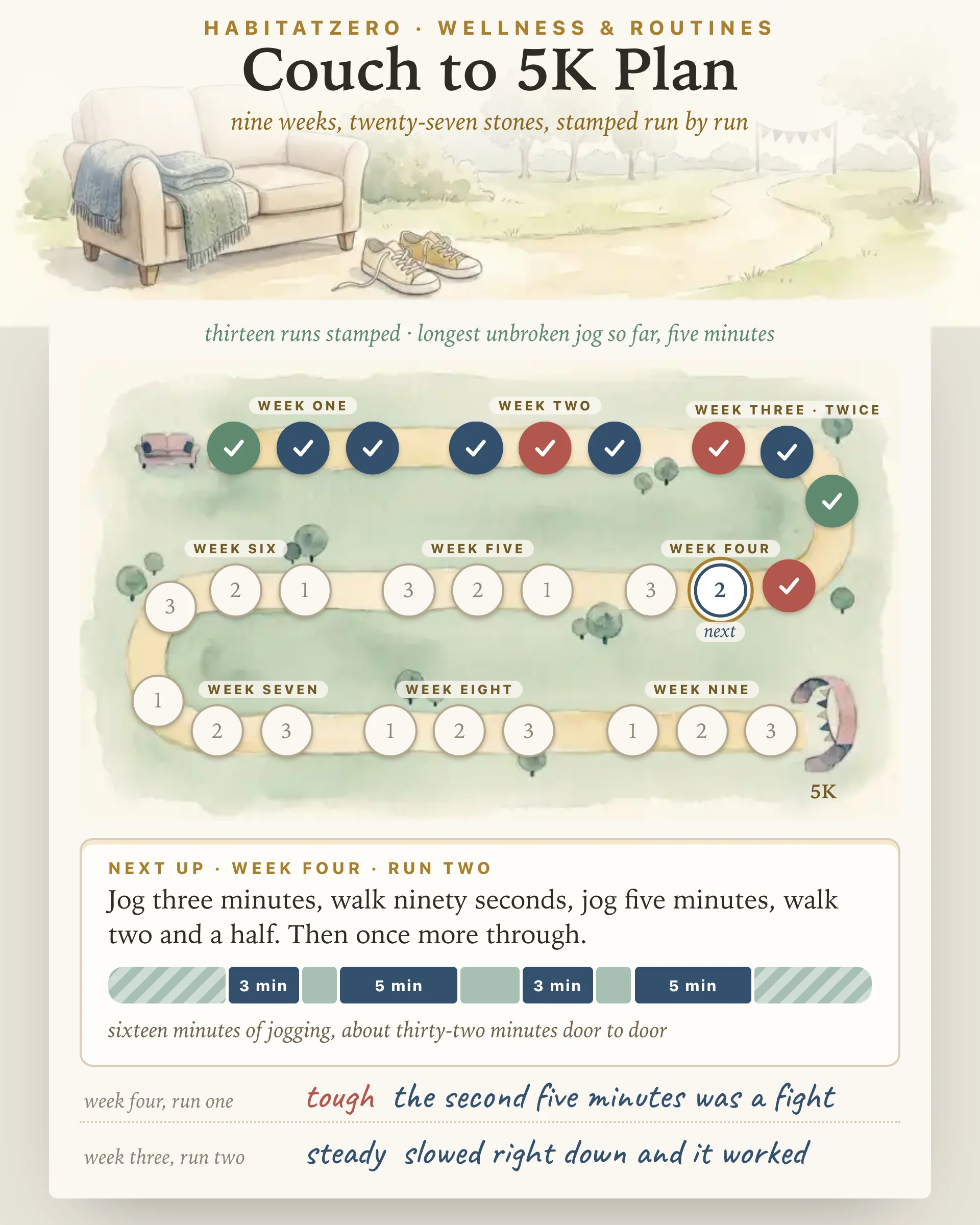
The schedule below follows the version the NHS publishes. You go out three times a week, and every outing is wrapped in a five-minute walk at each end.
The page turns those twenty-seven runs into stones on a painted path that starts beside a couch and ends under a string of bunting. The stone marked next is the one to run. Its card gives you the session in a sentence, then draws it as a ribbon to scale: striped for the warm-up and cool-down walks, green for walk breaks, blue for jogging. Week one is mostly green with slivers of blue; by the last run of week five the blue runs unbroken from warm-up to cool-down.
When you get home, tap how it went: easy, steady or tough. The stone takes that color, the line above the trail updates your longest unbroken jog so far, and the trail log totals your time spent jogging. There is room for one short note, and a stamp made by mistake lifts off with two taps.
The day picker underneath does a single job: choose three days and it tells you whether any two sit back to back, because the schedule assumes a rest day after every run.
Running has solid observational evidence behind it. A pooled analysis of fourteen studies covering more than 230,000 adults found that people who ran at all had a 27 percent lower risk of dying from any cause than people who did not run, and that bigger weekly amounts did not clearly add to the benefit. That is an association in cohort data, not proof that running caused the difference. It does suggest the modest dose this plan builds toward is enough to matter.
Couch to 5K itself is far less studied than its popularity implies. A 2023 study that followed 110 people through a nine-week beginner program in the UK found that only about a quarter of them finished. Interviews with people who dropped out kept returning to injury, to the way the schedule ramps up, and to feeling bad about not finishing, and the authors recommended injury-prevention advice and more flexible designs.
That finding shaped this page. The feel stamps make a hard week visible, and when two runs out of three come back tough, the card suggests running the week again. A cleared week keeps its earlier runs in your totals, so going round twice never reads as going backwards.
When a jog feels impossible, change the pace before anything else: if you could not get a full sentence out, ease off until you can. The plan only ever asks for minutes, never for speed.
Rest days are part of the training. After a break of a week or more, lift a few stamps and rejoin the trail a week earlier than where you stopped.
Tired legs and heavy breathing are expected. Sharp pain, pain that builds as you run, or pain still there the next morning is a reason to stop and have it looked at. The NHS also advises speaking to a doctor before you begin if anything about your health worries you.
One honest note about the name: week nine trains thirty minutes of continuous running. Depending on your pace that may come to a little under five kilometers, and it still counts as finishing.
Start in a week where you can protect three slots of about forty minutes, which is what the longest outing takes door to door. If you want the rest of your movement on the same wall, the Workout Calendar holds a month of moved-or-rest stamps, and the Weekly Fitness Reflection is the place to think about sleep, energy and what your body is telling you between runs. When the bunting is behind you, the 12-Week Fitness Planner is a good next block.
Weeks one to four alternate short jogs with walks, starting at one minute of jogging to ninety seconds of walking and building to five-minute jogs. Week five ends on a twenty-minute run and week six on twenty-five. Weeks seven, eight and nine are continuous jogs of twenty-five, twenty-eight and thirty minutes. Each outing opens and closes with a five-minute walk.
Three, with at least one rest day between them. Monday, Wednesday and Saturday works, while Tuesday followed by Wednesday does not. The day picker on this sheet warns you when two chosen days sit back to back.
Yes, and the NHS write-up of the schedule says so outright. Here, a fully stamped week can be cleared for another pass, up to four passes in all, and the runs from earlier passes keep counting toward your totals.
You will be running for thirty minutes without a walk break, which is what the last week trains. For plenty of new runners that is a little short of five kilometers. Keep the three weekly runs going afterwards and the distance usually catches up.
The full nine-week schedule is written out in the article below, so it can be printed or copied as it stands. The tracker itself is made for a screen, because scaled run ribbons, feel stamps and running totals are things a sheet of paper cannot do. Personalizing it in HabitatZero is free and keeps your stamps between visits.
By the team behind Fabulous, the science-based self-care app used by over 30 million people.


