
The Overwhelm Recovery ProtocolWellness & Routines · ~5 min
About this template · Updated September 2026
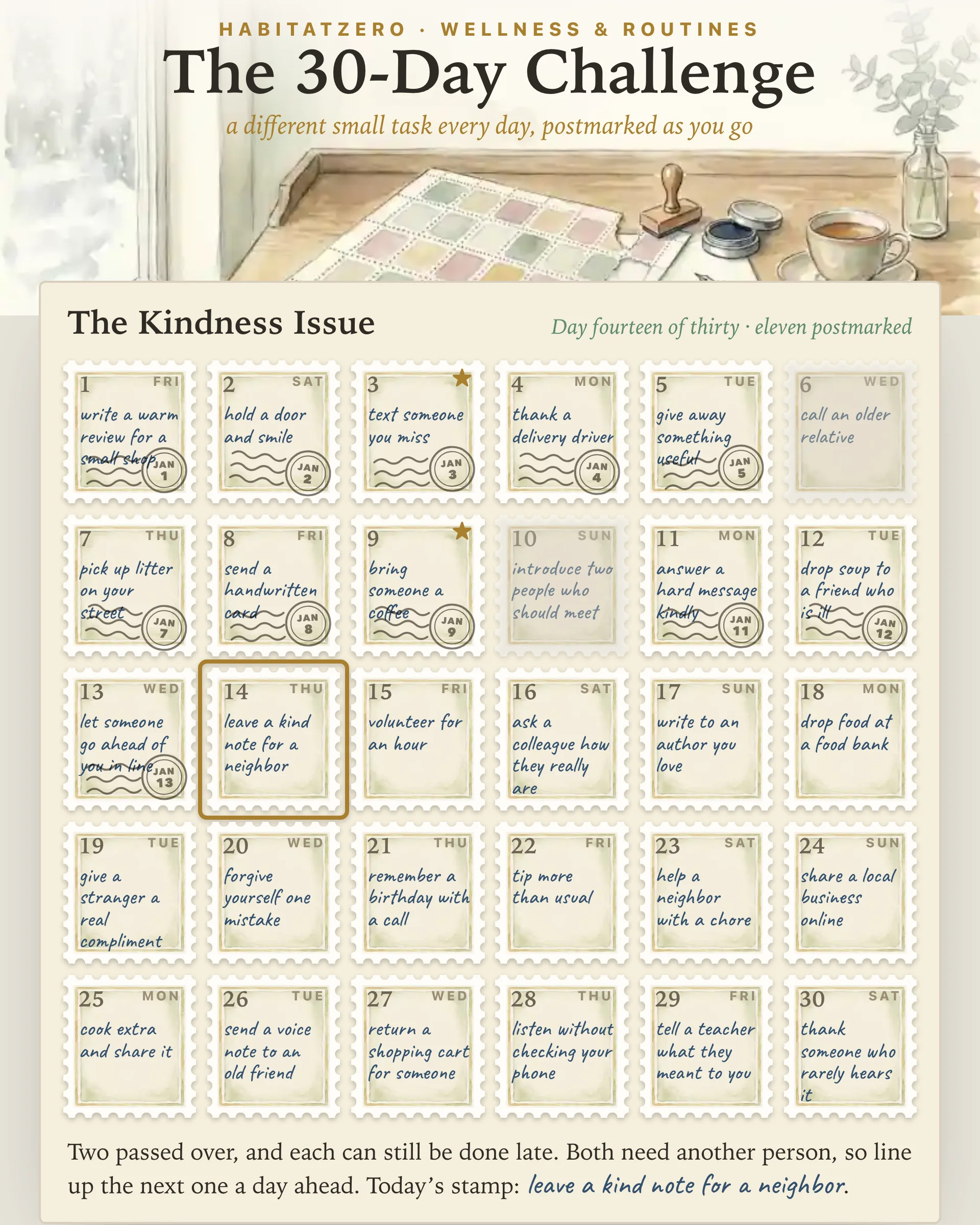
A thirty-day challenge gives a month edges: a first day, a last day and one small thing to do on each day in between. It comes in two shapes. In one you repeat a single action every day, and the 30-Day Habit Tracker is made for that. In the other you choose a theme and do something different inside it each day: thirty small kindnesses, thirty ways into a book, thirty drawers and shelves cleared. This page is the second shape, drawn as a sheet of thirty postage stamps.
Pick a theme from the ten on offer: reading, decluttering, kindness, movement, creativity, money, screen time, cooking, the outdoors and self-care. Each theme holds thirty-six small tasks, and the page deals thirty onto the sheet, one per stamp, always with a quick one on day one so the start costs almost nothing.
Next, choose day one. It can be today, tomorrow or the first of next month, or, if you began on paper and are only now catching up, the first of this month. Every stamp then carries a date, so you can check which task falls on a busy Tuesday and which on a slow Sunday.
Tap a stamp to open it. You can change it three ways before doing it. Another stamp draws a fresh task from the same theme, never one already on the sheet. Swap days trades it with any stamp that is still blank, which is how the long ones end up on weekends. Or write your own line of up to forty characters, and it replaces the dealt task.
When the task is done, press postmark it. A dated cancellation lands on the stamp, as it would on a letter. A day you miss stays blank rather than being crossed out, and you can still postmark it later. Taking a postmark off takes two taps, so a stray finger cannot erase a day.
Under the sheet, a few sentences say how the month is going: the day you are on, how many stamps carry a postmark and how many days slipped past without one. When most of the days that slipped share something, the page names it. Perhaps they all need another person, or all mean leaving the house. Then it suggests the small fix that fits, such as lining the next social task up a day ahead or moving the long ones onto days with room in them.
You can also star a postmarked task as worth keeping, up to three of them. The cap is there because starring is about choosing, and when the month ends, the reading asks you to pick one star to carry on.
Doing something new every day seems to lift people a little on its own account. In one experiment, people randomly assigned to do an act of kindness or an act of novelty each day for ten days finished with higher life satisfaction than they started with, while a third group asked for no acts at all served as the comparison. Variety may also help people keep showing up. In a six-week trial with 121 inactive university students, the exercise program built to offer more variety kept people coming back more reliably, and the effect ran through how varied the sessions felt to them.
The day you begin matters a little too. Three archival field studies found that diet searches, gym visits and goal commitments all rose just after temporal landmarks such as a new week, month or year, which is why the first of next month sits among the choices for day one.
Here is the limit, stated plainly. Thirty different tasks will not turn any one of them into a habit. Habits grow out of one simple action repeated in the same setting, and habit researchers point out that variety can hold boredom off while getting in the way of automaticity. In the study their advice draws on, the feeling of doing a new daily action automatically took an average of about sixty-six days to level off.
So treat the themed month as a way of finding out which small things suit you. When it ends, take one of your starred tasks, fix a time and a place for it, and repeat it daily on the habit tracker.
Deal the sheet a day or two early and read it over before anything is postmarked. New Year is the obvious moment, but the first of any month, or the Monday after a holiday, works just as well. Then open it once a day, ideally at the same point in your routine, do the stamp and postmark it.
Some themes have a deeper page of their own. If screens are the real issue in your evenings, the Evening Digital Detox takes on that single problem night by night. If a month feels too short and you would rather keep a handful of daily rules through the darkest part of the year, the Winter Arc Challenge runs for three months.
By the last stamp you will know which of the thirty you would do again without being asked. That task is what the month was for.
It is a month with a clear first day, a clear last day and one small commitment for each day in between. In one version you repeat the same action thirty times. In the themed version this page deals, you pick a subject such as kindness or cooking and do a different small task from it every day.
Themes that split into many small, varied tasks hold up best over a month: reading, decluttering, kindness, movement, creativity, money, less screen time, cooking, time outdoors and self-care. Each one here carries thirty-six tasks, such as reading a poem out loud, clearing one kitchen drawer or texting someone you miss.
Usually not, and a month of different tasks is not designed to. Habits come from repeating one simple action in the same setting, and in the best-known study the sense of doing it automatically took about sixty-six days on average to level off. Use the themed month to find the task you enjoy, then repeat that one on its own.
Nothing resets. The stamp for that day stays blank, and you can still postmark it later, swap it onto a better day or leave it. If most of the skipped stamps share something, for instance needing another person, the reading under the sheet says so and suggests a small adjustment.
The sheet shown on this page is a sample, two weeks into a month of kindness. Dealing a theme of your own, keeping your postmarks from one visit to the next and reading your month back all start when you personalize it in HabitatZero, which is free.
By the team behind Fabulous, the science-based self-care app used by over 30 million people.


