The Overwhelm Recovery ProtocolWellness & Routines · ~5 min
About this template · Updated September 2026
Credit first: nobody owns the winter arc. The phrase borrows "arc" from storytelling, the stretch of a story in which a character changes, and it had been drifting around gym corners of the internet since at least 2022 when a TikTok creator posting as @carlyupgraded set off the challenge most people now recognize with a video in late September 2024. The Daily Dot has traced how the trend took off. This tracker is an independent take on the idea and has no tie to her, to TikTok, or to any brand that has run a winter arc of its own.
The premise is slightly contrary. Most people coast through the last quarter of the year toward January, when the resolutions begin. A winter arc starts on October first instead, holds a short list of daily rules through the darkest, busiest, most snack-laden months, and lands on New Year's Eve with those habits already three months old.
There is no official rulebook, which is the appeal and the trap. The common shape:
The trap is ambition. Rule lists online run to ten items with a five a.m. alarm, and lists like that tend to survive until the first head cold. A rule earns a place on your arc only if you could keep it on a bad Tuesday in late November, with a deadline and a sore throat.
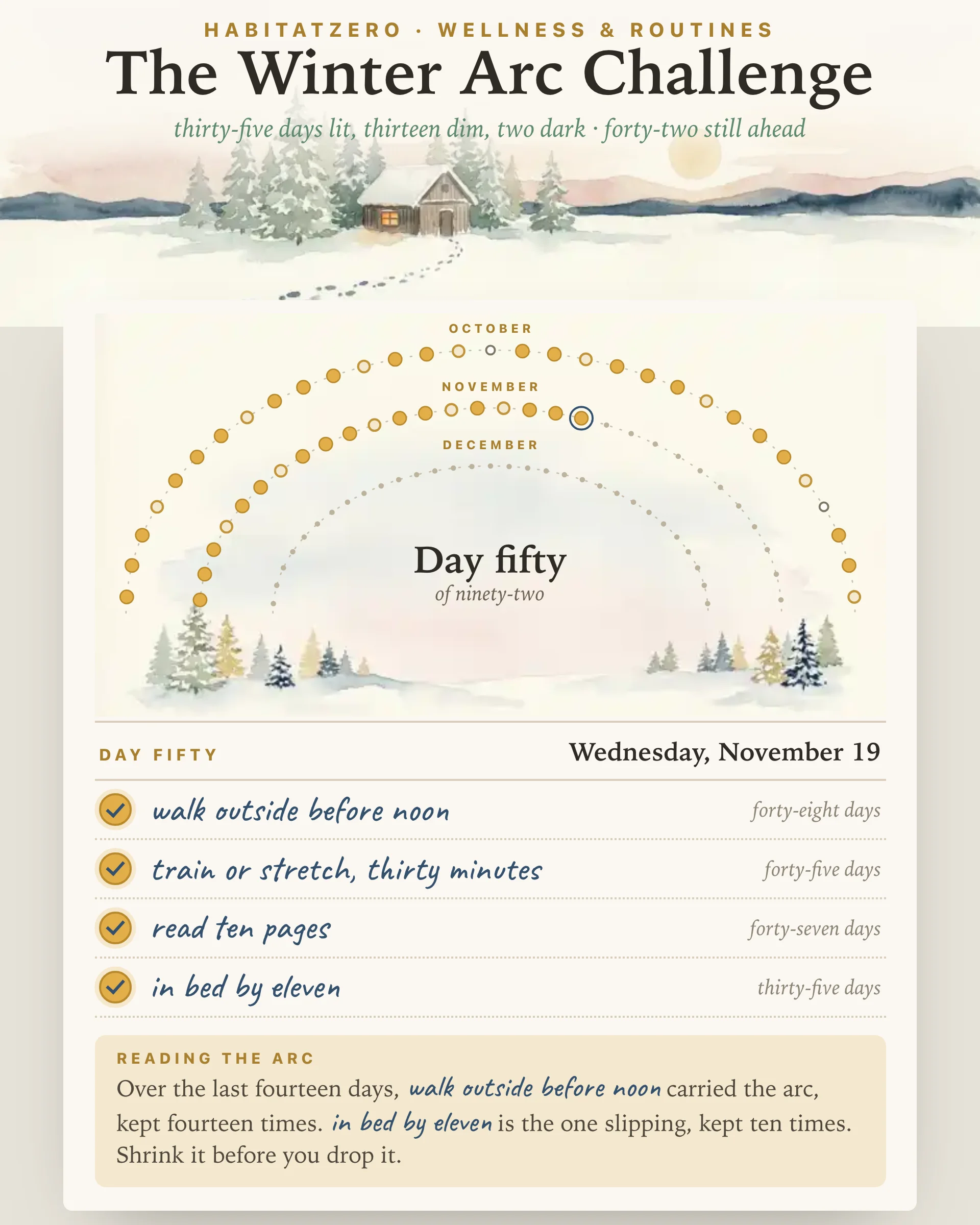
The page draws your season as three arcs rising over a snowy ridge, one arc per month, one small circle per day. You choose up to five rules by tapping suggestions or writing your own, and the sheet stops you at five on purpose.
Each day you stamp the rules you kept. Keep all of them and that day's circle turns gold. Keep some and it glows pale. Keep none and, once the day has passed, it stays on the arc as a dark ring. You can step back to any earlier day and fill it in honestly, and you can slide the whole arc a month earlier or later if October first is not your starting line.
Two things happen that paper cannot do. The line under the painting keeps the count in plain words: days lit, days dim, days dark, days still ahead. And once you have a week behind you, a short reading names the rule that carried the last fourteen days and the rule that is slipping, with the same advice each time: shrink it before you drop it. "Train for an hour" can become "train or stretch, thirty minutes" and the arc loses nothing.
Nobody has run a trial of the winter arc itself, so be wary of anyone promising a transformation by Christmas. The parts it is built from have been studied, though.
Picking a date that feels like a clean page is a measurable effect. One set of field studies found that diet searches, gym visits and goal commitments all climb after temporal landmarks such as a new week, month or year. October first is a landmark you pick yourself.
Writing progress down helps too. A meta-analysis pooling 138 experiments found that prompting people to monitor their progress made them likelier to reach the goal, and the effect grew when the record was physical instead of kept in the head. A circle you stamp every evening counts as a record.
The dark ring exists because of the best-known study of habit formation, in which ninety-six volunteers repeated one small daily behavior for twelve weeks, close to the length of an arc. Automaticity took anywhere from 18 to 254 days to level off, and missing a single opportunity did not materially change the curve. Ninety-two days may not finish the job for every rule, and one blank day will not undo the ones that are forming.
What none of this supports is the punishing version. Extreme restriction, training through illness and trimming sleep to fit everything in mostly produce an injury or a crash by mid-December. If a rule touches a medical condition, a history of disordered eating or a medication schedule, settle it with a clinician before it goes on the list.
Set your rules in the last days of September, or today if the season is already under way. Stamp every evening; tying it to the end of your Wind-Down Routine Builder works well, since a bedtime rule is usually on the list anyway. If a single habit is all you want this winter, the 30-Day Habit Tracker is the lighter tool, and if your quarter is about outcomes more than daily rules, it fits neatly inside the 12 Week Year Planner.
January turns up either way. The arc only decides what you are already doing when it does.
It is a self-improvement challenge that took off on TikTok in fall 2024. You pick a handful of daily rules, usually about training, food, sleep and focus, and keep them quietly from the start of October to the end of December, so that the new year begins with habits you already have.
The classic window runs from October 1 to December 31, which is ninety-two days. Plenty of people join in November or begin a fresh three months in January. This tracker follows three calendar months from whichever month you set, so a late start is a normal start.
There is no official list. Most versions share three ideas: a fixed three-month window, a short set of daily non-negotiables that you choose yourself, and doing the work without announcing it. Popular rules include a daily walk or workout, a protein or water target, a set bedtime, reading a few pages and keeping the phone out of the bedroom.
The day stays on your arc as a dark ring and the count carries on. In the best-known habit formation study, skipping a single day made no material difference to how the habit developed. If two dark days arrive back to back, the tracker suggests stamping any one rule that day to break the run.
Reading this page and studying the filled-in example costs nothing and needs no sign-in. Stamping your own days means saving them somewhere, so the tracker asks you to personalize it in HabitatZero first, and that is free as well.
By the team behind Fabulous, the science-based self-care app used by over 30 million people.