ADHD Daily Task OrganizerFocus & ADHD · ~10 min
About this template · Updated July 2026
Annual goals have a design flaw: December is imaginary. In January it's so far away that skipping a week costs nothing, and by the time it stops being imaginary, the year is spent. The 12 Week Year — Brian Moran and Michael Lennington's system, from the book of the same name — deletes the flaw instead of managing it. Your year is now twelve weeks long. There is no someday left to hide in.
The system starts with a trade: depth for breadth. You get one to three goals for the twelve weeks — the planner stops you at three, on purpose — and each goal gets a short list of tactics: the concrete, repeatable actions that add up to it. Not "get fit" but "three runs a week." Not "write the book" but "five hundred words before work." Goals are what you want; tactics are what you'll actually be scored on.
The short horizon isn't just motivational seasoning — it moves real machinery. Deadline research shows that meaningful, well-placed deadlines measurably improve follow-through, and the goal-gradient effect — effort accelerates as the finish line gets closer — barely exists when the finish line is fifty weeks out. At twelve weeks, week one already matters. That's the whole trick.
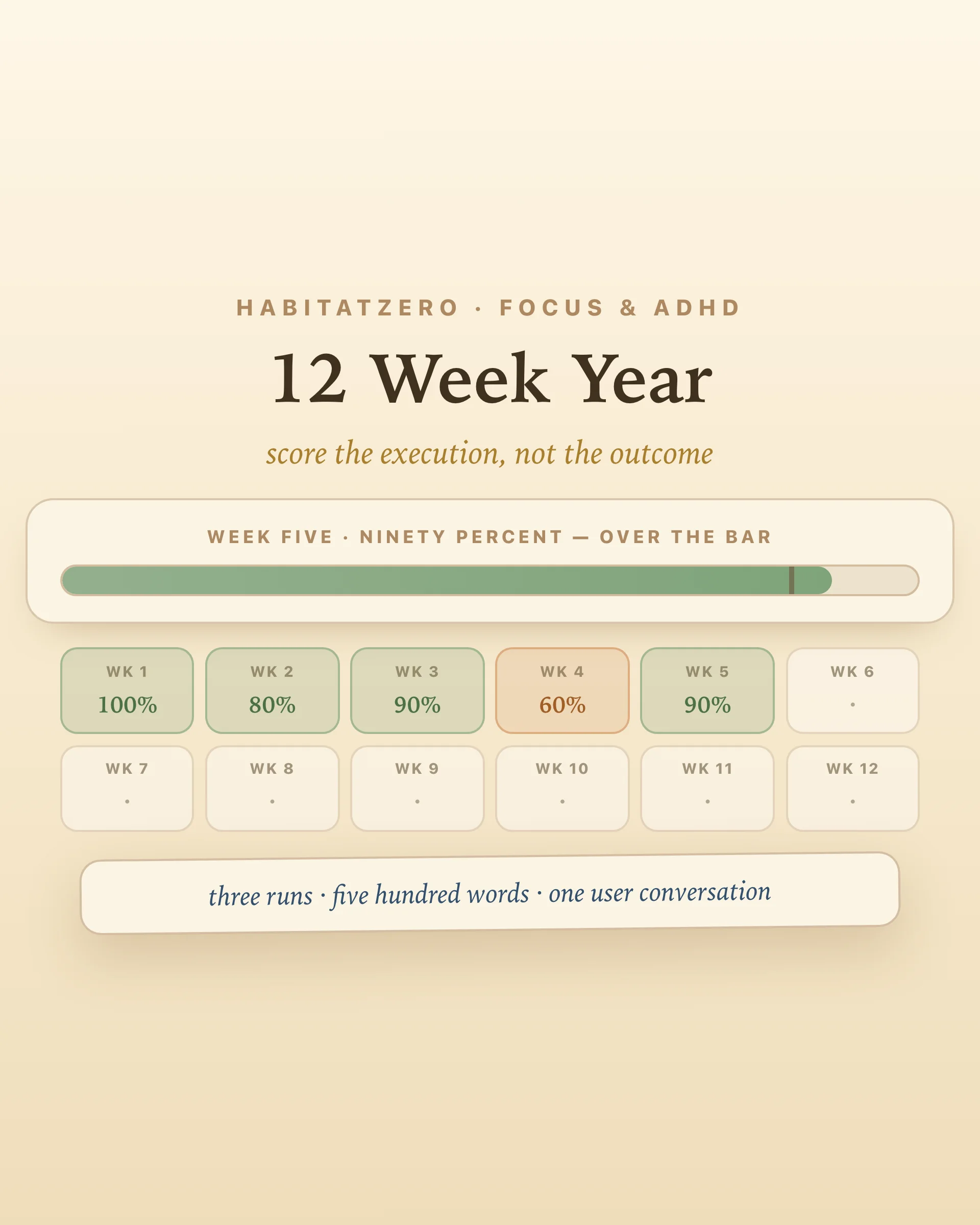
Every week, you tick the tactics you actually did. Ticked over planned is your weekly execution score, and the book's bar is eighty-five percent — not a hundred, because plans collide with real weeks and the system knows it. The planner draws that line right on the score bar, so the question each week is never "am I a disciplined person" but the far more useful "did this week clear the bar, and if not, which tactic slipped?"
This is the system's quiet genius: outcomes lag, but execution is measurable now. A bad outcome after twelve well-executed weeks means the plan was wrong — fix the tactics. A bad outcome after forty-percent weeks means the plan was never really run. The score tells you which story you're in while there's still time to change it.
The grid gives the sprint a face: twelve cells, one per week, each colored by whether its score cleared the bar. Weeks you haven't reached stay quiet; weeks you've lived are on the record. It's the same honest-visibility trick a weekly review runs on a smaller scale — and when the twelfth cell fills, the planner totals the sprint and offers you a fresh twelve, with your goals and tactics carried over for editing. Between sprints is where course corrections belong; a monthly reset makes a good boundary ritual.
Set the goals tonight. Not for the year — just for twelve weeks. It's close enough to feel, which is exactly why it works.
A planning system from Brian Moran and Michael Lennington's book of the same name: instead of a yearly plan that dies by March, you treat twelve weeks as a full year — few goals, weekly tactics, and a weekly execution score. The deadline is close enough to feel this week, which is exactly why it changes what you do this week.
In the 12 Week Year you score execution, not outcomes: the percentage of planned tactics you actually did that week. Eighty-five percent is the book's bar for a well-executed week — not a hundred, because plans meet real life. This planner draws that line on the score bar and colors each week's grid cell by whether the week cleared it.
One to three — and the planner physically stops you at three. The system's core trade is depth for breadth: a twelve-week sprint with five goals is a yearly plan wearing a disguise. If a goal cannot earn a spot in your top three, it is waiting for the next twelve weeks, not competing with these.
While the twelve weeks are running, the goal and tactic lists are locked — the score only means something if the plan holds still. Starting a fresh twelve weeks unlocks the setup with your goals and tactics carried over for editing, so course corrections happen at the boundary, not mid-week.
Yes — free, in your browser, no signup. Your goals, tactics, start date, weekly ticks, and scores save as you go. In the Fabulous app the same worksheet syncs across devices.
The weekly layer inside it is exactly that: each of the twelve weeks carries its own commitments and a score at the end. If you only want one week at a time, run a single row - the quarter view will be waiting when the weeks start adding up.
By the team behind Fabulous, the science-based self-care app used by over 30 million people.