The Overwhelm Recovery ProtocolWellness & Routines · ~5 min
About this template · Updated July 2026
Every productivity system eventually fails the same way: not with a crash, but with quiet rot. The list stops being trusted, the calendar stops being read, and the head goes back to holding everything — badly. The weekly review is the maintenance habit that prevents the rot. David Allen called it the critical success factor of Getting Things Done, and the insight travels far beyond GTD: any system you don't review weekly, you slowly stop believing.
This is a weekly review you'll actually repeat — about fifteen minutes, three movements, archived automatically.
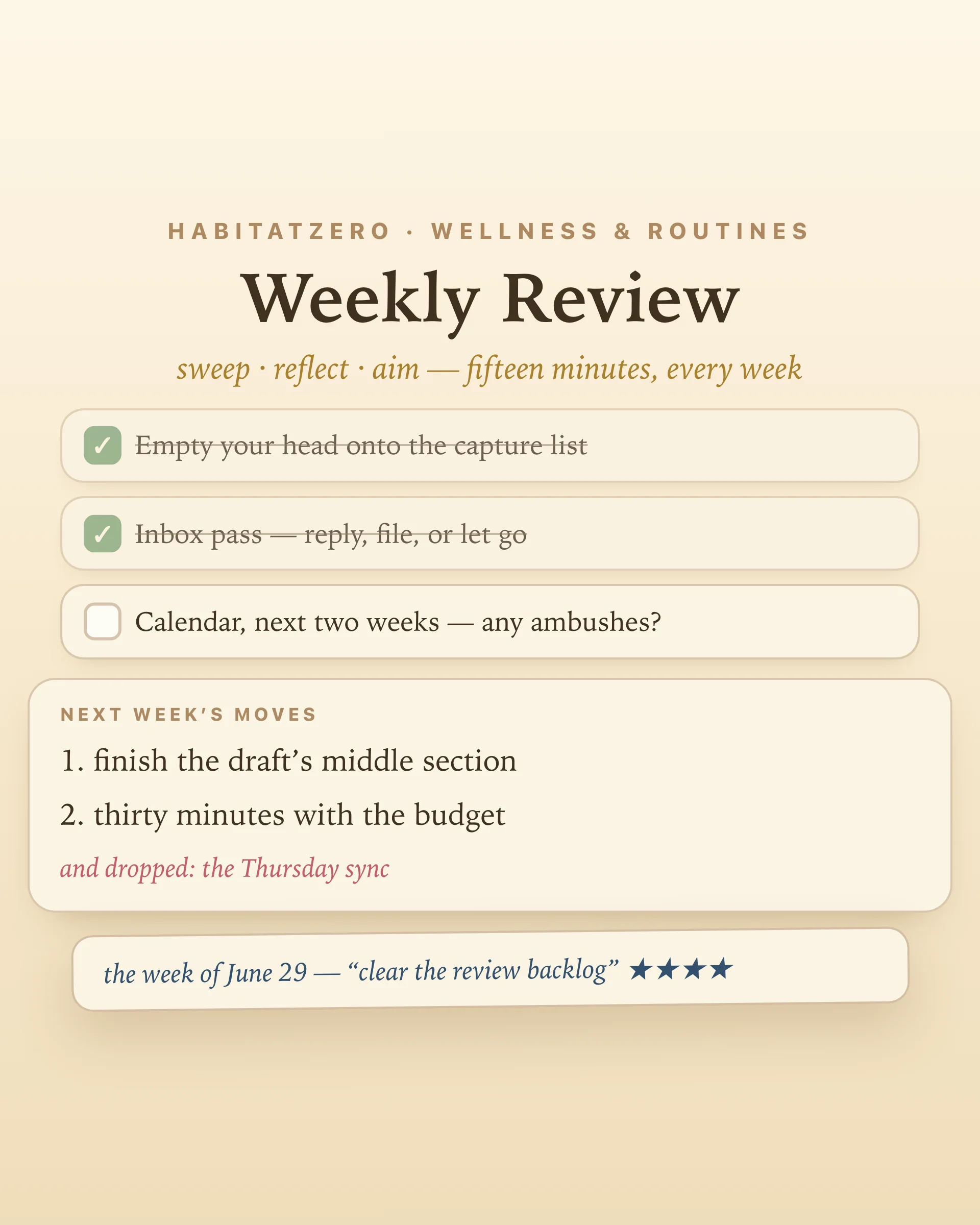
Sweep. First, get clear. Work the checklist: empty your head onto the capture list — every unsent reply, unmade call, and half-remembered promise goes on paper. Pass through the inbox. Glance back a week on the calendar for anything still owed, and ahead two weeks for anything about to ambush you. This isn't busywork; it's the price of an honest reflection. There's a well-studied reason the head-emptying step feels so good: unfinished tasks nag at the mind until a plan for them exists somewhere — writing them down with intent quiets the loop, before anything is actually done.
Reflect. Then three honest questions. What moved forward this week? Name the real progress, however small — monitoring progress is itself one of the most reliable levers for reaching goals, which makes the noticing a productive act, not a sentimental one. What stalled — and why? The why is the harvest: stalled-because-waiting is different from stalled-because-avoiding. What did the week teach you? Research on reflection found that workers who spent even a few minutes deliberately thinking about what they'd learned outperformed those who spent the same time just working more. Rate the week one to five while you're there. No week is a five. The trend is the point.
Aim. Finally, the week ahead — as decisions, not a schedule. Three moves, maximum: the things that would make next Friday's review a good one. And one thing to drop or hand off, because a review that only ever adds is a treadmill. Download the moves card if you want it staring at you from a wall.
When the new week begins, the review archives itself — week, rating, and your first move as its headline — and the history strip becomes a running story of how the weeks are actually going.
A weekly review that turns into calendar Tetris stops being a review. The reflection decides what matters; other tools decide when. Give recurring habits their row on the weekly habit tracker, and if a move needs edges and a date, shape it in the SMART goals worksheet. Daily closing lives in Tend Your Day — the weekly review is its zoom-out, and the monthly reset is the zoom-out of this. Three altitudes, one habit family.
Fifteen minutes, same slot every week — Friday afternoon while the week is still warm, or Sunday evening before the new one asks anything of you. Forty short reviews a year beat four thorough ones, and this one is built short on purpose.
A standing appointment with your own week: sweep up every loose end, look honestly at what moved and what stalled, and choose what the next week is for. It is the maintenance habit that keeps every other system trustworthy — lists stay current, commitments stay visible, and Monday starts with a decision instead of a scramble.
Three parts, in order. A sweep: capture everything nagging at you and pass through inboxes, calendar, and lists so nothing lives only in your head. A reflection: what moved, what stalled, what the week taught. And an aim: a small number of moves for next week — three is plenty — plus one thing to deliberately drop. This template walks all three with an archive that keeps the trend.
In Getting Things Done, David Allen calls the weekly review the critical success factor of the whole method — a recurring pass he summarizes as get clear, get current, get creative. This template maps that arc: the sweep checklist gets you clear, the reflection questions get you current, and the three-moves section is where get creative becomes something concrete enough to survive Monday.
Canonical GTD reviews run an hour or more, which is exactly why most people stop doing them. This one is built for about fifteen minutes: six sweep checks, three reflection prompts, three moves. A short review done forty times a year beats a thorough one done four times — and research on reflection suggests even brief, deliberate looking-back measurably improves later performance.
Yes — free, in your browser, no signup. Answers save as you type, each review archives itself when the new week begins, and the three-moves card downloads as an image. In the Fabulous app your review history syncs across devices.
By the team behind Fabulous, the science-based self-care app used by over 30 million people.