The Overwhelm Recovery ProtocolWellness & Routines · ~5 min
About this template · Updated July 2026
Here is the quiet problem with most goals: they're written so they can't fail. "Get in shape" has no finish line, so missing it never stings — and never teaches. "Read more" is unfalsifiable. "Save money" is a mood. These aren't goals; they're wishes wearing a goal's clothes, and your calendar treats them accordingly.
The SMART checklist is forty years old and still the fastest way to give a wish edges. This worksheet is the checklist with the checking built in: it reads what you type and pushes back — flagging the fuzzy words, demanding the number, refusing the deadline that isn't a date.
Write it rough. The first box wants the goal exactly as it lives in your head. "Get in shape" is perfect raw material — the sharpening is the worksheet's job, not yours.
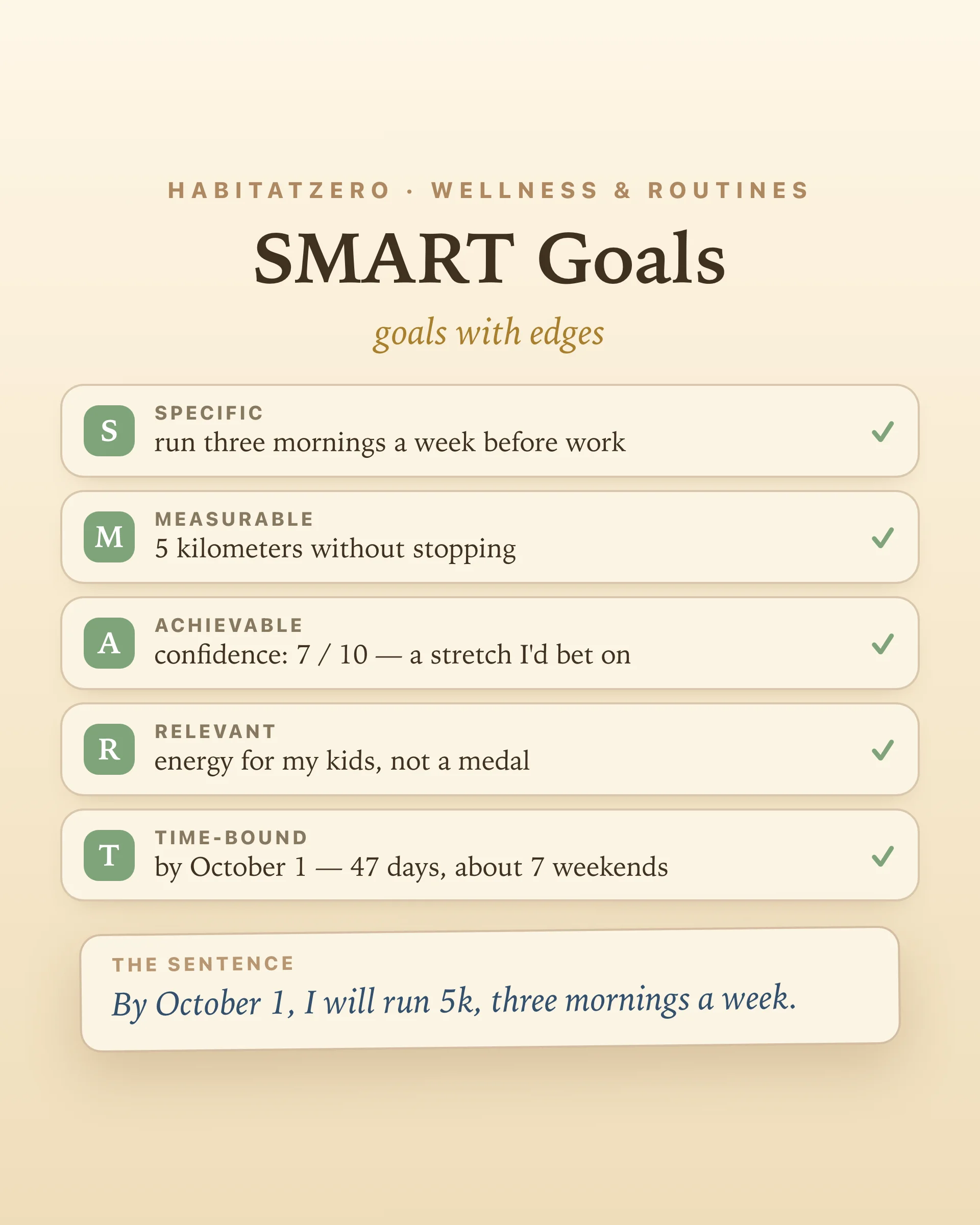
Pass the five checks. One letter at a time, each with a live check that either lights up or tells you why not:
Keep the sentence. As the checks light up, your goal assembles itself into one line at the top: By [date], I will [the specific thing], measured by [the number], because [the reason]. Five green checks and it's done — download the card, or send it straight into a self-contract.
The acronym was coined by George Doran in a 1981 Management Review paper, but the reason it survived four decades of management fads is that the research kept agreeing with it. Locke and Latham's goal-setting theory — built on hundreds of studies — found the same two ingredients over and over: specific goals beat vague ones, and difficulty helps up to the edge of ability. "Do your best" turns out to be one of the weakest instructions you can give anyone, including yourself.
The deadline and the number matter for a second reason: they make progress visible. A large meta-analysis on progress monitoring found that simply tracking movement toward a goal — which is only possible when the goal is countable — reliably increases the odds of reaching it. The M and the T aren't bureaucracy. They're the sensors.
Every January proves it: five sharp goals collapse into the fuzzy pile they came from, because they all bid on the same Tuesday evenings. Set one goal per season — three at the absolute most — and let the Relevant check be ruthless about the rest. A goal that doesn't survive "why this, why now" wasn't a goal. It was an obligation with ambitions.
A SMART goal is a specification; it still needs a delivery system. If yours is a repetition goal — the three-mornings-a-week kind — give it a visible streak on the 30-Day Habit Tracker. If it's the kind you might quietly abandon in week three, make it binding with My Promise to Myself — a goal with a signature is harder to unsee. And if you're not sure which goal deserves the slot, spin the Wheel of Life first and read your lowest spoke.
One sentence, one number, one date. That's a goal. Everything else is weather.
Specific, Measurable, Achievable, Relevant, and Time-bound. The acronym was introduced by George Doran in 1981 as a checklist for writing management objectives, and it stuck because each letter fixes a specific way goals quietly fail: vagueness, uncountability, fantasy, pointlessness, and someday-ness.
Start rough, then sharpen letter by letter. Take 'get in shape' — Specific: run three mornings a week. Measurable: 5 kilometers without stopping. Achievable: you can run 2k today, so 5k is a stretch, not a fantasy. Relevant: you want energy for your kids, not a medal. Time-bound: by October 1st. The finished sentence is one line with a number and a date — this worksheet assembles it as you pass each check.
By March 31, I will save 900 dollars by moving 75 dollars to savings on the 1st and 15th of each month, so the summer trip goes on the calendar and not on the credit card. Note what makes it SMART: a number, a mechanism, a date, and a reason — not effort words like try, more, or better.
Decades of goal-setting research, led by Locke and Latham, found that specific, appropriately difficult goals reliably outperform vague do-your-best intentions. A vague goal can't fail — there's no line to miss — which is exactly why it can't succeed either. Specificity plus a deadline creates the feedback loop: you always know whether you're on track, and knowing is what changes behavior.
One to three. Every goal you add competes for the same weekly hours, and five sharp goals collapse back into the fuzzy pile you started with. If you're tempted to set six, the Relevant check is your friend: the goals that survive a hard 'why does this matter right now' are the ones worth a number and a date.
This one is free, runs in your browser, and needs no signup. When your goal passes all five checks you can download it as an image — that's your printable. The interactive version's advantage over a blank PDF is the checking itself: a paper worksheet accepts 'exercise more' without complaint; this one doesn't.
By the team behind Fabulous, the science-based self-care app used by over 30 million people.