The Overwhelm Recovery ProtocolWellness & Routines · ~5 min
About this template · Updated July 2026
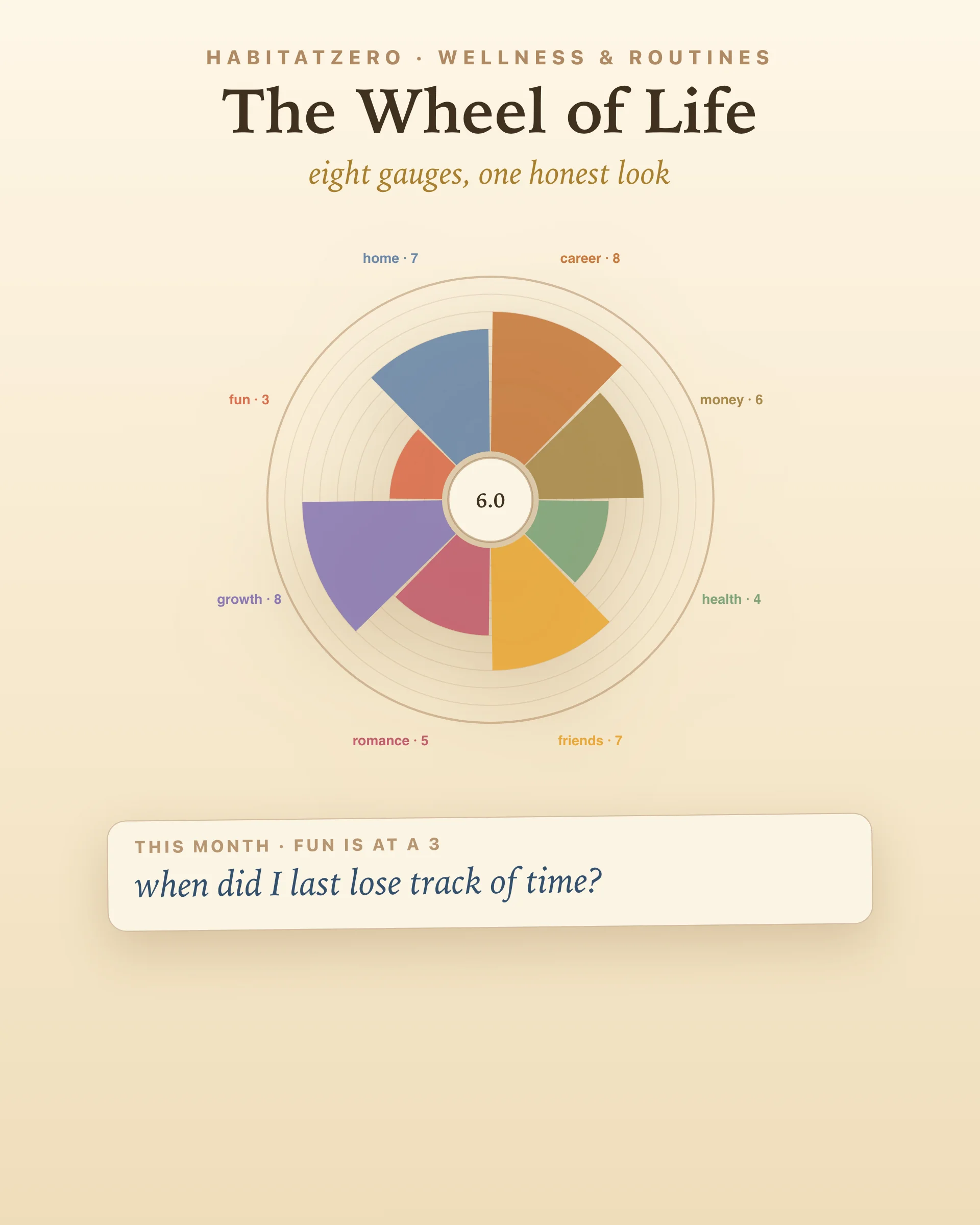
Most of us run our lives off two gauges. Work and one other thing — the kids, the training plan, the renovation — get checked daily, while the other six areas of life hum along unexamined until one of them seizes. You can be genuinely winning at work and not notice that fun has been at a 2 since March.
The wheel of life is the coaching world's answer to that blind spot: one honest look at all eight gauges at once. It's been photocopied onto a million workshop handouts. This is the version where the wheel actually turns.
Eight segments, the classic set: career, money, health, friends & family, romance, personal growth, fun & recreation, physical environment. Tap inside each segment to set your satisfaction from 1 to 10 — tap near the center for low, near the rim for high. First instinct beats deliberation; this is a snapshot, not an audit.
The wheel takes shape as you go. Full segments reach the rim; neglected ones barely leave the hub. By the eighth tap you're looking at something no spreadsheet of scores can show you: the shape of your life right now — and whether a wheel that shape could roll.
Then the part the photocopies can't do: your two lowest areas each get a reflection prompt written for that area — not "reflect on your results" but "what's the smallest habit your body has been asking for?" Answer in a sentence. Download your wheel, and check the shape again next month; this page keeps your past wheels so the comparison is waiting.
The single most useful instruction: ignore the average. A 6.2 tells you nothing. The shape tells you three things:
The dips. Any spoke at 3 or below is usually taxing the others — a health dip makes the career score expensive to maintain; a money dip leaks worry into everything. The lowest spoke is rarely where you're weakest; it's where attention went unpaid longest.
The gaps. A 9 sitting next to a 3 often means one area is funding the other. That trade can be worth it for a season. The wheel just asks: did you choose the trade, or did it happen to you?
The tens trap. Don't chase a perfect circle at 10. A wheel of steady sevens rolls; a wheel with one heroic ten and a flat tire doesn't. "What would a 6 look like?" is almost always a better question than "how do I get to 10?"
The wheel is credited to Paul J. Meyer, who founded the Success Motivation Institute in 1960 and wanted clients to stop optimizing one life area while the rest rusted. Sixty years on, it's one of the most widely used tools in coaching — partly because it takes five minutes, and partly because the psychology holds up: satisfaction ratings across distinct life domains, reviewed regularly, are exactly the kind of structured self-assessment that supports lasting behavior change rather than resolution-style bursts.
The wheel doesn't fix anything. It's a gauge cluster. But you can't steer toward what you haven't looked at.
The classic paper version works fine — eight spokes, pencil, honesty. This interactive one gives you the same template with the friction removed: the wheel draws itself, your scores are saved, the downloadable image is your printable, and next month's wheel lands next to this one so you can see the shape change. If you're a coach, the download makes a clean client handout.
The wheel's job ends with the honest look; the follow-through belongs to smaller tools. If your lowest area needs a daily rhythm, put it in the 30-Day Habit Tracker and make it visible. If it needs a decision you keep deferring, write it as a promise in My Promise to Myself. And if one segment came with a feeling you couldn't quite name while rating it, take that to The Feelings Wheel first.
One look, eight gauges, one small move. That's the whole practice.
The classic set is career, money, health, friends and family, romance, personal growth, fun and recreation, and physical environment. Some coaches swap categories — spirituality, community, parenting — and that's fine: the tool works as long as the areas cover your whole life and matter to you. This assessment uses the standard eight.
You rate your satisfaction in each life area from 1 to 10, and the ratings are drawn as spokes of a wheel — full spokes for high scores, short ones for low. The result is a shape you can read at a glance: a round, full wheel rolls smoothly, while a spiky one shows exactly where life is grinding. In this interactive version the wheel draws itself as you tap, and your lowest areas get targeted reflection prompts.
Ignore the average — read the shape. Deep dips are the areas quietly draining the rest; big gaps between neighboring areas often mean one is funding the other, like a career spoke at 9 propping up a health spoke at 3. And don't chase tens: a wheel of steady sevens rolls better than one heroic ten next to a four.
The life-assessment wheel is credited to Paul J. Meyer, who founded the Success Motivation Institute in 1960 and used the wheel to help people see all their life areas at once instead of optimizing one. It has since become one of the most widely used tools in coaching.
Monthly or quarterly is the sweet spot — often enough to catch a slipping area early, rare enough that the scores reflect real change rather than mood. This tool keeps your past wheels so you can compare shapes over time; the trend matters more than any single snapshot.
Yes — it's free, runs in your browser, and needs no signup or email. When you finish, you can download your wheel as an image to print or keep. If you'd like your wheels saved and compared automatically over time, the Fabulous app keeps your history.
Same exercise, different name. The happiness wheel — sometimes the coaching wheel or life balance wheel — is the wheel of life: rate the big areas of your life on a circle, look at the shape, and let the dents tell you where attention should go next. Coaches renamed it over the years, but the mechanics and the point are identical, and this interactive version scores, draws, and remembers the wheel for you.
That is essentially what the wheel is - a structured audit of the areas of your life, each rated honestly and drawn where you can see the shape. The audit ends the way any good one does: not with a grade, but with the one or two areas whose numbers surprised you enough to act on.
By the team behind Fabulous, the science-based self-care app used by over 30 million people.