
The Overwhelm Recovery ProtocolWellness & Routines · ~5 min
About this template · Updated November 2026
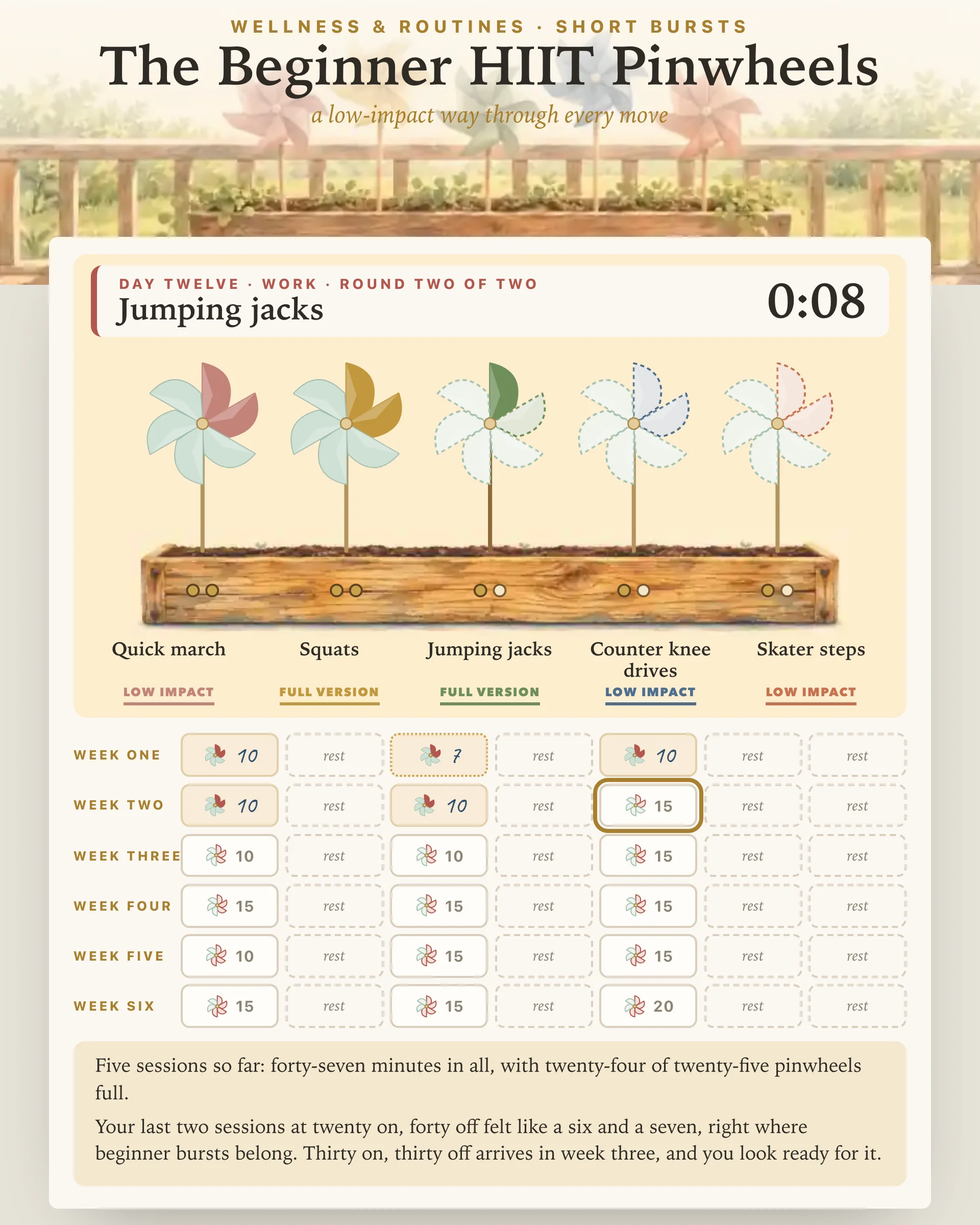
High-intensity interval training has a reputation for sprints and burpees, but the idea underneath suits a first week. You push for a short spell, harder than a walk, then rest for longer than you pushed, and repeat. Beginner HIIT keeps that shape and shrinks everything else: twenty seconds of effort, forty of rest, ten minutes from the first march to the last slow breath.
This page lays out six weeks of it, three sessions a week, with a no-jump version of every move.
Each session opens with three minutes of easy marching and arm swings. Then come five moves, one minute each: high knees, squats, jumping jacks, mountain climbers with your hands on a kitchen counter, and skaters. Ten minutes goes through the five moves once, fifteen twice, twenty three times, and two minutes of slow marching close it out.
The split is what grows: twenty seconds on and forty off in weeks one and two, thirty and thirty in weeks three and four, forty on and twenty off in weeks five and six, with the first sessions of each new split kept short. Sessions fall on days one, three and five, so a rest day always follows a hard one.
Each move is a paper pinwheel in a window box, with six vanes of ten seconds each. The deep vanes are the work in that minute and the pale ones are the rest, so in week one you see two deep vanes and four pale ones, and by week five the deep vanes outnumber the pale.
Press start and, after the warm-up, the first pinwheel fills one vane every ten seconds and spins while you work. When its sixth vane fills, the next move takes over, and a brass tack on the box marks each round a move has finished. The timer reads the clock, so a phone that locks does not slow your session, and a pause holds everything where it was.
If you stop early, the page keeps only what was done: whole minutes, and only the pinwheels whose six vanes all filled. Under a minute logs nothing.
Tap a move's name under its pinwheel to switch between its low-impact and full versions. The low-impact ones keep a foot on the floor: a quick march instead of high knees, chair squats, step jacks, counter knee drives and skater steps. The effort comes from pace and range rather than landings, which spares your knees and feet.
You can mix them: keep step jacks for good, say, and move squats to their full version in week two. Both versions fill the pinwheel the same way. To build a no-jumping habit before intervals, The Low-Impact Stepping Stones is a gentler start.
After every session you tap a number from one to ten for how hard the bursts felt. One is barely moving and ten is all you have. For beginners, about seven is the target: you can say a few words in a burst but not a sentence, and your breathing settles during the rest.
Rating a whole session afterward is an established training tool: Foster and colleagues found that such ratings tracked closely with a heart-rate method, for steady work and for intervals alike. The reading uses your last two ratings at the current split. A nine or ten means stay there, or switch one more move to low impact, before the plan moves you up. A four or below means quicker feet or a full version before you add seconds. Anything between means you are ready when the plan is.
In a meta-analysis of ten trials with people living with heart and metabolic conditions, interval training raised aerobic fitness almost twice as much as steady moderate exercise, a difference of about nine percent. The trials were small, two hundred seventy-three patients in all.
A large trial in older adults, Norway's Generation 100 study, asked about fifteen hundred people in their early seventies to do interval sessions twice a week at around ninety percent of their peak heart rate, or steady sessions, or follow national activity advice, for five years. Deaths did not differ between the exercise groups combined and the advice group. The interval group showed a trend toward fewer deaths that the trial could not confirm.
So intervals are a sound way to fit real effort into a short session. They are not a fat-burning trick, and nothing here promises extra calories after you stop.
Use this page when you have ten to twenty minutes and a clear patch of floor near a counter. If you only need a clock for your own intervals, The HIIT Timer does just that. If a fixed circuit of twelve moves appeals more, try The 7-Minute Workout.
Talk to your doctor before starting if you have a heart or blood pressure condition, have had a fall, dizziness or a joint replacement, or live with pain. Stop if you feel chest discomfort, faintness or sharp pain, and drop to the low-impact version whenever a move asks more than your body offers today.
A short warm-up, then a handful of simple moves done in bursts with longer rests between them, then an easy cool-down. Here that means three minutes of marching, five moves at twenty seconds of effort and forty of rest, and two minutes to slow down, ten minutes in all, three days a week with a rest day after each.
It is interval training where one foot stays on the floor. Step jacks replace jumping jacks, a quick march replaces high knees and skater steps replace the hop, so your joints skip the landings while your heart and lungs still work hard. The effort comes from speed, range and a steady push, not from leaving the ground.
Yes. Intensity is about how hard the bursts feel, not about jumping. If a quick march or chair squats bring you to about seven out of ten, where you can only say a few words at a time, the interval is doing its job. Research trials set their bursts by heart rate rather than by footwork: a large Norwegian trial of people in their seventies aimed for about ninety percent of peak heart rate.
Two or three sessions a week is plenty to begin with, with at least one easier day between them. Hard bursts tire the body in a way a walk does not, and the recovery days are when it adapts. The six weeks on this page keep three sessions a week and leave the other days for rest or gentle movement.
When the bursts at twenty seconds feel like a six or a seven out of ten and you recover in the rest. The plan steps up in week three and again in week five, but if a session at the new split feels like a nine or ten, go back a step for a session or two. Feeling ready matters more than the calendar.
By the team behind Fabulous, the science-based self-care app used by over 30 million people.


