
The Overwhelm Recovery ProtocolWellness & Routines · ~5 min
About this template · Updated November 2026
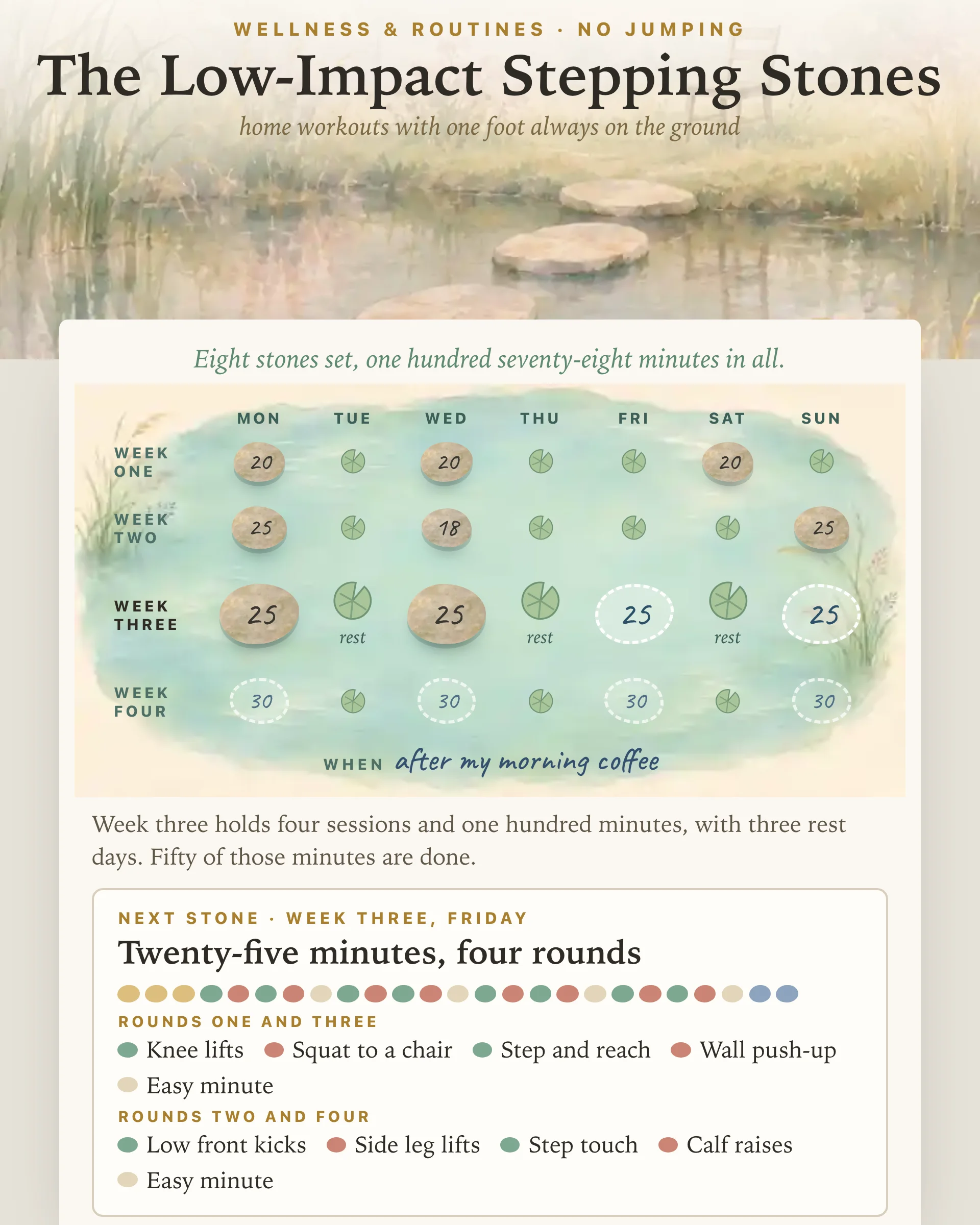
A low impact workout is one where at least one foot stays on the floor the whole time. Nothing leaves the ground and you never land with your full weight, which also keeps things quiet for the neighbors downstairs. It is still real exercise: brisk marching lifts your heart rate, and a chair and a wall are enough to build strength. This page turns that into a four-week low impact workout plan for home, with every session laid out on a pond as a stepping stone.
In a study that measured landing forces on a force platform, peak vertical force rose from a little over body weight in walking to about two and a half times body weight at fast running speeds, and slow jogging produced more than half again the force of walking. Moves with a flight phase, where both feet leave the floor, add a landing to every repetition. Marching, step touches and knee lifts keep a foot down, so they stay close to walking. The effort comes from your muscles and your pace, not from coming back down.
Week one has three twenty-minute sessions. Week two keeps three and stretches each to twenty-five minutes. Week three adds a fourth session, and week four runs four sessions of thirty minutes. Altogether that is fourteen sessions and three hundred fifty-five minutes, with at least three rest days in every week.
Every session has the same shape:
The cardio moves are march in place, step touch, knee lifts, step and reach, low front kicks and heel digs. The strength moves are squat to a chair, wall push-up, calf raises and side leg lifts. Any move that has you on one leg comes with the chair: rest a hand on its back for knee lifts, kicks, calf raises and leg lifts.
That makes it a low impact full body workout: legs and hips work in the squats and lifts, chest and arms press against the wall, the bridge works the back of your body, and the marching keeps your breathing up.
The pond holds four rows, one for each week. A painted stone is a session you have done, a dashed outline is one still planned, and a lily pad is a rest day. Tap a planned stone to pick it up, then tap a rest day to set it down there, so the plan fits the week you actually have. Sessions on neighboring days get a gentle note, since strength moves usually rest a day in between.
Under the pond, the next session lists every move with a one-line description. Press start and a silent timer walks you through it a minute at a time. You can pause, skip a move or stop, and the page keeps only the minutes you really did, or you can mark a session done your own way. Each stone takes the size of its minutes, so the rows fill out as the weeks lengthen.
The World Health Organization's 2020 guidelines ask adults for 150 to 300 minutes of moderate activity a week, along with regular muscle strengthening, and they say outright that some activity beats none. This plan starts at sixty minutes a week and finishes at one hundred twenty, so it climbs toward that range instead of opening there. A walk on a rest day counts toward it too.
Plenty of people go looking for low-impact exercise because their knees complain. The 2024 Cochrane review of exercise for knee osteoarthritis pooled 139 trials and found that exercise probably eases pain and improves function a little, measured soon after a program ends. It found no kind of exercise clearly ahead of the others, and it could not say the gains were large enough to matter to everyone. That review covers one condition and makes no promise about your knees. If you have a diagnosis, a physical therapist can tell you which of these moves to keep and which to change.
This is not a weight-loss plan. Before you start, talk with your doctor or a physical therapist if you have had a fall, dizziness, a joint replacement, a heart or blood pressure condition, or pain that keeps coming back, and stop any move that hurts.
Reach for it when jumping is off the table: a shared floor, a sore knee or a long break from exercise. Tie the sessions to something you already do, like your morning coffee, and set the stones on days you can really keep. If one move deserves more attention, The Wall Push-Up Ladder spends four weeks on that single press. Rest days suit The Walking Workout Ribbon, and if twenty minutes on your feet is too much right now, The Chair Circuit keeps everything seated.
It is exercise where one foot stays on the floor at all times, so nothing involves jumping or a hard landing. Brisk marching, step touches and knee lifts raise your heart rate, while chair squats and wall push-ups build strength.
Begin with three short sessions a week and let them grow. This plan opens with three twenty-minute sessions, stretches them to twenty-five in week two, adds a fourth in week three and reaches four sessions of thirty minutes in week four, keeping rest days in every week.
A mix of cardio and strength that reaches each major area: squats and side leg lifts for legs and hips, wall push-ups for chest and arms, glute bridges for the back of the body, and marching or step touches in between to keep your breathing up.
Yes. Moderate effort is the pace where you can talk but could not sing, and brisk marching with your arms pumping gets most people there. The strength part comes from slow, controlled squats and push-ups rather than from impact.
Yes. What you see here is a sample plan halfway across the pond. Personalizing your own copy costs nothing, and it remembers every stone you set along with the session that comes next.
By the team behind Fabulous, the science-based self-care app used by over 30 million people.


