
The Overwhelm Recovery ProtocolWellness & Routines · ~5 min
About this template · Updated November 2026
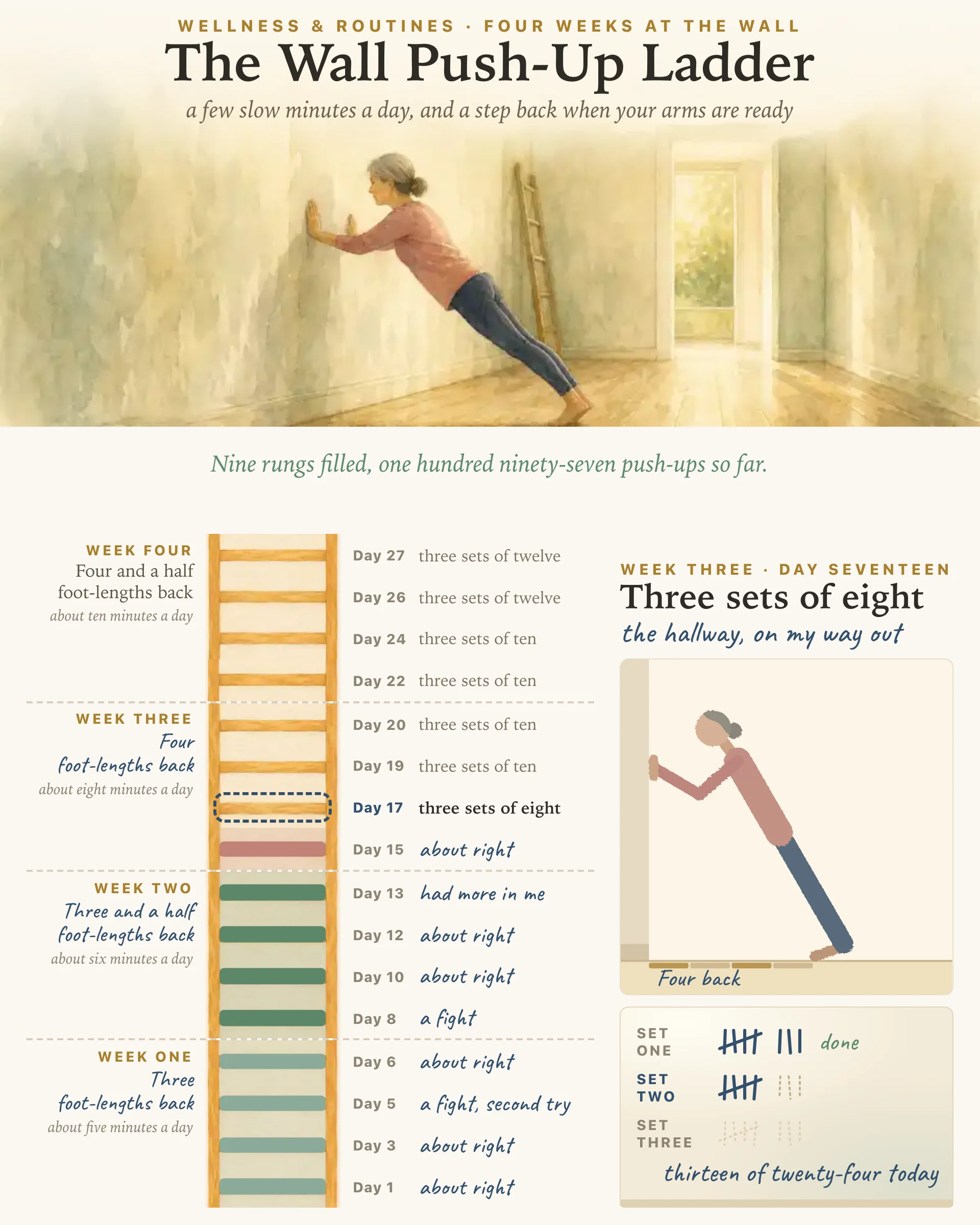
A wall push-up is a push-up you do standing up. You put your palms on a wall at chest height, walk your feet back, keep your body in one straight line from heels to head, then bend your elbows until your face nears the wall and press away again. Most guides stop there and never say what to do on day two, or day twenty. This page turns wall push ups into four weeks with a plan: four push days a week, a rep target for each one, and a distance from the wall that grows when your arms are ready.
How much of your weight your arms push depends on how high your hands are. In a force-plate study of recreationally fit men and women, push-ups with the hands raised on a box produced lower peak forces than regular push-ups, and so did push-ups from the knees. A wall takes that idea as far as it goes: your hands sit higher than any box, so your arms carry a small share of you while you learn the shape.
The plan runs that in reverse: the further your toes stand from the wall, the lower your body leans and the more weight passes through your hands. Stepping back half a foot-length makes the same move harder without adding a rep. We found no study of these exact distances, so treat the marks as a sensible ladder rather than a proven dose.
Measure the distance with your own feet, heel to toe. Week one starts at three foot-lengths with two sets of eight. Each week has four push days and three rest days, and the targets climb inside each week.
Tap the painted wall on the sheet once for each push-up and a pencil tally grows. Or press count me through it and the page calls a slow count, four seconds down and one up, adding a rep each time round.
When the day's target is met, that day's rung on the ladder fills in the color of your distance, and the page asks how the last set felt: you had more in you, it was about right, or the last few were a fight.
If you need to stop early, say why. Tired arms keep the rung open with the same numbers for next time. Something that hurt also asks you to leave the next push day until it settles, and suggests a doctor or physical therapist if the pain stays or returns.
When a week's four push days are full, the page reads them. A week that ended about right, or with something left over, suggests moving your toes half a foot-length further out. A week that ended in a fight, held more than one hard day, needed more than one stop, or brought any pain suggests staying where you are while next week's numbers do the climbing. You choose either way, and the figure on the sheet walks to the new mark.
The furthest mark is four and a half foot-lengths. Once three sets of twelve feel comfortable there, the next rung is a sturdy kitchen counter, and after that The 30-Day Push-Up Challenge, which starts with a test at the counter, your knees or your toes.
The American College of Sports Medicine's 2026 position stand pooled 137 systematic reviews and found that, compared with no exercise, resistance training improved strength, muscle size and physical function. Strength rose more with two or three sets and with two or more sessions a week, while training to the point of failure made no consistent difference. That is why this plan uses two, then three sets, four days a week, and slows down when you report a fight.
Wall push-ups also turn up in small home programs. In one, ten sedentary adults with an average age of 54 kept up a five-minute daily routine of chair squats, wall push-ups and two other moves, lowering slowly and moving to harder versions over eight weeks. They kept it up on most days, and their push-up scores kept improving into the second month. Ten people and no comparison group show the routine is doable; they do not show it works better than anything else.
Push-ups train your chest, shoulders and the backs of your arms. U.S. guidance asks adults for muscle-strengthening activity on two or more days a week that works all the major muscle groups, so pair this ladder with something for your legs, such as The 30-Day Squat Challenge.
If you have had a fall, dizzy spells, a replaced hip, knee or shoulder, a heart or blood pressure condition, or pain in your shoulders, elbows or wrists, talk with your doctor or a physical therapist before day one. Stop any set that hurts. Wear shoes that grip or go barefoot rather than socks, so your feet cannot slide. Chest pain, unusual breathlessness or feeling faint mean stop at once and get medical help.
Pick a wall you pass every day and tie it to something that already happens there, like the coffee brewing. Fill the rung right after your last set. On rest days, The Daily Stretch Mat gives your shoulders and wrists some gentle attention.
The Whole-House Strength Routine uses a wall push-up as one of eight stops around the home, and The Resistance Band Rack adds pulling moves to balance all that pushing.
They can, for a while. They load your chest, shoulders and the backs of your arms with a fraction of your body weight, which is real work when you are new to strength training or coming back after time off. As they get easy, the load has to grow, which is why this plan moves your feet back each week you are ready and later points you to a kitchen counter.
This plan starts with two sets of eight and ends at three sets of twelve, on four days a week with a rest day in between most of them. Stop each set with a rep or two still in you. Pushing every set until your arms give out is not needed, and daily sessions leave little time to recover.
Usually a set number of days with a rep count that climbs on a fixed schedule. This version keeps the climb but lets your answers steer it: a week that ended with hard reps or a stop keeps you at the same distance, and a week that felt comfortable suggests a half step back.
Start with your toes three of your own foot-lengths from the wall, measured heel to toe. Closer is easier and further out is harder, because your body leans lower and your hands take more of your weight. Shoes that grip or bare feet keep you from sliding.
Once three sets of twelve feel comfortable at four and a half foot-lengths, move your hands down to a sturdy kitchen counter and keep the same slow count. From there the 30-day push-up page tests you at the counter, on your knees or on your toes and builds a month from that.
By the team behind Fabulous, the science-based self-care app used by over 30 million people.


