
The Overwhelm Recovery ProtocolWellness & Routines · ~5 min
About this template · Updated September 2026
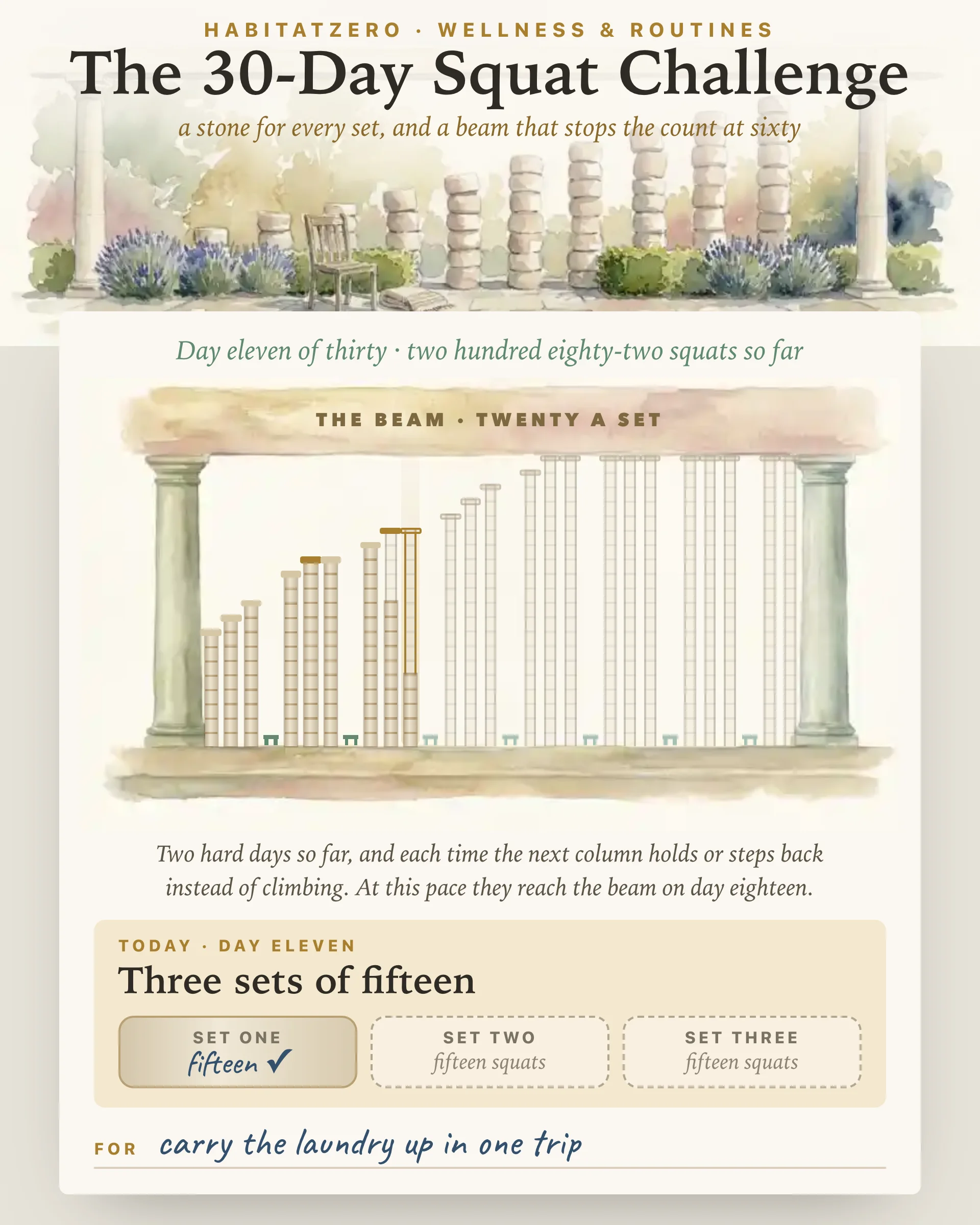
The squat chart you have probably seen starts at fifty squats on day one and climbs to two hundred and fifty by day thirty. Its second half mostly measures how long you can keep bobbing up and down. This page keeps what works about that chart, a daily rhythm and a clear finish, and changes the rest: your month starts from where your legs are now, it bends after a hard day, and it has a ceiling.
The worksheet draws your thirty days as a row of stone columns under a painted beam. Every set you finish lays a stone, every squat day raises a column, and every rest day leaves an open bay with a bench in it. Days you have not reached yet stand in pale outline, so you can see the whole month from the first morning.
Choose a starting point first. From a chair means sitting down to a chair and standing back up, arms crossed, five times a set; a few in a row starts at eight, and twenty with ease at twelve. Each day is three sets with about a minute between them, and every fourth day is a rest day.
After your last set, the page asks how much was left in your legs:
A line under the columns reads your log back in plain words and says which day you will reach the beam at this pace.
The rule behind "a couple left" comes from the American College of Sports Medicine's position stand on progression, which suggests moving up once you can do one or two repetitions more than the target. The same paper places sets of more than fifteen repetitions in the range it uses for muscular endurance. Three sets of twenty bodyweight squats already sits past that mark, and nothing in the guidance asks for hundreds a day.
So the beam holds the count at twenty a set. Once a column touches it, the page asks you to make each squat harder instead: three slow counts down, a short pause, then stand. A slower squat asks more of your legs without adding minutes.
ACSM's broader guidance for adults also notes that gradual increases in exercise intensity and volume may reduce the risks of exercise. One more squat per set after each good day is about as gradual as a daily plan gets.
That same ACSM guidance favors working each muscle group on two or three days a week, and a thirty-day challenge asks for more than that. This plan keeps the daily habit reasonable in three ways: a rest day after every three squat days, sets that end with a couple of good squats still in you, and a count that holds or backs off whenever a day was hard. When the month is over, drop to two or three squat days a week and keep them in sight on a Workout Calendar.
A month of steady squats can make standing up from a low seat, climbing stairs and getting up off the floor feel easier, especially if you started from a chair. It will not reshape your body on a schedule, and this page makes no promise that it will.
Sore thighs a day or two after a new exercise are common and usually fade on their own. Sharp pain in a knee or in your back is different. Stop, mark the day as it hurt, and if the pain returns, end the challenge and have it checked. If you have a joint condition, or a recent injury or surgery, talk with your clinician before day one.
Start on any Monday, or on the first of January if a new year is the nudge you want. Pick your starting point the evening before and keep a chair nearby. On rest days, a walk is a good use of the open bay, and the Walking Challenge gives those walks a route of their own. If squats are one of several habits you want to hold for a month, The 30-Day Challenge deals out thirty small tasks across the same stretch.
Start from where your legs are today rather than from a viral chart. This plan opens at three sets of five chair squats, three sets of eight, or three sets of twelve, and adds a squat to each set only after a day that went well.
Three sets of twenty bodyweight squats already sits in the high-repetition range that strength guidance files under muscular endurance. Once your columns reach that beam, the count holds and each squat gets slower and harder instead of more numerous.
Not quite every day. The plan rests after every three squat days, holds the count after a hard session, and turns the day after a painful one into rest. Guidance for strength work favors two or three sessions a week, so drop to that rhythm once day thirty is behind you.
Stop for the day and mark it as it hurt. Tomorrow becomes a rest day and the next column starts one squat lower. If the pain comes back, stop the challenge and see a clinician, and with a joint condition, ask before day one.
The page shows a month already underway so you can see how the columns behave. To choose your own start and lay your own stones, open it in HabitatZero at no cost.
By the team behind Fabulous, the science-based self-care app used by over 30 million people.


