
The Overwhelm Recovery ProtocolWellness & Routines · ~5 min
About this template · Updated September 2026
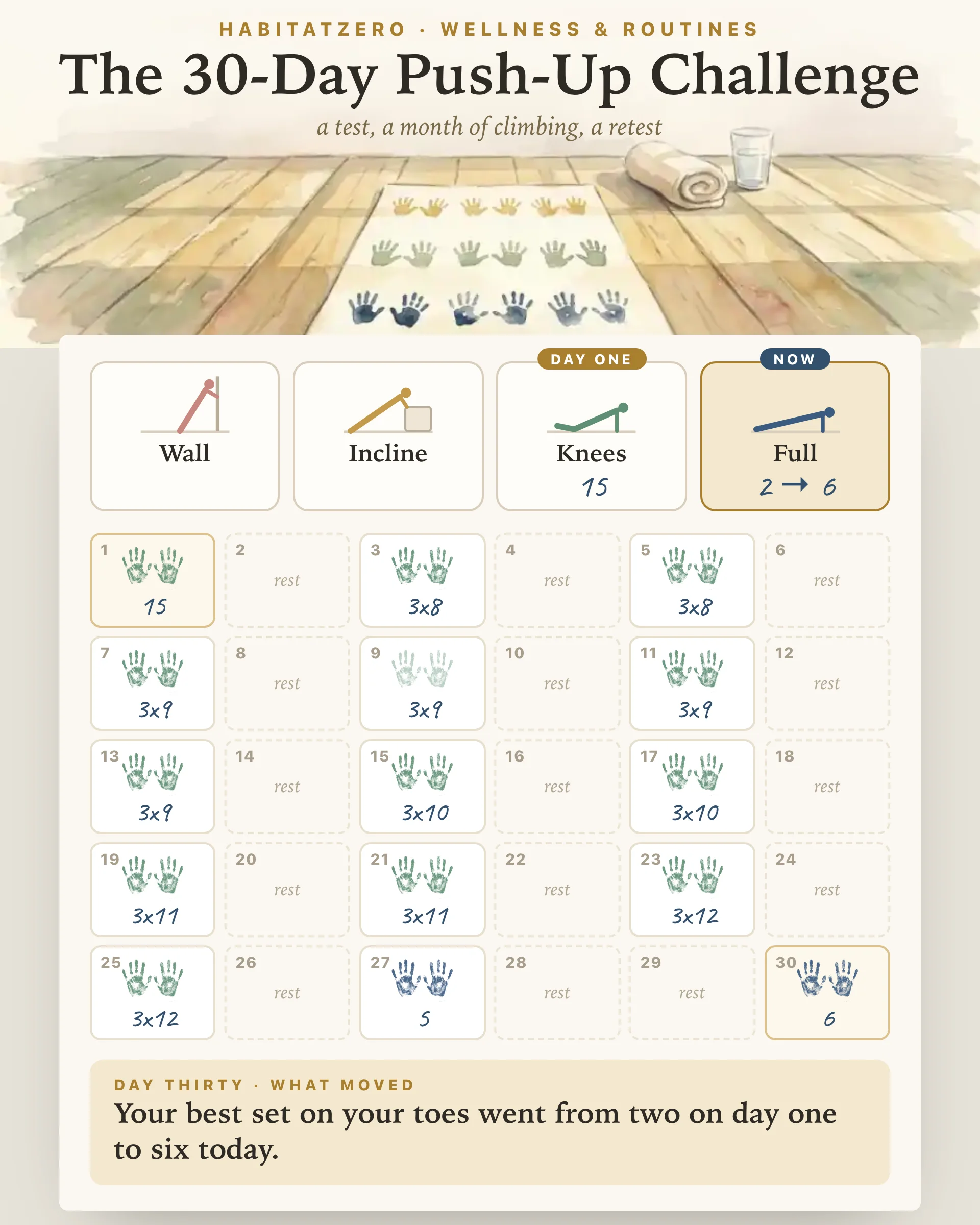
The push-up chart that makes the rounds every January starts you at five, adds a couple of reps each morning and ends at sixty. It never asks where you are starting, and it climbs whether or not yesterday went well. This version keeps the thirty days and changes three things: a test sets your level, the plan climbs only when you are ready, and a retest on day thirty shows what moved.
A push-up comes in four heights: hands on a wall, hands on an incline such as a kitchen counter, knees on the floor, or up on your toes. The higher your hands, the less of your weight your arms have to move. A force-plate study of push-up variations found that raising the hands or dropping to the knees lowered the load compared with a regular push-up, and its authors suggested those loads could be used to progress a program. The four levels here do exactly that.
Pick the level where about eight clean reps feel possible, do one set, and stop the moment your form breaks rather than when your arms give out. Past fifteen, that level is too easy to train on, so the page asks you to rest two minutes and test one harder; under five, one easier. You train at the hardest level where you managed five clean reps, starting at three sets of about half your best.
At an incline, note what your hands press on. A higher or lower surface changes the load, so the retest only counts on the same one.
After the test, the page fills in fifteen push-up days and fifteen rest days: a rest day after every push-up day, and two before the retest. Each push-up day is three sets with a minute or two between them. Then you log it one of three ways:
Twelve reps a set is the cap. After two clean days at twelve, the next push-up day becomes a step test: one easy warm-up set, then a single set at the next level. Five clean reps there and the plan moves you onto that level, starting at about half that count. Fewer, and you stay at twelve and try again after two more clean days.
The cap follows the American College of Sports Medicine's 2026 position stand on resistance training, which found larger strength gains with heavier loads, a full range of motion, two or three sets and two or more sessions a week, while training to failure made no consistent difference. With push-ups, a heavier load means a harder level, not a longer set, so the plan changes your level instead of piling on reps and asks you to end every set with a rep or two still in you.
Each push-up day you log leaves a pair of painted handprints in your level's color: rose at the wall, gold at the incline, sage on your knees, ink blue on your toes. Short days print faintly and a pain stop leaves none, so one glance shows the month and the day your level changed.
On day thirty, after two rest days, do one set at your current level, set up the way you tested. The page compares it with your first set at that level, from day one or a step test, and suggests where next month begins. A drop is one noisy reading: poor sleep, a hard week or a cold can drag a single set down, so retest after two more rest days before drawing conclusions.
Push-ups build strength when they keep getting harder. In a four-week trial, moderately trained men who practiced push-up variations of increasing difficulty three days a week raised their bench press strength, and so did a group that trained on the bench press itself. It was a small study of young men, so read it as a direction, not a promise.
Push-ups are also said to predict heart health. In a ten-year study of male firefighters, the men who could do more than forty push-ups had far fewer cardiovascular events than those who managed fewer than ten. That is an association in one group of active men. It suggests push-up capacity reflects overall fitness; it does not show that a month of push-ups protects your heart.
End the set if a wrist, elbow or shoulder hurts, and don't push through it. With a shoulder or wrist problem, a heart condition or high blood pressure, talk with your clinician before day one. Chest pain, dizziness or unusual breathlessness mean stop at once and get medical help.
It suits a January start, but any rested morning works. If you want something for the rest days, The 30-Day Squat Challenge works your legs instead of your arms, and The Daily Stretch Mat gives stiff wrists and shoulders some attention between push-up days.
It does when the numbers start from your own level and leave time to recover. In a four-week trial, moderately trained men who practiced harder and harder push-up variations three days a week gained bench press strength. Over one month, expect more clean reps and better control rather than a changed physique.
Many people can if they begin at the right height. Raising your hands on a wall or counter, or dropping to your knees, takes part of your weight off your arms, so this plan starts wherever you manage five clean reps and only moves you lower after a step test shows you are ready.
You would probably get better at long sets, but daily high volume leaves wrists, elbows and shoulders little time to recover, and strength research favors harder efforts over longer ones. This plan stops each set at twelve and moves you to a tougher level instead of stacking up reps.
For a strength challenge, every other day is the better rhythm. Resistance training guidance links strength gains to two or more sessions a week, and a rest day between push-up days gives the same muscles a break, which is why this month has fifteen push-up days and fifteen rest days.
The preview is a sample month that is already half done. Personalize it in HabitatZero to run your own test and log each push-up day. It costs nothing, and your prints are still there when you come back.
By the team behind Fabulous, the science-based self-care app used by over 30 million people.


