The Overwhelm Recovery ProtocolWellness & Routines · ~5 min
About this template · Updated September 2026
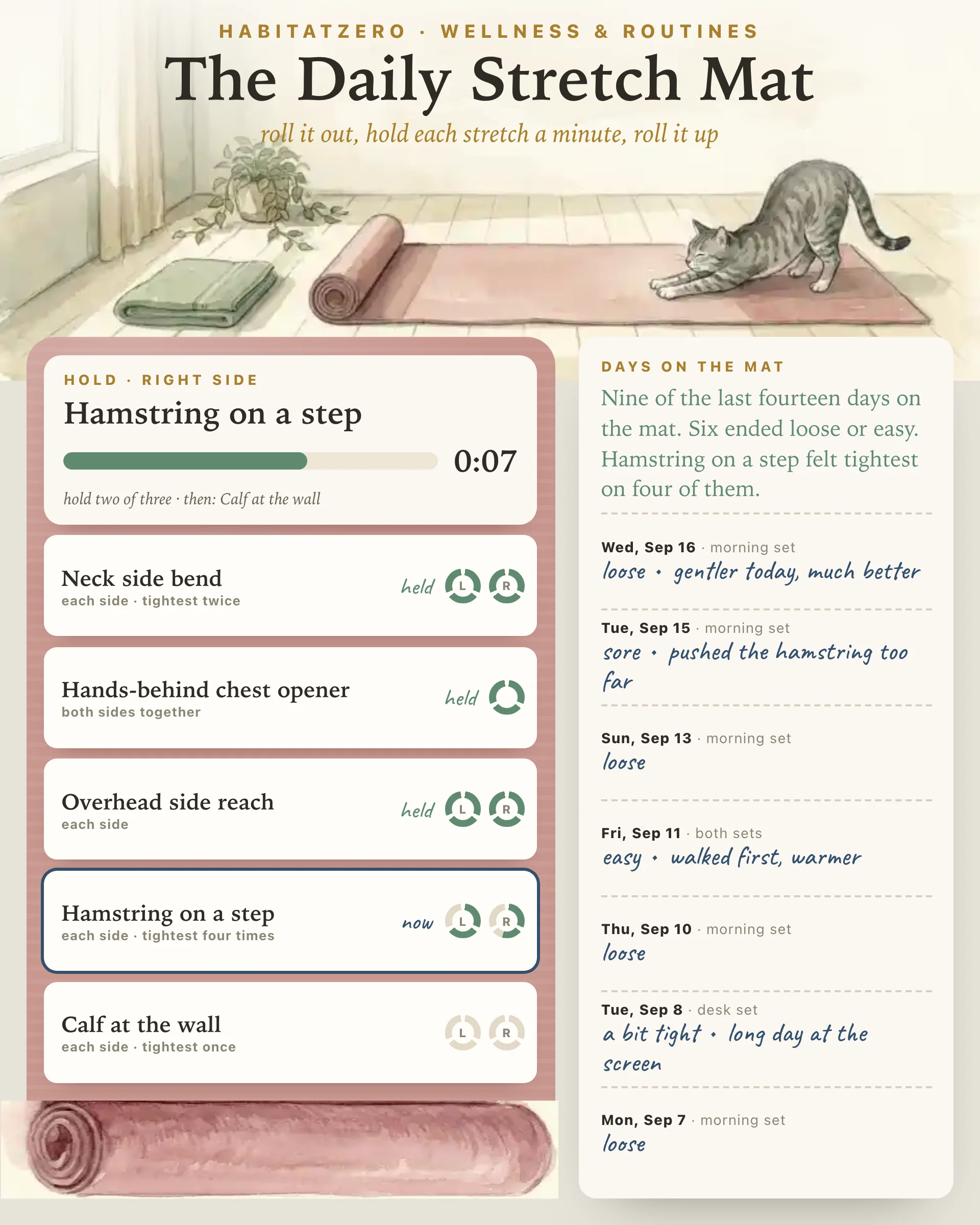
Most people who search for a daily stretching routine already know they should stretch. What they are missing is a routine short enough to keep and plain enough to follow half awake, or in the ten minutes between two meetings. This page is built for that: a mat with five stretches laid out on it, a timer that tells you when to hold and when to switch sides, and a log that remembers how your body felt afterward.
The clearest numbers come from the American College of Sports Medicine. Its position stand on exercise for healthy adults asks you to stretch each major muscle-tendon group for about sixty seconds in total per exercise, on at least two days a week. Harvard Health's summary of the same panel's advice turns that minute into simple arithmetic: hold for fifteen seconds and repeat three more times, or hold for twenty seconds and do two more.
The mat does that sum for you. Choose fifteen, twenty or thirty seconds per hold, and it sets four, three or two holds so each stretch still comes to a minute, with a full minute on each side for the one-sided ones. Pick the hold length you can keep still and relaxed through; the minute is what counts.
Two sets come ready. The morning set is all standing: a neck side bend, a hands-behind chest opener, an overhead side reach, a hamstring stretch with one heel on the bottom stair, and a calf stretch at the wall. The desk set works from a chair: the neck again, a chair-back chest opener, a seated twist, a wrist and forearm stretch, and a seated figure-four for the hips. Tap a stretch's name to read how to do it. Add others from the suggestions or write your own. Seven stretches fill the mat, and every routine keeps at least one.
Press roll out the mat and the timer takes over. You get ten seconds to get set, then each hold runs along a band that fills slowly, with five seconds between holds to switch sides or ease off. Every stretch carries small rings, one per side, cut into as many arcs as it has holds, and each arc fills while you hold it. You can pause, skip a stretch that pinches, or stop early. The mat makes no sound unless you switch the chime on; then a soft tone marks the start and the end of every hold, which helps when your eyes are on the floor instead of the screen.
When you finish, roll it up. Pick how your body feels, from sore through stiff, a bit tight and loose to easy, tap the stretch that felt tightest, and add a few words if you want to. The log then reads your days back to you: how many of the last fourteen you spent on the mat, how many ended loose or easy, and which stretch keeps coming up tightest. That count also shows on the stretch itself, so the spot that needs the gentlest attention is marked where you will see it tomorrow.
Regular stretching does let your joints move further. A 2024 meta-analysis of 77 studies found that stretch training increased range of motion by a moderate amount compared with not stretching, and static holds like the ones on this mat were among the styles that worked best. The same analysis found no clear gain from more volume, more intensity or more sessions a week, which is a fair argument for a short routine you will actually repeat.
It is not armor, though. A large review of injury-prevention trials found that stretching on its own showed no protective effect against sports injuries, while strength training cut them sharply. Stretching is not a treatment for pain either, and this page does not pretend to be one. Read your log as a record of how your body felt on the days you stretched, not as proof that any stretch fixed something.
Go to a mild pull and stay there. Breathe slowly, keep each hold still instead of bouncing, and back off the moment the pull turns sharp. On cold mornings, a few minutes of walking around first can make the early holds feel easier. If a stretch pinches a joint, skip it; the timer has a button for exactly that. If you have an injury, joint problems or recent surgery, ask a clinician or physical therapist which of these stretches suit you before you begin.
Roll out the morning set before breakfast, or the desk set when you have been sitting for too long; the same position stand also encourages breaking up long spells of sitting with short bouts of standing and moving. If stretching is one piece of a wider plan, the Workout Calendar keeps a month of movement in view, and the Tai Chi Walking Plan adds slow balance work that sits well beside a morning stretch. For a bigger goal, the 12-Week Fitness Planner gives the season a shape and leaves room for the mat on rest days.
For most adults, fifteen to thirty seconds per hold, repeated until the stretch totals about a minute. The American College of Sports Medicine sets that sixty-second target per stretch, so fifteen-second holds take four rounds and thirty-second holds take two.
For most people, yes. Guidelines ask for flexibility work on at least two or three days a week, and a daily habit is simply easier to keep than a schedule. Range of motion builds over weeks of regular practice, so consistency matters more than any single long session.
One stretch for each big area: the neck, the chest and shoulders, the sides of the trunk, the backs of the thighs and the calves. The morning set here covers all of them standing up, using a wall, a counter and the bottom stair as props, so you never need to get down on the floor.
Not reliably. In a large review of injury-prevention trials, stretching on its own showed no protective effect, while strength training did. What stretching does improve is how far your joints move. If something hurts, or you have an injury, joint problems or recent surgery, ask a clinician which stretches suit you.
The sample mat on this page shows every stretch and how the timer moves through them. Personalizing it in HabitatZero, which costs nothing, lets you run your own holds, reshape both sets and keep your days on the mat.
By the team behind Fabulous, the science-based self-care app used by over 30 million people.