The Overwhelm Recovery ProtocolWellness & Routines · ~5 min
About this template · Updated September 2026
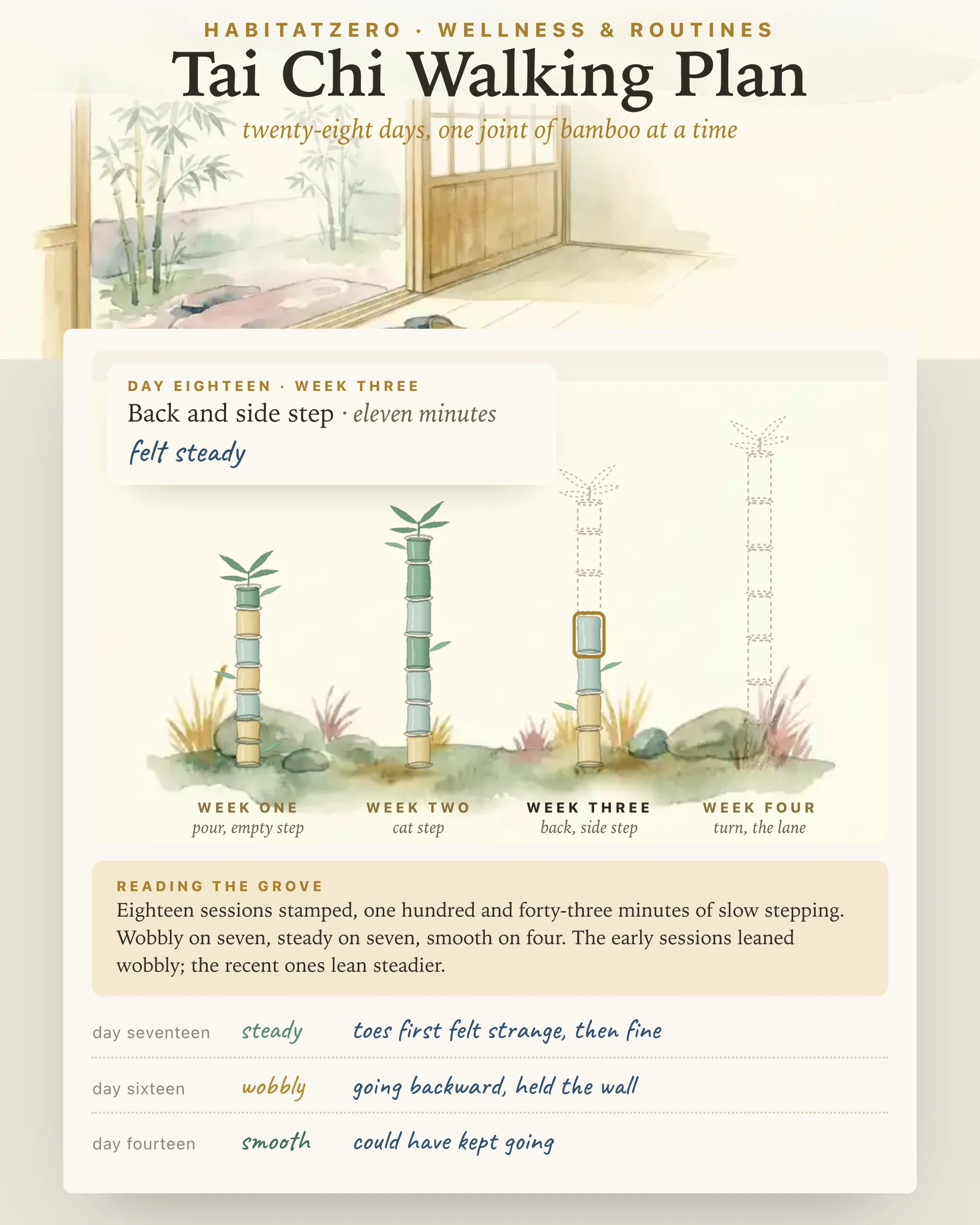
If an advert brought you here, it probably promised that tai chi walking would melt weight off in twenty-eight days. Set that aside. Tai chi walking is real, and it is worth four weeks of your evenings, but the honest reasons are steadier balance, an easier relationship with your own feet, and a calmer quarter of an hour. This page is built around those reasons and says so plainly.
Tai chi is a slow martial art from China, and its forms are stitched together from a small vocabulary of steps. Teachers pull those steps out of the forms and drill them on their own: walking forward heel first, walking backward toes first, stepping sideways, turning on a heel. The rule underneath all of them is the same. The weight is poured completely into one leg before the other foot is allowed to move, so a foot lands empty and fills slowly, the way a cat sets a paw down. Practiced this way, ordinary walking becomes a balance exercise you can do in a hallway.
That is what the plan teaches, in plain words rather than Chinese names: the pour, the empty step, the cat step, the back step, the side step, the turn, and finally a full lane that joins them.
The plan is a grove of four bamboo stalks, one for each week. Each stalk has seven joints sketched in pencil. Walk a day's session, tap wobbly, steady or smooth, and that joint is inked: longer for more minutes, tinted by how it felt. Finish all seven days of a week and the stalk grows leaves. Miss a day and its joint stays a pencil outline; nothing falls over and nothing resets.
Every day shows its step with three footprints, where dark ink means a full leg and a pale outline means an empty one, plus a short recipe and the minutes. Sessions begin at five minutes and reach fifteen by day twenty-eight, with a lighter seventh day each week. After a handful of sessions the reading under the grove tells you whether the recent ones have been steadier than the first. A line about each session, tapped or written, adds a small leaf to its joint and goes into the walking log at the bottom.
The best-studied benefit of tai chi is balance. A Cochrane review of exercise for preventing falls in older people living at home found that tai chi may reduce the rate of falls by about a fifth, and the number of people who fall by about the same, and the NCCIH summary of the literature draws the same conclusion: tai chi may improve balance and help prevent falls in older adults. A separate meta-analysis of eighteen trials suggested the protective effect grows with how often you practice, which is one argument for a daily plan over a weekly one.
Wellbeing is the second reasonable expectation. A review of forty studies found tai chi associated with lower stress, anxiety and depression scores and better mood, while noting that the trials were uneven and that firmer conclusions need better ones.
Weight is where the adverts and the evidence part ways. The strongest trial on the question, a three-arm randomised study of adults over fifty with central obesity, found that twelve weeks of tai chi trimmed waist circumference by under two centimeters relative to no exercise, roughly what conventional aerobic and strength training achieved, with a small drop in body weight and no change to diet. That is a real result and a modest one. Tai chi walking is slow, so it burns few calories, and no twenty-eight-day plan, this one included, can promise you pounds lost. If a lighter body is the goal, this plan is a way to move on the days you would otherwise not move at all, not a substitute for the harder work.
Two more honest caveats. The balance findings come from supervised classes that ran for months, not from a month of solo practice at home; ten minutes a day is a way in, not a replication. And if your balance is already unreliable, or a hip, knee or ankle is complaining, ask a clinician before you start, and keep a wall or a counter within reach throughout. The page asks you to name that support before day one.
Start on a day when you have a clear stretch of floor and no reason to hurry. Open the page before you walk to read the step, and again afterwards to stamp it. Week one is only pouring your weight and touching a heel forward, which will feel like nothing until, around day four, it doesn't.
If you would like these sessions to sit inside a larger set of daily rules, The Winter Arc Challenge tracks up to five of them across a season. If one habit at a time is more your speed, the 30-Day Habit Tracker makes a month visible in a single grid. And if what you want from slow movement is mostly the calm, Somatic Exercises for Anxiety works the same ground without a plan attached.
The grove will be grown in four weeks. Whether you keep walking after that is the only measure that matters.
It is the stepping practice drawn out of tai chi: slow, deliberate steps in which the weight is poured fully into one leg before the other foot moves. Teachers use it to train balance and the empty-and-full rhythm of the forms. It is not brisk walking and it is not a cardio workout.
Not in the way the adverts suggest. Tai chi burns few calories because it is slow, and the strongest evidence for it concerns balance, fewer falls in older adults and psychological wellbeing. One large trial found a modest waist reduction after twelve weeks, but nobody can promise pounds lost from a twenty-eight-day walking plan, and this page does not.
Five minutes on day one, growing gently to fifteen by day twenty-eight, with a lighter day at the end of each week. The steps are learned two at a time, so week one is only shifting your weight and touching a heel forward.
It is one of the gentler ways to move, and studies of tai chi in older adults report few problems. Even so, if your balance is unreliable or a hip, knee or ankle is troubling you, check with a clinician first, and practice near something you can hold.
You can read every step and its footprints right here. Stamping days, growing the grove and keeping your notes happens in the HabitatZero app, where the plan is free to personalize.
By the team behind Fabulous, the science-based self-care app used by over 30 million people.