Leaves on a StreamEmotional Fitness · ~3 min
About this template · Updated September 2026
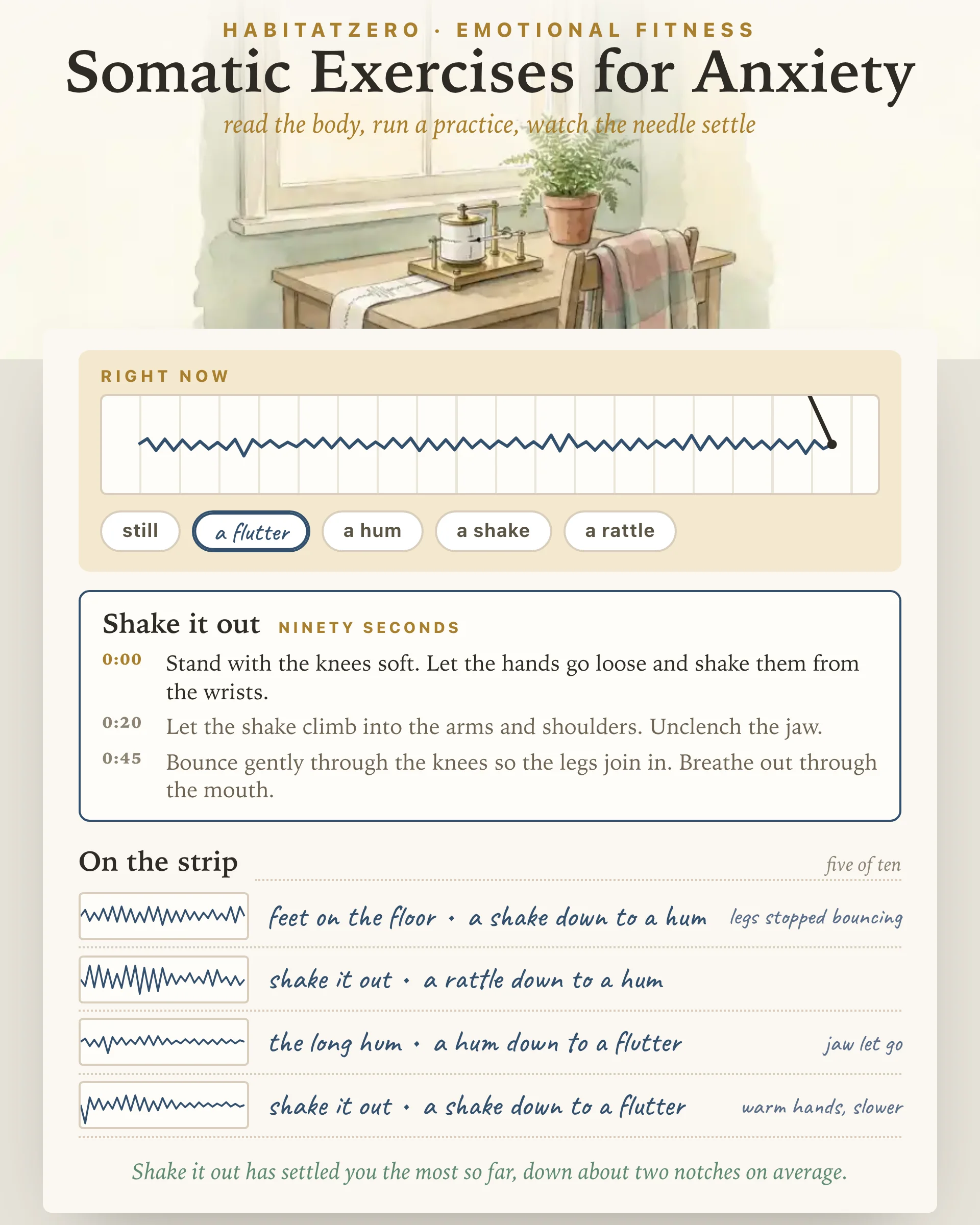
Anxiety rarely stays in the head. It shows up as a jaw held tight, a breath parked high in the chest, legs that will not keep still, a sense of being an inch behind your own eyes. Somatic exercises start from that end of the problem. Rather than arguing with the thought, you give the body something plain to do for a minute, then check what changed.
Somatic only means "of the body". The practices here are the gentle, everyday kind: shaking the limbs loose, turning the head to take in the room, pressing the feet into the floor, resting a hand on the chest, humming on a long out-breath, pushing against a wall. None of them needs a mat, a teacher or a diagnosis, and none takes longer than ninety seconds.
Shake it out. Soften the knees, let the hands flop and shake from the wrists, then let the shake climb through the arms and shoulders and bounce down into the legs. Ninety seconds, then stand still and feel the hum fade.
Look around the room. Somatic therapists call this orienting. Turn the head slowly, let the eyes lead, and land on plain things: a corner, a lamp, a doorframe. Then find one thing you like the look of. A mind racing ahead gets pulled back to the room it is actually in.
Feet on the floor. Press the toes down, then the heels, push as if the floor could push back, then let go and notice it is still holding you. For feeling floaty or far away.
A hand on the heart. One hand on the chest, one on the belly, no pressure, and breathe so the lower hand moves. Long enough for the shoulders to drop on their own.
The long hum. Breathe in through the nose and hum out low and long, so the out-breath outlasts the in-breath. For a breath stuck high and shallow.
Push the wall. Palms flat on a wall, lean in and push as if you could move it, then ease off and shake out the arms.
Before you begin, you read the body on a five-word scale: still, a flutter, a hum, a shake, a rattle. The needle draws a trace at that amplitude, jagged for a rattle, nearly flat for still. Then you open one practice. Its four cues are listed with their time marks, and when you press begin, a timer lights each cue as its moment arrives. You can pause, or finish early if the body has had enough.
When time is up, you read the body again. The session lands on the strip as a small trace that starts at your before and ends at your after, named in your handwriting, with room for a few words about what shifted. The strip holds ten sessions, and once two of them carry both readings, the page tells you which practice has settled you most on average. That line is the reason to come back for a week: you find out whether you are a shaker, a hummer or a feet-on-the-floor person.
Nothing on the page measures your nervous system; it records what you noticed, before and after, and shows the pattern back to you.
Several of these practices come out of Somatic Experiencing, the body-oriented trauma therapy developed by Peter Levine, and this page has no connection to his organization. The first scoping review of that method analysed sixteen studies and found preliminary evidence of benefit for post-traumatic symptoms and for mood and body symptoms more generally, alongside a frank note that study quality was mixed and that unbiased randomised trials were still needed. Promising, not proven.
Some of the individual pieces stand on firmer ground. A systematic review of slow-breathing studies linked breathing at under ten breaths a minute with higher heart-rate variability and with reports of relaxation and reduced anxiety, which is roughly what a long hum asks of you. And a randomised trial with one hundred and fifty-nine people found that those who gave themselves a soothing touch, such as a hand on the heart, before a standardised stress test showed lower cortisol afterwards than the control group, as did those who received a hug, although self-reported stress did not differ between the groups.
What none of this says is that a minute of shaking treats an anxiety disorder or a history of trauma. This page is a practice, not therapy. If anxiety is running your days, or if any of these exercises stirs up more than you can sit with, that is a signal to work with a professional rather than to push through alone.
Reach for it when the trouble is in the body more than the head: before a meeting, after a hard message, at the desk when the legs start to bounce. If what you need is to name what you can see and hear, 5-4-3-2-1 Grounding walks the senses one by one. If the breath is the whole problem, Box Breathing paces it for you. And when it is everything at once, The Overwhelm Recovery Protocol takes the first ninety seconds off your hands.
Then come back and read the needle.
They are short, body-first practices that work on the physical side of anxiety rather than on the thoughts: shaking the limbs loose, pressing the feet into the floor, turning the head to take in the room, resting a hand on the chest, humming on a long exhale, or pushing against a wall. Each one gives the nervous system a plain physical signal that this moment is safe enough to soften.
Many people find that a minute of loose shaking lets a wound-up body come down a notch or two, and deliberate tremoring sits at the heart of several body-oriented therapies. The formal research is still thin and made up mostly of small studies, so treat it as something to test on yourself with the needle rather than a proven cure.
Shorter than you might think. The practices on this page run from forty-five seconds to ninety seconds, because the aim is a quick change of state you can repeat several times a day, not a long session. If one minute helped, you can always run it again.
Orienting means slowly turning the head and letting the eyes take in the room, landing on plain, harmless things like a lamp or a doorframe. It borrows from the way animals scan their surroundings before they settle, and it gives an anxious mind evidence, through the eyes, that nothing here is a threat.
Every practice and its cues are readable right here. To run the timer, read the body before and after, and keep your own strip of sessions, personalize the page in HabitatZero, which costs nothing.
By the team behind Fabulous, the science-based self-care app used by over 30 million people.