Leaves on a StreamEmotional Fitness · ~3 min
About this template · Updated July 2026
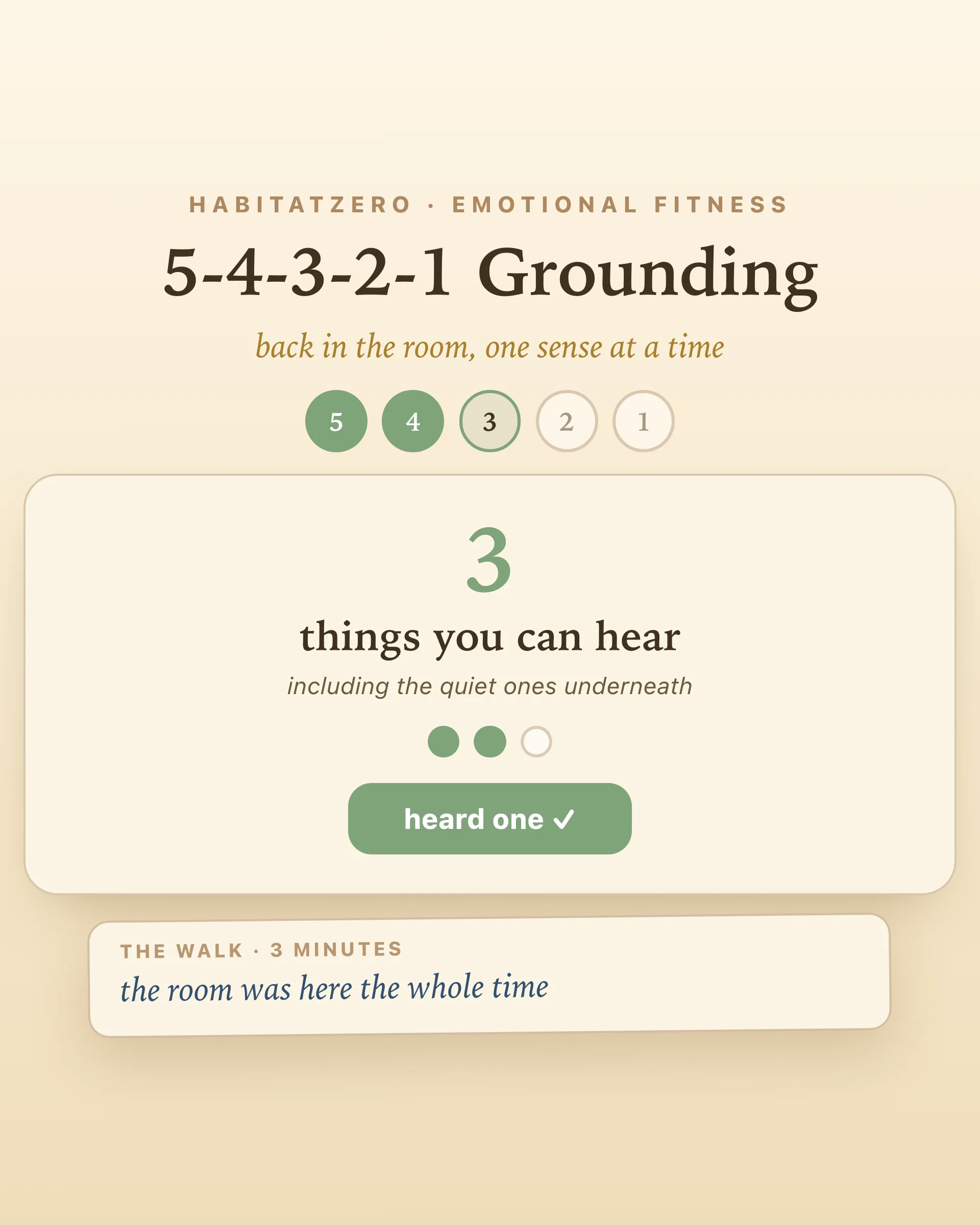
Anxiety has a favorite trick: it removes you from the room. Your body stays in the chair, but you are twenty minutes into a conversation that hasn't happened, or three weeks into a disaster that probably won't. The spiral feels urgent and it feels like thinking — but it's really just attention, kidnapped.
The 5-4-3-2-1 technique is the oldest rescue in the book, taught in therapy offices, classrooms, and backstage hallways everywhere: walk your attention back through the five senses, one concrete thing at a time, until you're standing in the actual room again. This page is that walk, guided — so that mid-spiral, when remembering a technique is itself too much, the countdown remembers for you.
Five things you can see. The screen asks; you look. Tap the big counter as you find each one — or flip on name them and type, which forces the kind of specific looking ("the chipped mug, the blue spine, the dust in the light") that grabs attention hardest. No typing is required, ever: mid-panic hands get tap targets, not text fields.
Four you can touch. The chair's texture, the cool table, fabric, your own thumbnail. Touch them properly, one tap each.
Three you can hear. Including the quiet ones underneath — the fridge hum, the traffic wash, your own breath.
Two you can smell. Coffee, sleeve, outside air. Improvising is allowed and encouraged.
One you can taste. The last sip, a mint, or just the inside of your own mouth. The soft chime at the end isn't a reward — it's a marker: you're back.
The whole walk takes about three minutes. Nothing you type is stored anywhere or sent anywhere; like the stream, this page keeps nothing but your count of completed walks.
You cannot out-argue a spiral — engaging with its content is feeding it. Grounding works by a different route entirely: attention is a single spotlight, and a spotlight pointed at four touchable textures is a spotlight no longer available for catastrophe. The 5-4-3-2-1 technique is built on exactly this redirect, and the broader research agrees about the mechanism: studies of how mindfulness practices actually work consistently identify attention monitoring of present-moment experience as a core active ingredient. The countdown is that ingredient with the ceremony stripped off — no cushion, no app subscription, no belief system. Just five, four, three, two, one.
The descending count matters too. It's effortful enough to occupy the mind, structured enough to need no decisions, and finite — you always know how far from done you are, which is precisely the certainty a spiral lacks.
Grounding is first aid. It ends an episode; it doesn't treat a pattern. If you're reaching for this page daily, that's real information — worth taking to a professional who can work on the pattern itself. (And they'll likely be pleased you already know this technique; it's the one they'd teach you first.)
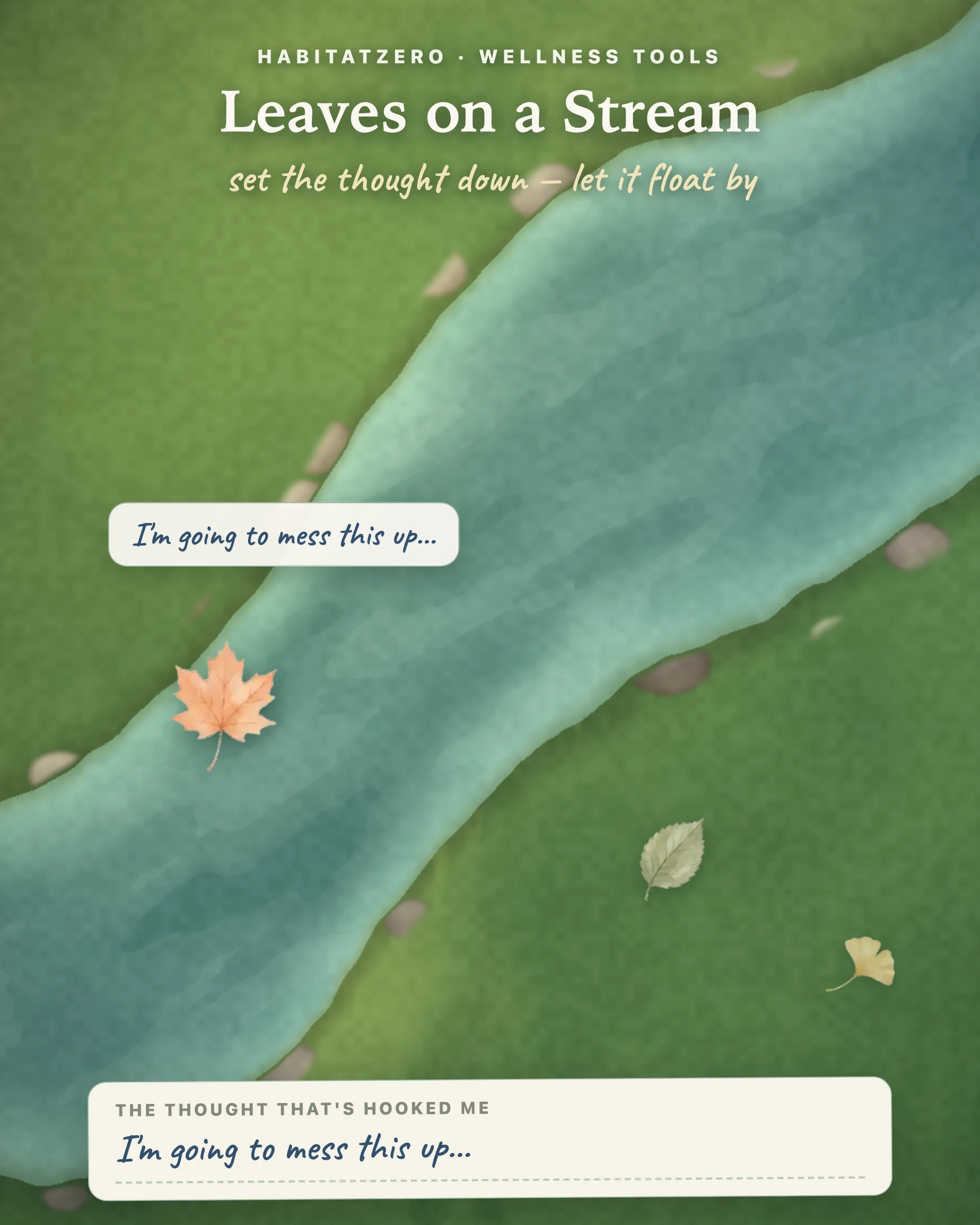
Landing is step one; what you do next decides the hour. If the spiral was one specific thought, send it downstream at Leaves on a Stream. If your body is back but still revving, ninety seconds of Box Breathing settles the idle. And if the flood was really a pile of undone things wearing anxiety's costume, sort the pile with the Overwhelm Recovery Protocol.
Five you can see. Start with the nearest one. You're closer to the room than the spiral wants you to think.
A sensory countdown for anxious or spiraling moments: name five things you can see, four you can touch, three you can hear, two you can smell, and one you can taste. It's one of the most widely taught grounding exercises because it needs no equipment and no privacy — just attention, redirected sense by sense from the spiral to the room.
Anxious spirals run on attention — the mind looping through what-ifs while the body sits unnoticed. The countdown works by occupying that attention with a concrete, effortful sensory task: finding four touchable textures leaves little bandwidth for the loop. Research on mindfulness mechanisms points at exactly this — training attention onto present-moment experience is one of the core active ingredients in calming practices.
The moment you notice you've left the room — spiraling thoughts, a flood of worry, that floaty unreal feeling, or the buildup before panic. It also works preventively: before a hard conversation, in a waiting room, on a crowded train. It is a first-aid tool, not a treatment — if these moments are frequent or severe, that's worth bringing to a professional.
No. Naming out loud or in writing deepens the effect for many people — it forces more specificity — but tapping and noticing works too, and this tool supports both. On a rough day, the tap counter alone is enough; on a steadier day, try typing the names and notice how much sharper the looking becomes.
Improvise, honestly. Sniff your coffee, your sleeve, the outside air; for taste, the inside of your own mouth counts, and so does the memory of your last sip. The numbers are scaffolding, not law — the exercise is the noticing, and an imperfect walk down the senses still lands you back in the room.
Yes — free, in your browser, no signup. Nothing you type during a grounding walk is sent anywhere, and in the Fabulous app the tool is one tap away with your walks counted.
By the team behind Fabulous, the science-based self-care app used by over 30 million people.