Leaves on a StreamEmotional Fitness · ~3 min
About this template · Updated July 2026
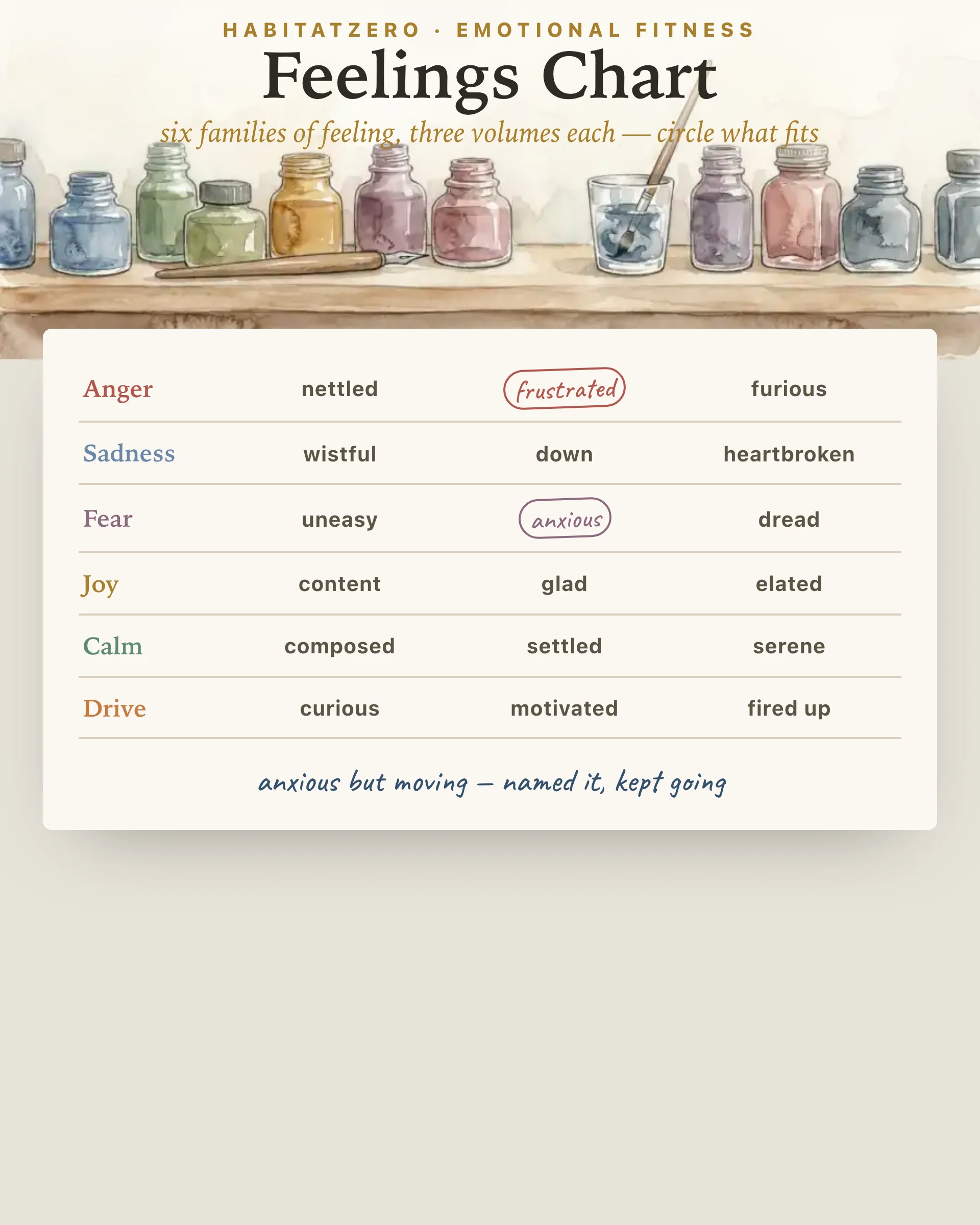
"How are you?" — "Fine." That exchange happens a billion times a day, and it is almost never true. The problem usually isn't honesty; it's inventory. Feelings arrive as weather, not as words, and unless the right word is within reach, fine fills the gap. A feelings chart fixes the inventory problem: it puts the vocabulary in front of you so you can recognize the word instead of producing it from nothing.
That distinction — recognizing versus recalling — is the whole trick of a chart. Asked point-blank what you feel, your mind offers the same four words it always offers. Shown thirty-six words sorted into families, you find yourself pointing: that one. Not angry — resentful, which is anger with a ledger. Not sad — wistful, which is sadness you can live in. The chart does for feelings what a menu does for appetite.
There's a reason to bother beyond precision for its own sake. In the affect-labeling experiments behind "Putting Feelings Into Words", attaching a label to an emotional stimulus changed how the brain responded to it — naming engaged regulation rather than just reaction. And the research on emotional granularity, summarized in Unpacking Emotion Differentiation, points the same direction: people who can tell their nettled from their seething tend to handle hard moments with more flexibility than people for whom it is all just "bad." The word is not decoration. The word is the handle.
The chart sorts its words two ways. Families run down the side — anger, sadness, fear, joy, calm, and drive, each printed in its own ink. Volume runs across — faint, clear, strong — because the difference between uneasy and panicked is not a detail; it decides what the moment needs from you. Faint feelings mostly want acknowledging. Strong ones want a plan.
Notice that half the chart is pleasant. Calm and drive get the same three volumes as fear and anger, because a vocabulary that only works for bad days teaches you to check in only on bad days. Knowing you are stirred rather than fired up is as useful on a Monday morning as knowing your dread from your unease on a Sunday night.
Using the chart takes about three minutes. Circle up to three words — three because real moments are blends, and the cap forces the sharpening. Add one honest line about where the words are coming from. Keep it. Kept check-ins collect in a log under the chart with their date and inks, and after a few weeks the log becomes the interesting part: your actual weather patterns, not the ones you assume you have.
If you land on a word and want to go deeper than a line, the feelings wheel walks the same territory from the middle outward with a definition for every word — the wheel is for exploring, the chart is for checking in. And when the word you circle keeps being the same one, the thinking-trap spotter is a good next stop for reading the story you tell about it.
One chart, thirty-six words, three circles at a time. Fine was never a feeling.
A feelings chart lays emotional vocabulary out in a grid so you can recognize a feeling instead of having to summon the word for it. This one sorts thirty-six adult words into six families, each running from faint to strong. You scan the chart, circle up to three words that fit the moment, add one line of context, and keep the check-in. The whole pass takes a few minutes.
Adults. Most printable feelings charts are built for classrooms, with cartoon faces and playground vocabulary. This one uses grown-up words — resentful, wistful, on edge, grounded, fired up — because naming an adult feeling with a playground word is exactly why so many adults answer fine to everything. If you want a version for children, a classroom resource will serve you better.
Putting a feeling into a specific word engages a different mental process than just having the feeling, and research on affect labeling suggests that the naming itself takes some heat out of the moment. The more precise the word, the better this works — which is why the chart offers three volumes of anger rather than one, since nettled and seething call for different responses.
A wheel walks you from the middle outward, one layer at a time — good when you have no idea what you feel. A chart shows you the whole vocabulary at once, sorted by family and intensity — faster when you roughly know the family and need the precise word, and better as a printed reference. HabitatZero has both; this page is the chart, and the interactive feelings wheel is its own worksheet.
Yes — the page carries a print stylesheet that strips the buttons and prints the chart clean, with each family in its own ink color. Signed-in HabitatZero users also get the interactive layer everywhere: circled words, the one-line note, and the running log of kept check-ins.
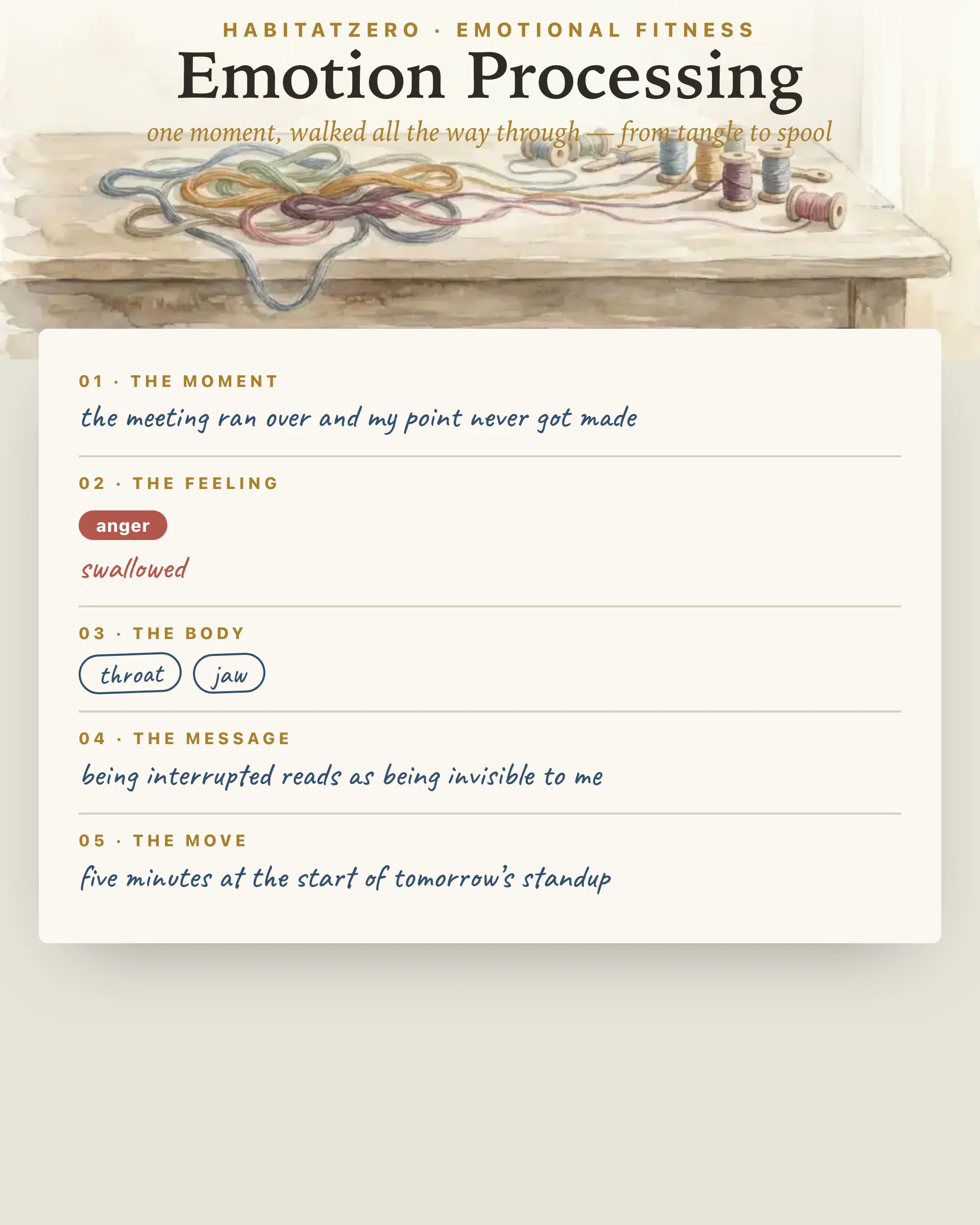
By doing the noticing rep on purpose, a little and often. Emotional awareness is two catches made before the story starts: something shifted, and it has a name. The chart is the naming half — scan, circle, one line of context — and a single check-in a day is a complete practice. When you want the full walk-through of a moment rather than the catch, the emotion processing worksheet picks up where the circled word leaves off.
By the team behind Fabulous, the science-based self-care app used by over 30 million people.