Leaves on a StreamEmotional Fitness · ~3 min
About this template · Updated July 2026
Ask yourself how last month felt and your memory will hand you a confident answer that is mostly fiction. The classic experiments behind the peak-end rule — including the memorably titled When More Pain Is Preferred to Less — showed that we judge past experience by its most intense moment and its ending, not by its actual run. One loud Thursday can repaint a perfectly decent month. That is the whole case for a mood tracker: dated dots don't editorialize.
When scientists wanted to know how life actually feels day to day, they stopped asking global questions and started sampling days — the logic behind the Day Reconstruction Method, which rebuilt wellbeing measurement from small dated entries instead of sweeping self-summaries. A mood tracker is the household version of the same move. One dot per day, recorded close to the day itself, produces a record your December self can trust — and your December self is the one making decisions about next year.
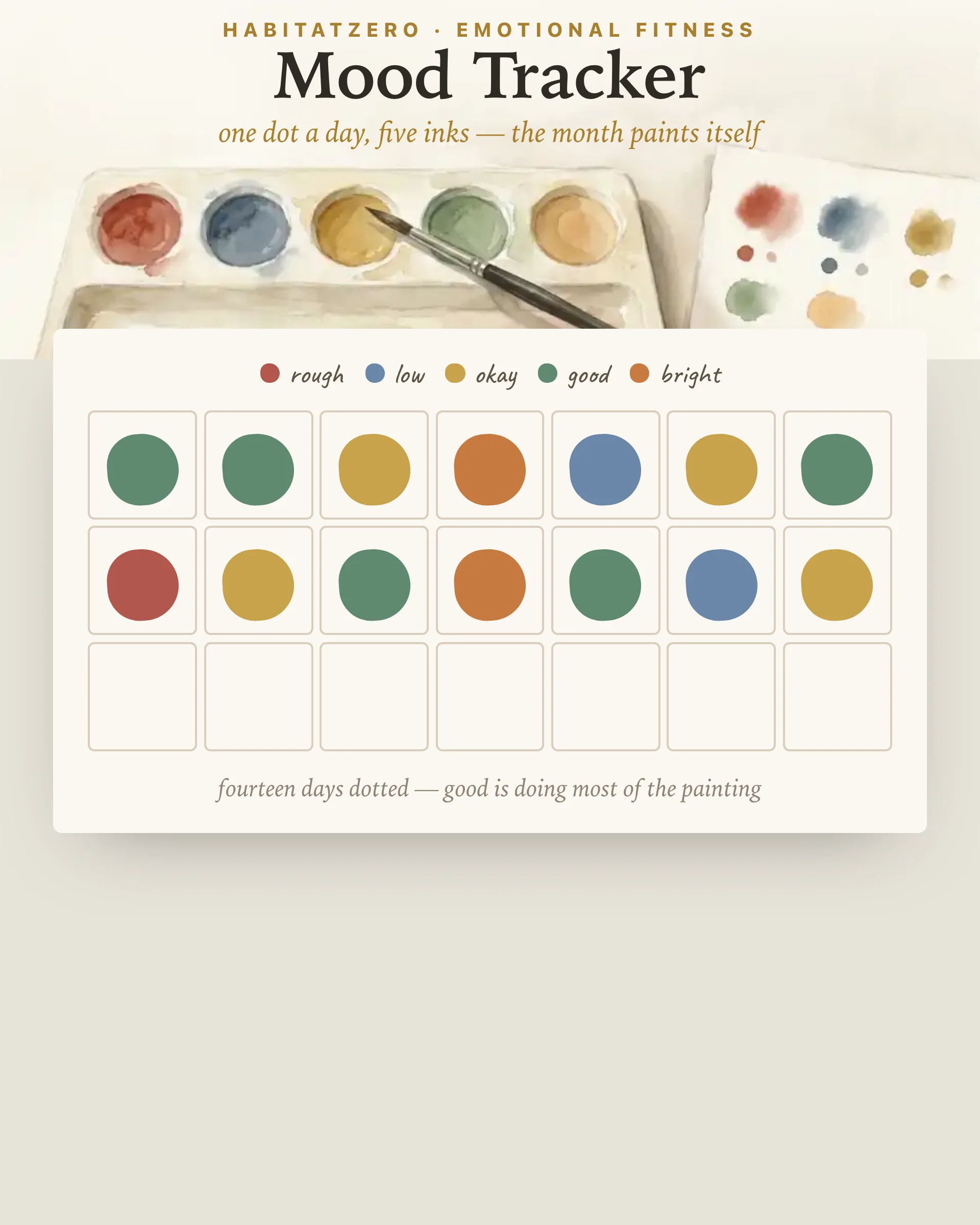
The tracker keeps the nightly decision almost embarrassingly small. Five pens sit above the calendar — rough, low, okay, good, bright — each with its own ink. Pick the color the day mostly was, tap today, and a hand-inked blot settles into the cell. Same ink tapped twice lifts the dot; a different pen re-inks it; yesterday accepts an honest late entry. Nothing else is asked of you: no rating scales, no notes required, no streak to defend.
Under the month, a plain italic line does the arithmetic — fourteen days dotted this month — good is doing most of the painting — with the per-ink counts beside it. That sentence is the product. Not the dots themselves, but the pattern your memory would have flattened: the low that clusters around certain meetings, the bright that reliably follows a protected weekend.
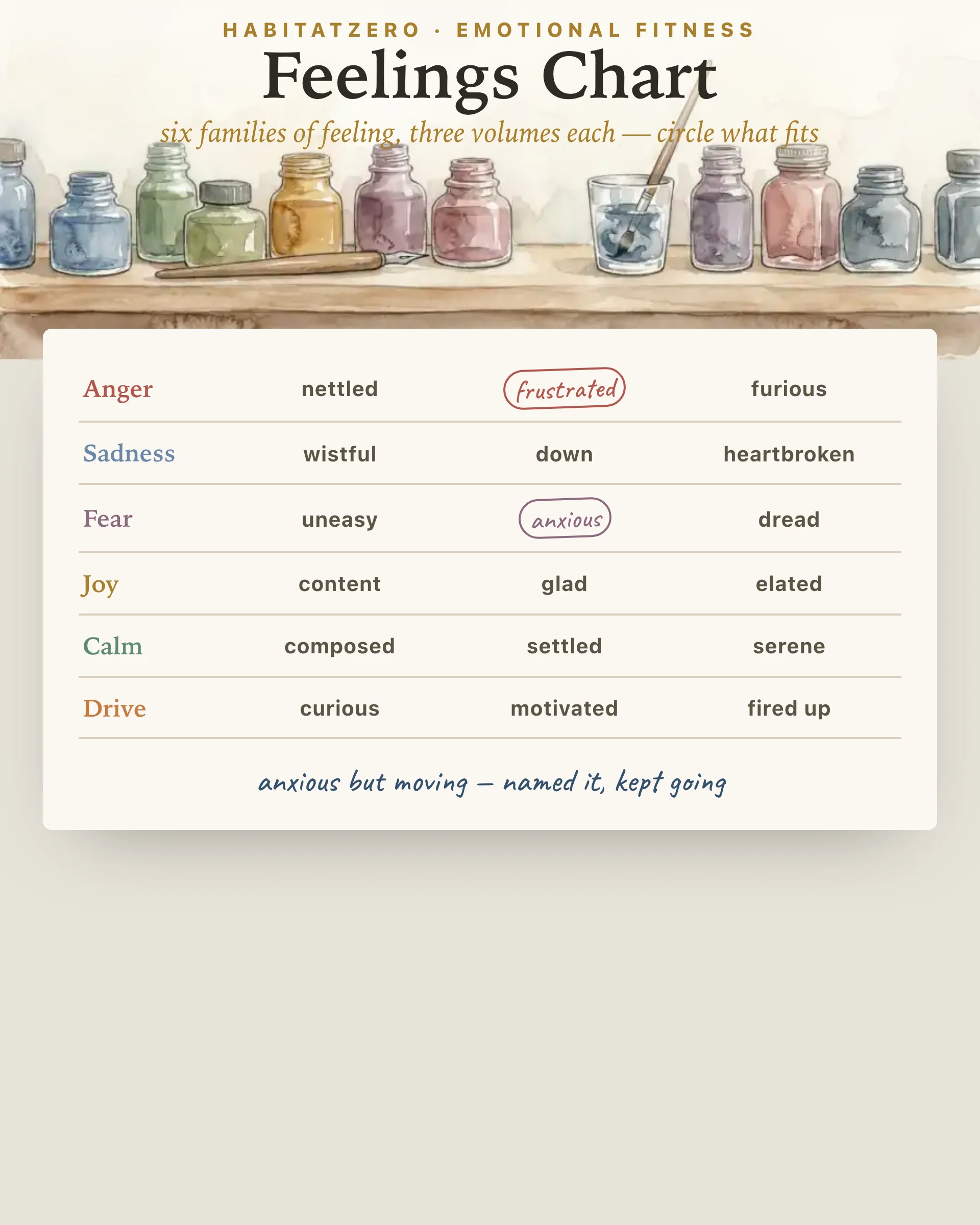
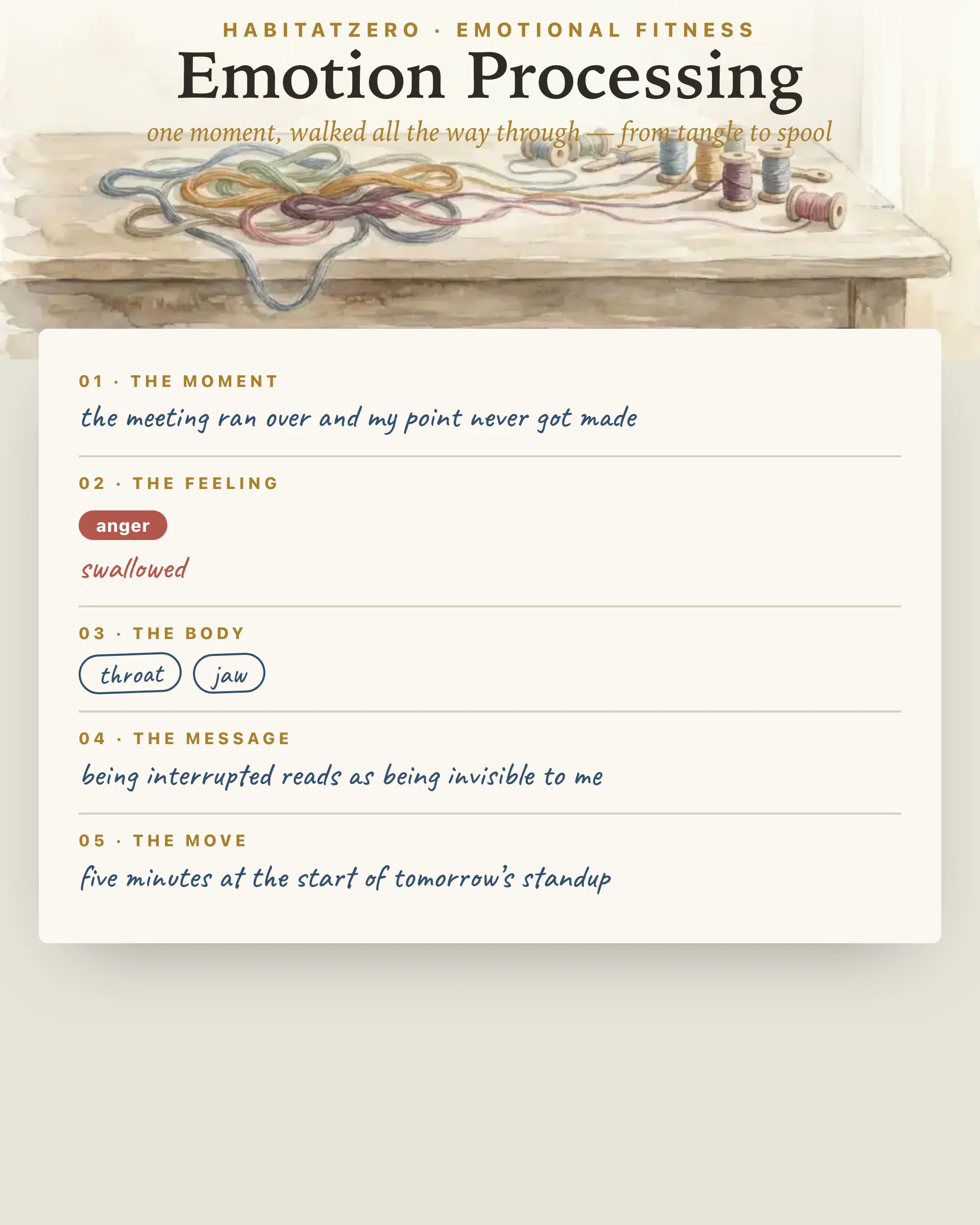
A dot is a summary, and some days refuse to be summarized. This tracker is deliberately the shallow end of HabitatZero's feelings family: when a day needs an actual word, the feelings chart holds thirty-six of them at three volumes; when one moment keeps circling and needs walking through, the emotion processing sheet takes it event → feeling → body → message → move. Dot daily, name weekly, process when a moment earns it — the three tools were built as a set.
And if the low ink is quietly winning month after month, treat the chart as information worth sharing with a professional, not a verdict to sit alone with. A dotted month is one of the most useful things you can hand someone whose job is to help.
Thirty-one cells. Five inks. One honest tap before the day starts telling stories about itself.
A mood tracker records a one-touch summary of each day so that patterns become visible over weeks. Memory is a poor historian of mood — retrospective judgments lean hard on peaks and endings — while a calendar of dated dots is unglamorous and accurate. After a month you can answer questions your recollection would fumble: how common were the rough days really, and what did the good ones share?
In everyday use the words overlap, and this page works as both: the calendar you dot day by day is the tracker, and the finished month — thirty-one cells in five inks — is the chart. If you were sent here looking for a printable mood chart, printing this page gives you exactly that, with the key across the top and the month grid below.
Fewer than you think. Five levels — rough, low, okay, good, bright — cover a whole-day summary without turning the nightly dot into a quiz. Finer scales feel scientific but mostly add hesitation, and hesitation is what kills daily practices. When a day genuinely needs more words than a dot, that is a signal to reach for a fuller worksheet, not for a bigger palette.
Yes — the page carries a print stylesheet, so printing (or saving as PDF from the print dialog) produces a clean paper month: the five-ink key, the calendar grid, and your dots in color. Signed-in HabitatZero users keep the interactive layer too — one-tap dots, honest backfill, and the running readout.
This one is a self-awareness tool, not a clinical instrument — it tracks the color of ordinary days. If your moods swing hard enough that tracking them feels medical, or the low ink is winning month after month, that pattern is worth showing to a professional rather than a calendar; bring the chart along, since a dotted month is a genuinely useful thing to hand a clinician.
A mood meter is a two-axis grid: one axis for how pleasant the feeling is, the other for how much energy it carries, so every mood lands in one of four quadrants — high-energy pleasant, high-energy unpleasant, low-energy pleasant, low-energy unpleasant. It is a fine way to place a single moment. This tracker makes the other trade: five named moods instead of four quadrants, dotted across a whole month, because the pattern over weeks — not the placement of one afternoon — is what a printed page on the fridge is best at showing. If you think in axes, map them: your high-energy unpleasant days and low-energy pleasant days will both be visible in the dots.
By the team behind Fabulous, the science-based self-care app used by over 30 million people.