Leaves on a StreamEmotional Fitness · ~3 min
About this template · Updated July 2026
Some feelings dissolve on their own. The rest circle — the meeting replays on the commute, the text you shouldn't have sent drafts its own sequels at 2 a.m. What keeps a feeling circling is rarely its size; it's that it never got walked anywhere. This worksheet is the walk: five steps that take one moment from still bothering me to filed.
The premise is old and sturdy: an emotion is information about what a situation meant to you, delivered in a format that's hard to read. Decoding starts with language. In the affect-labeling literature — summarized in Affect Labeling as Implicit Emotion Regulation — putting feelings into words dampened the raw response and engaged the regulating machinery instead, even when nobody intended to regulate anything. The word is the intervention.
But naming is step two of five, and stopping there is the most common way this kind of exercise goes soft. A name without a message is a label on an unopened envelope.
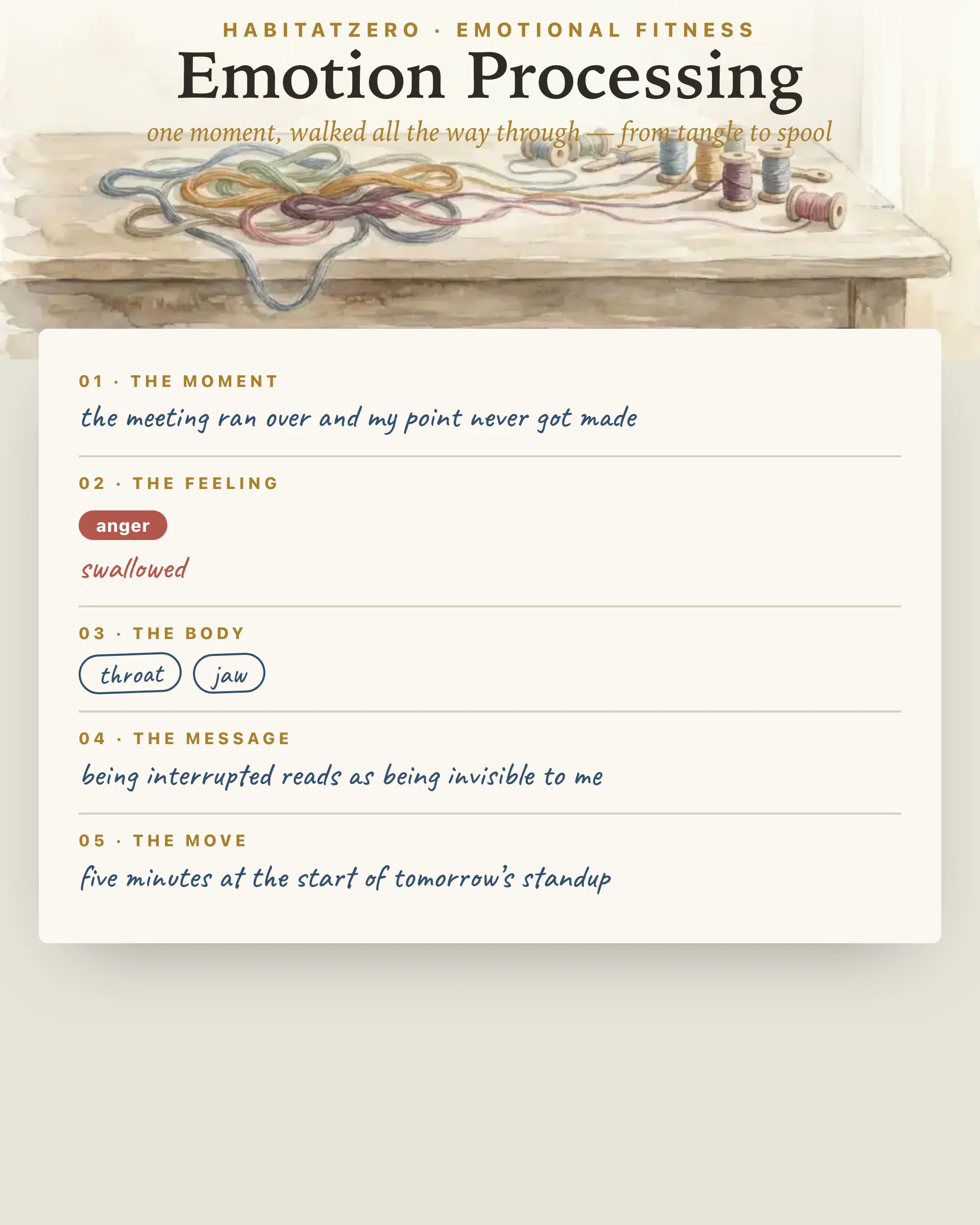
01 — The moment, in camera facts. The meeting ran over and my point never got made is a fact. Nobody respects my time is a story. Both may matter, but the untangling starts by separating them — most circling thoughts are stories wearing a fact's clothes.
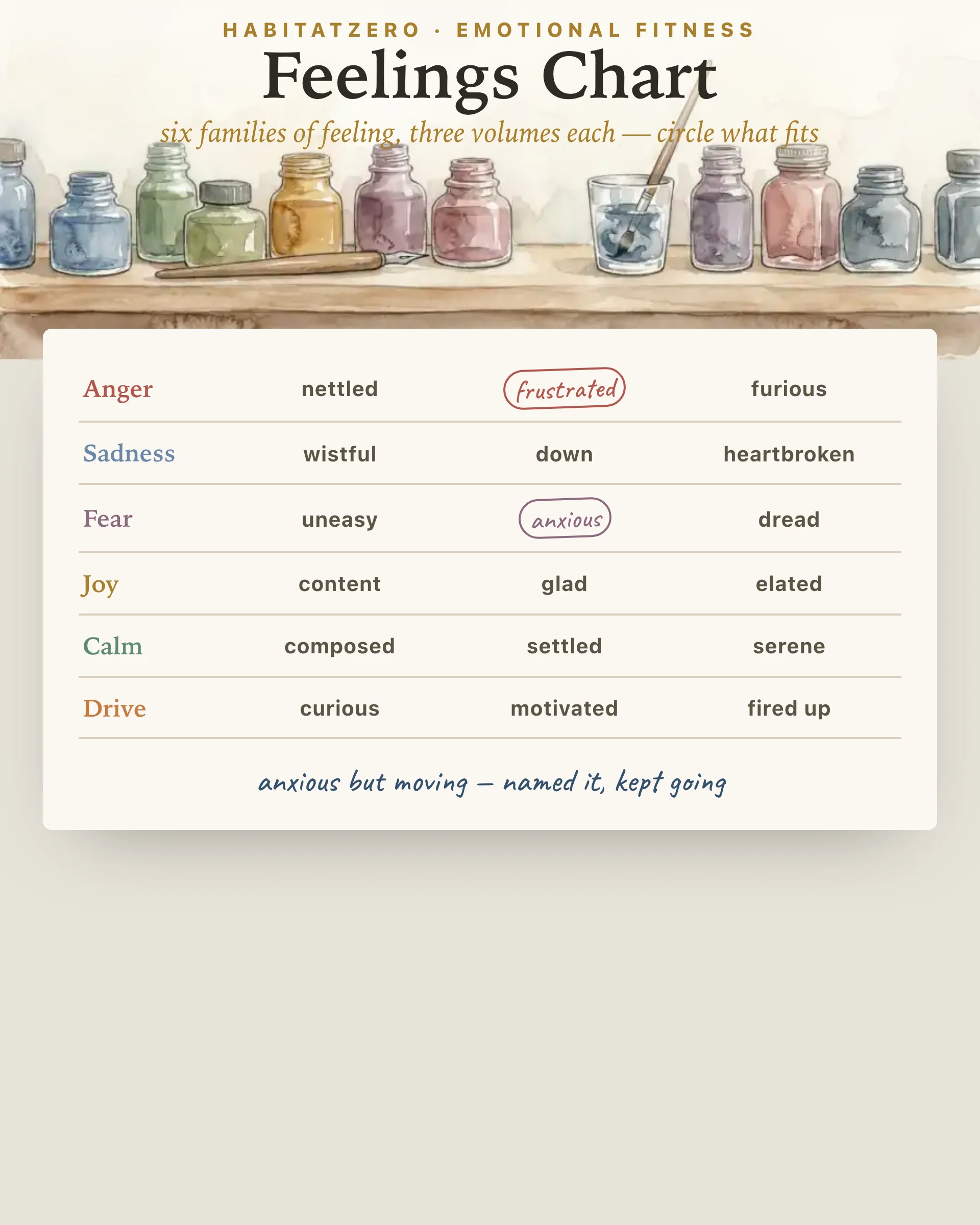
02 — The feeling, family first, then your own word. Pick the family — anger, sadness, fear, joy, calm, drive — then write what you'd call it. Swallowed tells you more than angry ever will, and the research on granularity says the precision is where the benefit concentrates. The sheet asks for your word instead of handing you a menu, because this is the processing room, not the vocabulary shelf — for the shelf, the feelings chart is one door over.
03 — The body. Throat, chest, stomach, jaw. Feelings rent rooms, and the room is diagnostic: the same meeting can land as a tight jaw one week and a hollow stomach the next, and those are different messages.
04 — The message. If the feeling could talk, what was it trying to say? Being interrupted reads as being invisible to me is the kind of sentence that only shows up when you ask directly — and it's worth ten replays of the meeting.
05 — The move. One small, concrete act: the five minutes you'll ask for, the walk you'll take, the message you'll send or deliberately not send. Processing that changes nothing tends to evaporate; the move is what makes the filing stick.
Filed moments collect below the sheet — date, your word in its family's ink, the moment in a quiet line. The rack holds twenty, on purpose: this is for the feelings that earned the walk, not a ledger of every flicker. Reread it monthly. The pattern — which families keep filling spools, which rooms of the body keep getting rented — is the real return on the practice.
When the word won't come at step two, the feelings wheel walks you to one layer by layer. And when the story wearing the fact's clothes turns out to be a familiar distortion, the thinking-trap spotter names those too.
One tangle, five steps, one spool. The moment stops circling once it's wound.
A structured page that walks a feeling through steps instead of leaving it to circle. This one uses five: the moment in plain facts, the feeling named in a family and in your own word, where it sat in the body, what it was trying to tell you, and the one small move that follows. The structure is the point — an unprocessed feeling loops, a processed one files.
Separate the event from the reaction, name the reaction precisely, locate it, and ask what it wants. Research on affect labeling has found that putting a feeling into words engages regulation rather than just reaction, and that precision matters — which is why this sheet asks for your own word after the family, not instead of it. The last step turns insight into one concrete move, because processing that changes nothing tends not to stick.
No. It is a self-help tool for the ordinary tangles of a normal week — the meeting that went sideways, the message that stung. It borrows the everyday skill of naming and reflecting on feelings, nothing clinical. If emotions are regularly overwhelming or interfering with your life, a licensed professional is the right room, and resources like therapist-directories exist precisely for that.
Those tools answer what am I feeling; this one answers what do I do with it. The chart gives you vocabulary at a glance, the wheel walks you outward to a precise word, and this worksheet takes the named feeling the rest of the way — through the body, the message, and the move. They chain naturally: name it there, process it here.
When a moment earns it — not on a schedule. The filing rack holds twenty processed moments on purpose: this is a tool for the feelings that are still circling hours later, not a diary of every flicker. Most people find one or two moments a week genuinely worth the five steps, and rereading the rack monthly shows patterns no single entry could.
By the team behind Fabulous, the science-based self-care app used by over 30 million people.