
The Overwhelm Recovery ProtocolWellness & Routines · ~5 min
About this template · Updated November 2026
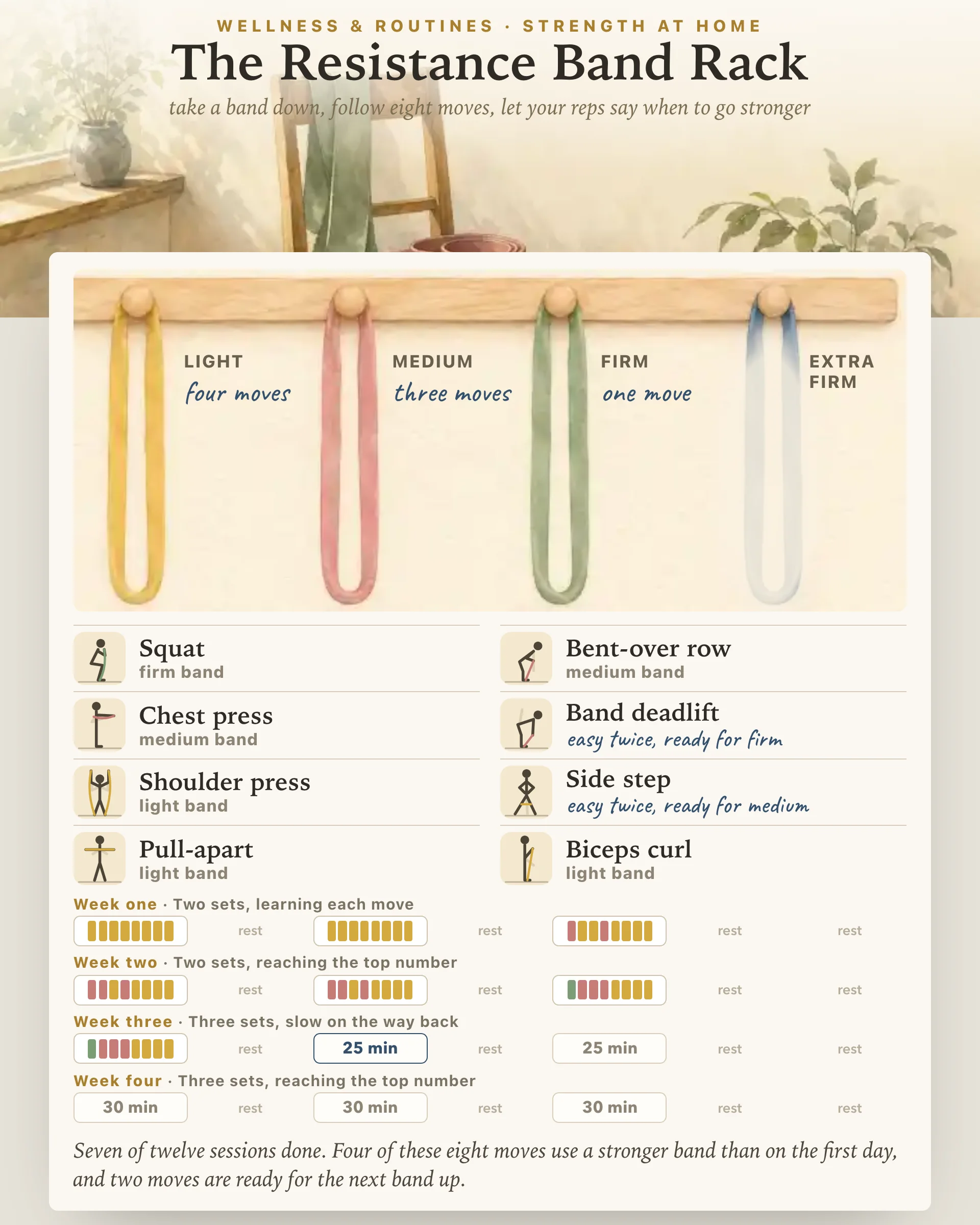
A resistance band costs little, fits in a drawer, and can work almost any muscle you can name. What it cannot do is tell you how hard to pull or when you have outgrown it. That gap is why so many bands stay in the drawer. This page is built to close it: you pick a band, follow eight resistance band exercises, and the sheet watches how your reps feel so you know when to go stronger.
Four bands hang on the rack: light, medium, firm and extra firm. Tap the one you own, or the lightest of your set. Makers color their bands differently, so treat the colors here as labels and judge each band by how it feels when you pull it.
Next, choose a focus. Full body mixes squats, rows, presses and steps, while upper body and lower body each have eight moves of their own. Every move comes with a small drawing, a plain instruction, and the sets and reps for your current week.
After each move, tap how the last reps felt. Easy means you reached the top number with more to spare. Hard means your form slipped or you stopped short. Anything between is about right, which is where you want to be most of the time.
When a move has felt easy in two sessions running, the sheet suggests the next band up, for that move alone. Your squat may reach the firm band while your shoulder press stays on light, and the tags on the rack count the moves on each band, so you know what to set out before you begin. No stronger band in the house? Hold your band shorter, which raises the tension. A move that felt hard gets the opposite suggestion.
You train three days a week, with a rest day after each session and a second one at the end of the week.
Each finished session prints eight small bars on the chart, one per move, in the color of the band you used. Over the weeks the colors shift, and that shift is the only score the page keeps. Skip a day and the chart waits at the next session. On rest days, The Daily Stretch Mat or the slow steps of the Tai Chi Walking Plan make gentle company, and for a longer record after week four, use the Workout Journal.
If you are new to this, stay on the full-body routine and pick a band lighter than your pride suggests. The numbers in week one are meant to feel comfortable, because learning the shape of each move matters more than how tired you get.
A resistance band workout for women uses the same moves as anyone else's. A review of 38 papers on women aged 45 to 80 reported positive changes in muscle mass, strength and everyday fitness after resistance training, and it also pointed out that the evidence for women has been sparse and inconsistent.
For resistance band exercises for seniors, switch the version to older adults. Upper-body moves become seated, lower-body moves use a chair or a counter, and nothing happens on the floor.
A meta-analysis of eight studies comparing elastic bands with machines and dumbbells found neither came out ahead for upper or lower body strength. In people aged 60 to 79, a review of elastic band training found strength improved, with smaller gains among those living with a health condition, and its authors noted how little anyone reported about training intensity. So no study can tell you which band is right for you, and the easy-twice rule on this page is a practical habit rather than a tested prescription.
Four weeks is also a short window, and this plan promises no particular result by the end of it.
This is not a falls program either. The Cochrane review of exercise and falls in older people found strong evidence for balance and functional exercise, and it was uncertain about programs that are mainly resistance training. If steadiness is your concern, add balance practice and talk it over with a physical therapist.
Ask a doctor or physical therapist before your first session if you have had a fall, dizziness, a joint replacement, a heart or blood pressure condition, or ongoing pain. Stop any move that hurts. Look over the band for nicks and small tears each time, since a worn band can snap, and make sure it sits securely under your feet before you pull. Keep a sturdy chair or counter within reach for standing moves.
Keep the sheet open during the session, because a tap between moves takes only a moment. Then let the reps do the deciding: when two sessions in a row come easy, take the next band down off the rack.
Strength Training for Women Over 50 runs a longer twelve-week block with bands or dumbbells, and The Wall Push-Up Ladder needs no band at all.
Moves that train large muscle groups and need nothing but the band: a squat, a row, a chest press, a deadlift, a shoulder press, a side step, a pull-apart and a biceps curl. Those eight make up the full-body routine here, and two sets of eight to ten is plenty for the first week.
Start lighter than you expect to need. Band colors differ from maker to maker, so judge by feel: you should reach the top number with good form and notice the last few reps. When a move feels easy in two sessions running, go up one band for that move.
The moves are the same for women as for anyone else. A review of 38 papers on women aged 45 to 80 reported positive changes in muscle mass, strength and everyday fitness after resistance training, while noting that the evidence for women has been sparse. Begin where each move feels manageable and adjust one band at a time.
Many older adults train with bands, and a review of trials in people aged 60 to 79 found strength improved. Whether it suits you depends on your health, so ask a doctor or physical therapist first if you have had a fall, dizziness, a joint replacement, a heart or blood pressure condition, or ongoing pain. The older-adults version here keeps every move seated or beside a counter.
For strength, they can. A meta-analysis of eight studies comparing elastic bands with machines and dumbbells found neither came out ahead for upper or lower body strength. Bands cost less and store easily, though your exact load is harder to know, which is why this sheet goes by how the reps feel.
By the team behind Fabulous, the science-based self-care app used by over 30 million people.


