
The Overwhelm Recovery ProtocolWellness & Routines · ~5 min
About this template · Updated November 2026
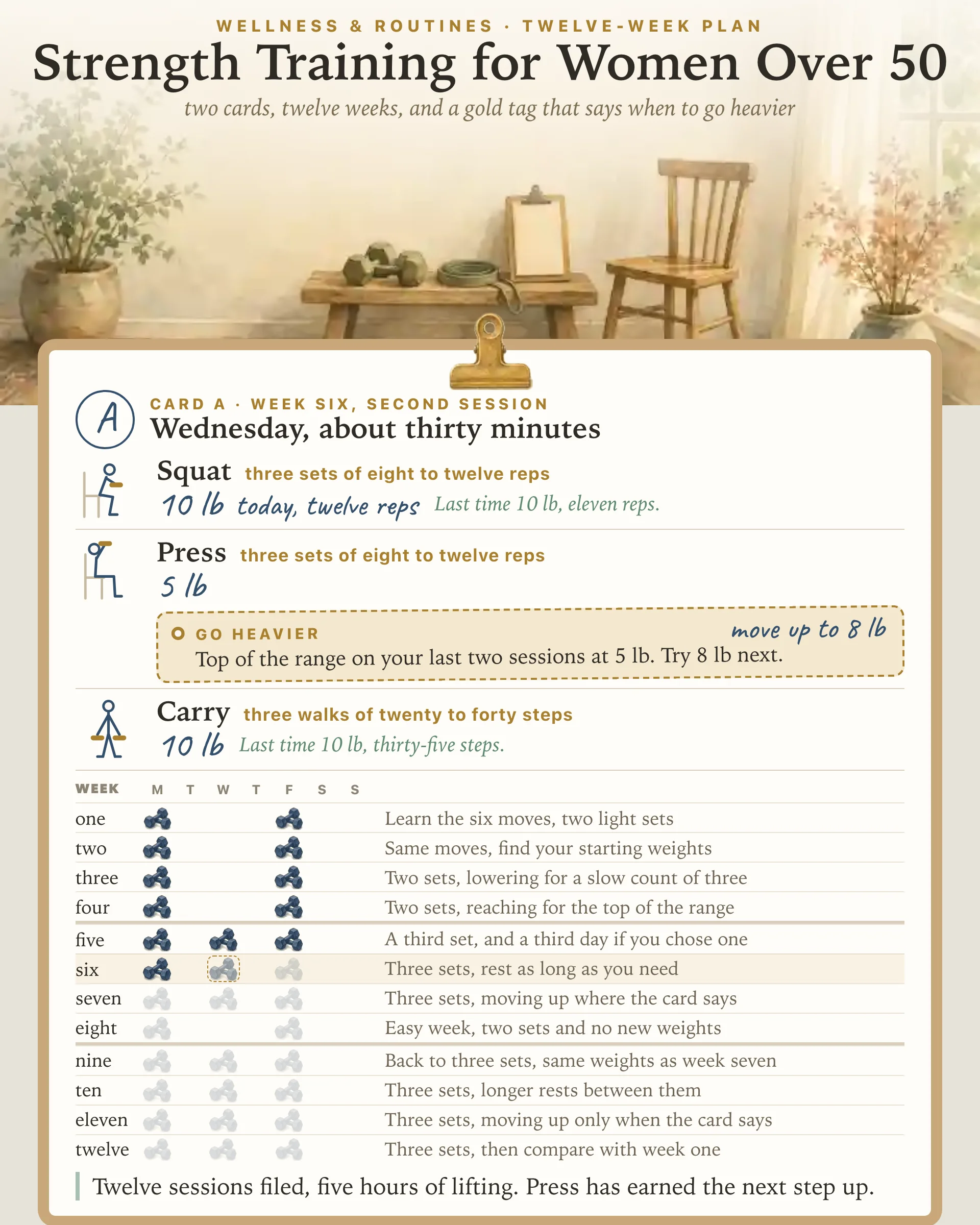
You do not need a gym or a barbell to begin. You need something to lift on a schedule, and a way to know when it has become too easy. This page gives you both: two short workouts that take turns for twelve weeks, built from dumbbells, bands or a chair, and a log that tells you when you have earned the next step up.
Get the go-ahead from your doctor or a physical therapist before you start if you have ever had a fall, dizzy spells, a joint replacement, a heart or blood pressure condition, or pain that keeps coming back. Stop any move that hurts. Keep a sturdy chair or counter within reach for everything you do standing.
Strength work has a good record in research on aging. A Cochrane review of 121 trials and 6,700 older adults found a large effect on muscle strength from training that got progressively harder, usually two to three times a week. It helped most with getting out of a chair, modestly with walking speed, and only a little with physical ability overall. The authors also warn that side effects were poorly recorded. Joint pain and muscle soreness appeared in many of the trials that watched for them, while serious problems were rare. Those trials studied older people in general, so read them as a guide, not a forecast.
Bone loss after menopause is one reason many women start. A Cochrane review of 43 trials in postmenopausal women found a relatively small but possibly important effect of exercise on bone density, with strength training for the legs among the most effective approaches at the hip. It found no effect on the number of fractures, and the trials were often weakly reported. Lift to get stronger, and treat any bone benefit as a modest possibility. If you have osteoporosis or low bone density, ask your clinician which moves suit you.
Falls are a separate question. In a Cochrane review of 108 trials on falls in older people, the programs that lowered falls mainly used balance and functional practice, and the authors were uncertain about programs built mostly on resistance training. This plan is not a falls program and cannot promise to prevent one; a physical therapist can show you what to practice for that.
The chart on the page shows the minutes for every day:
The six moves split across two cards. Card A holds a squat to a sturdy chair, a seated press and a slow carry. Card B holds a hip hinge, a row with one hand on a chair and a step-up with your hand on the rail. You already do rough versions of all six when you stand up from the couch or bring in the groceries. Every standing move names its support, a counter, a wall or the stair rail, and the press is done seated.
Home routines often stall here, because nobody says when. The American College of Sports Medicine's position stand on progression puts newcomers at eight to twelve reps, two to three days a week, with a small increase in load once you can beat your target by a rep or two.
This page turns that into one rule. Tap how far you got on your last set, the one that tells you the most. Reach the top of the range on two sessions running at the same step, and a gold tag appears on that move and names the next one. Household dumbbells jump in bigger steps than that, so expect your reps to drop when you move up; the card asks you to aim for eight and build back to twelve. Hard means the last few reps take effort while your form holds. Sharp pain means stop.
Tap what you have, then two or three days. Of three, the two with the most rest between them carry the first four weeks. Today's card clips on with a sketch and a support for each move. Set your step, tap your reps, and file it. A move left blank counts as skipped, which is the right call for a sore shoulder.
The plan moves when you do, so a missed day simply waits. Bars climb as each move gets heavier, and the chart marks every session.
Rest days are for recovering, and easy movement suits them. The Walking Challenge gives those days a gentle goal, and The Daily Stretch Mat makes a short routine for the mornings you feel stiff. If you train other things too, the Workout Journal holds a free-form log.
If loads feel like too big a first step, The Whole-House Strength Routine starts from a kitchen chair and your own body, and The Balance Ladder gives steadiness its own practice on your days off.
The best plan is one you can keep repeating and that slowly gets harder. Most trials in older adults used two to three sessions a week with a load that kept rising. This page uses six whole-body moves on two cards: squat, press and carry on one, hip hinge, row and step-up on the other.
A squat to a sturdy chair is a good first move, because the chair shows you how low to go and you already do a version of it every day. The first card pairs it with a seated press and a slow carry, then the second card adds a hip hinge, a row and a step-up with your hand on the rail.
In a large Cochrane review of older adults, serious problems were rare, but side effects were poorly recorded and joint pain and soreness did come up. If you have had a fall, dizzy spells, a joint replacement, a heart or blood pressure condition, or ongoing pain, ask your doctor or a physical therapist first. Stop any move that hurts.
Pick a step that feels hard by the last few reps and never painful. Guidance from the American College of Sports Medicine puts newcomers at eight to twelve reps and adds load once the target is beaten. Here, reaching the top of the range on two sessions running earns a gold tag that names your next step.
It may help a little, and nobody can promise more than that. A Cochrane review of 43 trials in postmenopausal women found a small but possibly important effect of exercise on bone density, and no effect on the number of fractures. If you have osteoporosis or low bone density, ask your clinician which moves suit you.
By the team behind Fabulous, the science-based self-care app used by over 30 million people.


