
The Overwhelm Recovery ProtocolWellness & Routines · ~5 min
About this template · Updated November 2026
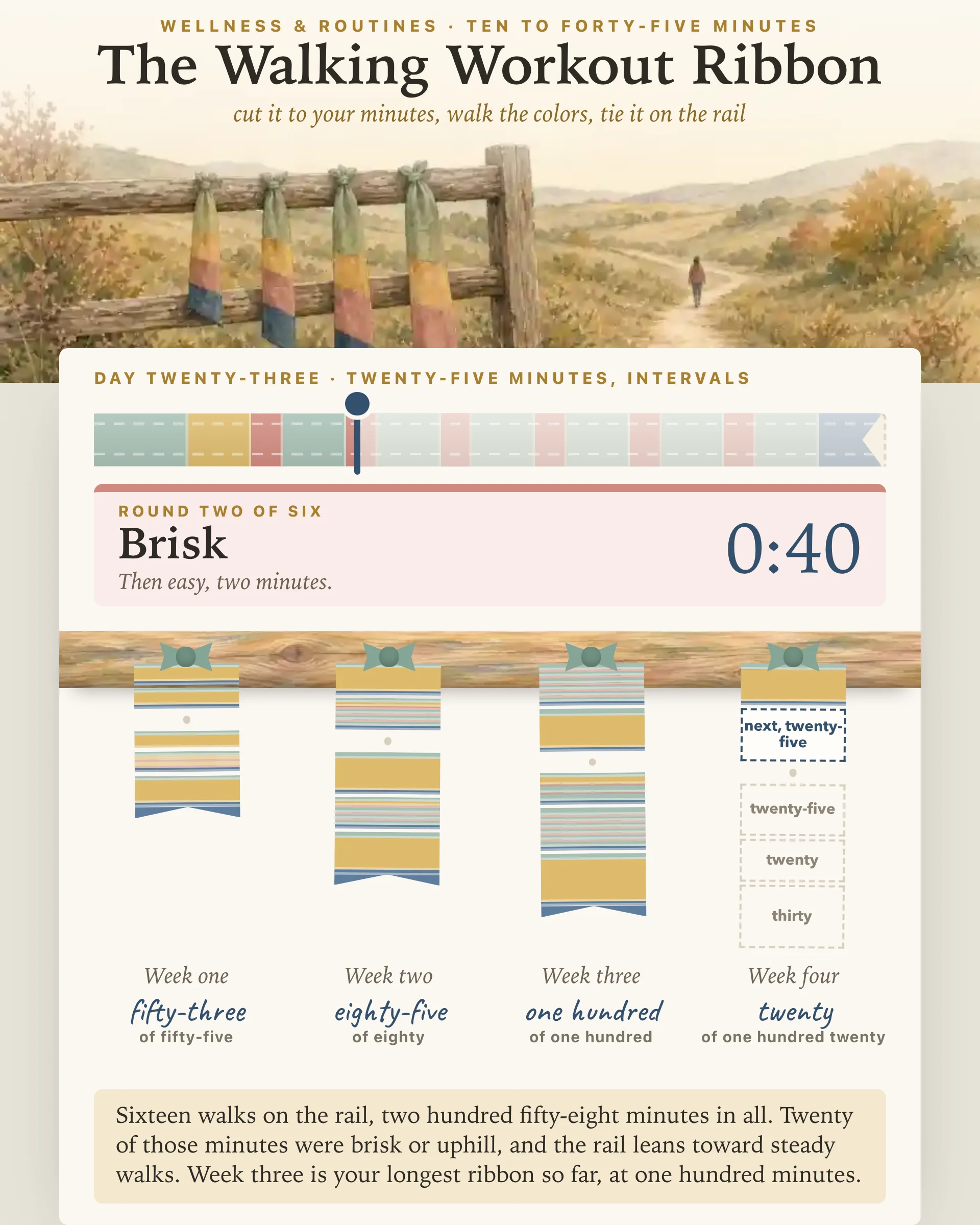
Most walks have no shape. You head out, you come back, and you could not say whether any of it asked anything of you. A walking workout gives those same minutes a plan: where to ease in, where to work a little, and where to slow down again. This page draws that plan as a ribbon you can see all at once, one color for each kind of effort, cut to the time you actually have.
Effort, mostly, and you can judge it without a watch. The CDC's rule of thumb is the talk test: at a moderate effort you can talk but not sing, and at a vigorous effort you cannot get out more than a few words before pausing for breath. The ribbon's colors follow that scale.
Steady is one even pace from end to end. Intervals break the middle into short brisk stretches with easy walking between them, so the hard part is never far from a rest. Hills or stairs use whatever is nearby, a steep street or a flight of steps with a rail, one climb at a time with a slow walk back down. Indoors is for rain, ice and dark evenings: marching in place, side steps, laps of the hallway and knee lifts at the counter, with something sturdy in reach the whole time.
If you would rather follow a set formula than cut your own, the Japanese Interval Walking Timer runs rounds of three minutes easy and three minutes brisk, and the 12-3-30 Workout Tracker keeps count of one steep treadmill routine.
Tap a kind of walk, then tap a number on the tape measure. The ribbon stops at that mark, anywhere from ten minutes to forty-five, and the list beneath it spells out each band and how it should feel. Press walk this ribbon and a silent timer moves along it, showing the color you are in, the time left in that color and what comes next. It keeps time from the clock, so locking your phone does not lose your place. If you stop early, the page offers to tie on only the minutes you really walked.
Each of the four weeks hangs from a painted fence rail as one long strip, and each walk adds a piece exactly as long as it was, striped in the colors you walked. Dashed pieces show what the plan still has waiting. Below the rail, a short reading adds up your minutes, how many were brisk or uphill, and which kind of walk you lean on.
Week one is mostly ten-minute steady walks, with one indoors. Week two moves to fifteen minutes and brings in brisk stretches. Week three reaches twenty and adds the first climb. Week four mixes all four kinds and ends on a thirty-minute walk, about two hours across that week. Every week holds five walks and two rest days. The plan counts walks rather than calendar dates, so a missed day moves nothing, and the next piece simply waits for you.
Two hours is a good place to stand, not a finish line. CDC guidance for adults is 150 minutes of moderate activity a week, split up however suits you. When your rail is full, start a fresh one and cut longer ribbons. If a destination would keep you going better than a color chart, the Walking Challenge turns logged days into a route on a map.
Ten minutes is a real start. A systematic review done for the 2018 US activity guidelines found that moderate to vigorous activity was linked to better health whatever the length of the bout, including lower all-cause mortality. That link comes from observational studies, and the randomized trials it found only tested bouts of ten minutes or longer, so read it as encouragement and not as a guaranteed result.
It also pays to be plain about the limits. A Cochrane review of exercise and falls in older people found strong evidence for balance and functional exercise, and said it was uncertain what effect walking programs have on falls. So if steadiness on your feet is the goal, add balance work rather than counting on this page for it. Nothing here promises a number on a scale or a smaller size either. Think of it as time on your feet at an effort you chose, kept where you can see it.
New to exercise, or living with a heart or blood pressure condition, a joint replacement, dizzy spells, pain or a recent fall? Talk this plan over with a doctor or physical therapist first. Stop if anything hurts, slow down if you cannot get a few words out, and hold a counter or a sturdy chair for the indoor moves.
For a slower kind of walk, The Indoor Tai Chi Walk paces each step to four counts, and Tai Chi Walking for Weight Loss builds its minutes over six weeks.
It is a walk with a plan for your effort: an easy start, a stretch where you work a little, and a slow finish. The middle can be one even pace or shorter brisk stretches. Deciding ahead of time how hard each part should feel is what turns a stroll into a workout.
On this page the steady version is two minutes easy, six minutes at a pace where you can still talk in full sentences, and two minutes slowing down. The interval version trades that middle for two rounds of one brisk minute and two easy ones.
Walk fast enough that you can talk but could not sing, which is the rule of thumb for moderate effort. For more of a challenge, add brisk stretches, a slope or a flight of stairs, and ease off whenever you can only manage a few words at a time.
Yes. The indoors ribbon mixes marching in place, side steps, laps of a hallway and knee lifts, with a hand on a counter whenever you want one. All you need is a clear stretch of floor and something sturdy to hold.
Yes, it is free to personalize. The picture on this page shows a sheet partway through the four weeks, and your own copy keeps every ribbon you tie on, along with the plan for the next walk.
By the team behind Fabulous, the science-based self-care app used by over 30 million people.


