
The Overwhelm Recovery ProtocolWellness & Routines · ~5 min
About this template · Updated September 2026
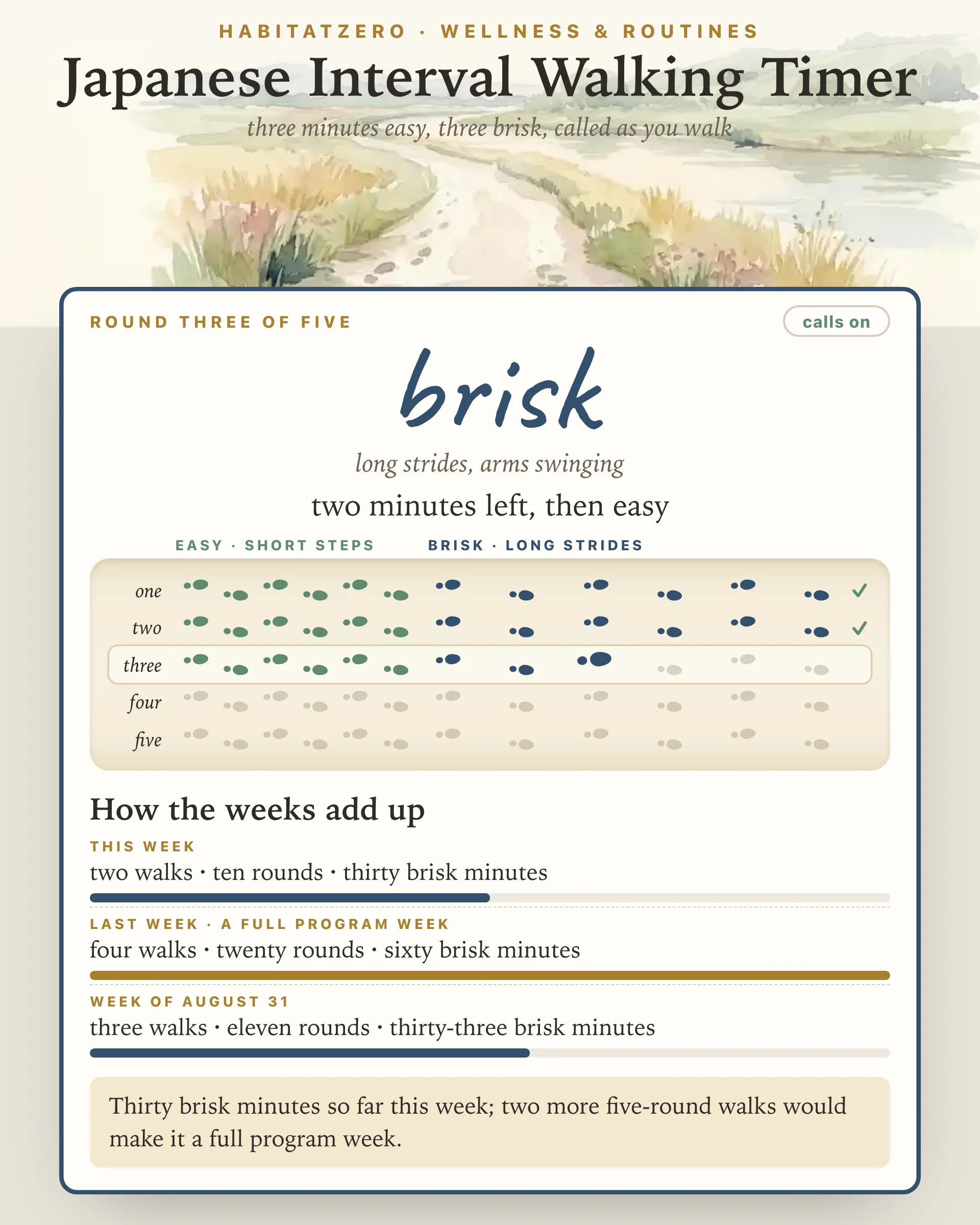
Japanese interval walking was developed by Hiroshi Nose and his colleagues at Shinshu University in Matsumoto, Japan, as a training program for middle-aged and older adults, and the team summarized the program and its results in a 2017 review. This timer is an independent page built from the protocol they published. It has no connection to the researchers or the university, and neither has reviewed or endorsed it.
The method fits in one line: walk easy for three minutes, brisk for three, and repeat. What made it work in the studies lives in the details.
In the group's 2007 randomized trial, each set was three minutes of slow walking at about 40 percent of a person's peak aerobic capacity for walking, followed by three minutes of fast walking above 70 percent. People aimed for five sets a day or more, on four days a week or more. That comes to a thirty-minute walk, and at least sixty minutes of brisk walking across a week.
Nobody guessed at those percentages. Each walker's peak was measured on a graded walk that finished at their fastest pace, with a small meter worn at the waist, and the same meter tracked every training walk after that. It also beeped when the pace was due to change, so people could walk their own routes without watching a clock.
Choose from one to ten rounds; five is the classic thirty-minute walk. Tap set off and put the phone in your pocket. Each round is one row of footprints on the trail: short steps packed close together for the easy stretch, then long strides spaced wide apart for the brisk one. The prints ink in from the clock as the minutes pass, so one glance shows where you are.
At every switch the page calls it out: a rising pair of notes for brisk, a falling pair for easy, and three notes when the walk is over. The sound comes from the page itself, only after your tap, and a mute sits in the corner; the big word on screen says brisk or easy either way. Keep the screen on and this page open, because a locked phone can silence the calls. Pause at a crossing and the trail waits for you.
When the walk ends, or you stop it, the page counts the full rounds you walked; change the count if the walk went differently, then tap how brisk felt. Kept walks gather by week, their brisk minutes set against the sixty the program asked for.
That 2007 trial split 246 adults with an average age of 63 into three groups for five months: no training, steady walking at a moderate pace, or interval walking. In the interval group, thigh strength rose by 13 to 17 percent and peak aerobic capacity by 8 to 9 percent, more than the steady walkers gained, and systolic blood pressure fell further. Sticking with the plan was hard, though: only 42 of the 87 interval walkers met their targets.
A later analysis of 679 people who completed five months of the program looked at which part of the walking mattered. Gains in fitness, and in a score of risk factors for lifestyle-related disease, grew with the minutes of fast walking each week up to about fifty, then leveled off. Slow walking time and total walking time did not predict the gains. That is why the weekly view on this page counts brisk minutes, not steps or distance.
Outside Japan, a Danish team gave people with type 2 diabetes the same waist-worn meter, which marked the three-minute cycles with a sound, and compared four months of interval walking with steady walking that burned the same energy. Only the interval walkers improved their fitness and lost body fat, and their glucose readings came down. With 32 participants, that trial points in a direction rather than settling anything.
None of this makes interval walking a quick route to weight loss, or shows that a phone timer does what a meter checking your effort did. The walkers were mostly older adults in organized programs with measurement and feedback, and the results are their averages.
Brisk in these studies meant real effort. Lengthen your stride, swing your arms and let your breathing climb until you can talk only in short phrases. If brisk lets you chat easily, find more pace or a gentle slope. If you cannot hold it, slow down; the next easy stretch is never more than three minutes away.
If you have a heart condition, high blood pressure, sore joints or any other health condition, check with your clinician before you add brisk intervals to your walks.
Use the timer on any walk you mean to take at two speeds. If you want a bigger goal around it, the Walking Challenge turns daily steps or minutes into a route across a map. On the days between, the Tai Chi Walking Plan practices slow, careful balance. And if the brisk stretches start asking to become jogs, the Couch to 5K Plan takes it from there.
It is a walking workout designed by Hiroshi Nose and his colleagues at Shinshu University in Matsumoto. You alternate three minutes of slow walking with three minutes of fast walking, five times or more, on at least four days each week.
In the Shinshu studies, fast meant above 70 percent of each walker's peak capacity for walking, checked by a meter clipped to the waist. Without one, go fast enough that you can only talk in short phrases, and let the slow minutes settle your breathing.
The program asked for four days a week or more, with five rounds or more each time. When the team looked at 679 walkers, fitness gains kept rising with weekly fast minutes up to about fifty, then flattened out.
In a five-month trial of 246 adults whose average age was 63, the interval group gained more thigh strength and aerobic capacity than steady walkers, and their systolic blood pressure dropped further. Most volunteers were older adults, so read the results as averages, not guarantees.
You can look through the sample walk on this page without signing up. Timing your own walks with the calls, and building the weekly log, happens in HabitatZero, which costs nothing.
By the team behind Fabulous, the science-based self-care app used by over 30 million people.


