
The Overwhelm Recovery ProtocolWellness & Routines · ~5 min
About this template · Updated September 2026
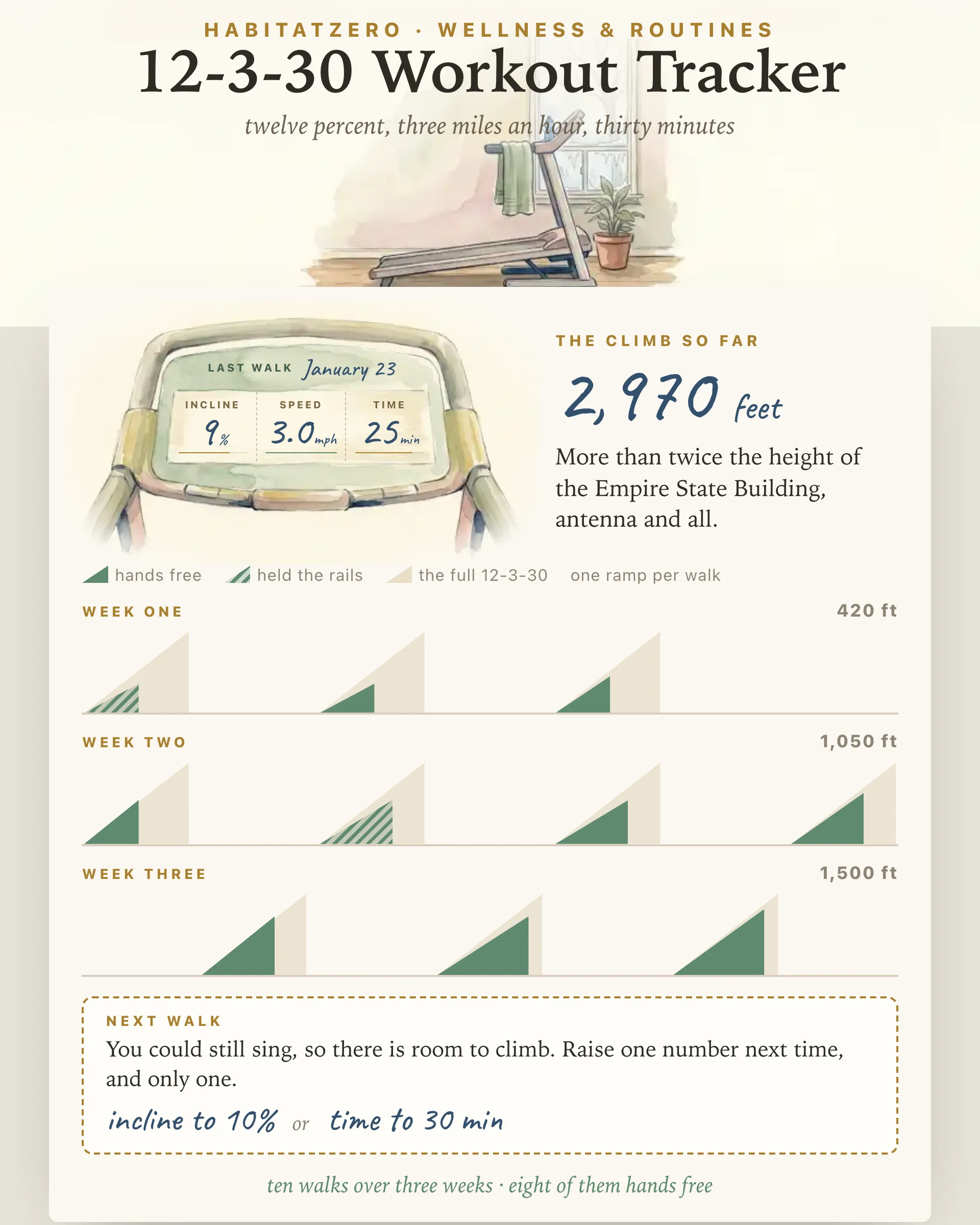
The 12-3-30 workout is Lauren Giraldo's. She walked through the routine in a YouTube video posted in November 2019, and a short repost on TikTok the following November is what turned it into a trend. This tracker was made separately. It has no tie to Giraldo, and she has neither reviewed nor endorsed it.
Set the belt to a 12 percent incline, walk at 3 miles an hour, and keep going for 30 minutes. There is no running; the whole difficulty lives in the slope.
That slope costs more than it looks. In a Stanford lab study of incline walking, sixteen people walking at their own easy pace, close to three miles an hour, used about half again as much energy at a 5 percent grade as on a level belt, and more than twice as much at 10 percent. Twelve is steeper still. Over the full half hour the belt carries you a mile and a half, and the vertical part of that distance comes to roughly nine hundred forty feet, about one and a half times the height of the Gateway Arch.
The first lab study of the routine that its authors knew of appeared in 2025. Researchers at the University of Nevada, Las Vegas asked sixteen adults who already exercised regularly to do the full 12-3-30 and, on another day, a self-paced run that stopped once it had used the same energy. Fourteen finished both. The walk used energy more slowly, so it needed about thirty minutes to match what the run did in about twenty-four, and during the walk a larger share of the fuel came from fat.
That last finding describes the fuel mix during one session, not a loss of body fat, and the authors call for longer trials before anyone connects the two. Nothing on this page promises a change in weight or shape. One detail from the study matters more for a beginner: even in that active group, one person could not finish the thirty minutes.
You do not need to start at twelve, three and thirty. Start with a walk you can finish while still able to hold a conversation, perhaps 4 percent at 2.5 miles an hour for fifteen minutes, and let the numbers climb as your legs and lungs adapt.
The simplest gauge is the talk test the CDC describes: at moderate effort you can talk but not sing, and at vigorous effort you cannot say more than a few words without pausing for breath. If you could still sing near the end of a walk, there is room to raise something. If you could only manage a few words, stay put or ease back. Then change a single number: an extra percent of incline, two tenths of a mile an hour, or five more minutes. Change all three at once and you cannot tell which one was too much.
Holding on changes the walk. In a 2006 study of steady treadmill exercise, ten healthy adults had lower heart rates and used less oxygen at the same speed and grade when they gripped the rails, and resting their hands lightly on them lowered both a little too. The UNLV researchers note that Giraldo herself holds on for part of her walks.
So hold on whenever balance calls for it, especially stepping on and off a tilted belt, and let go a minute at a time as the walk gets easier.
The top of the sheet is a treadmill console. Press the arrow keys until its three windows show the walk you did, then answer the talk test, mark the rails if you held them, and add a line if something is worth remembering. Each walk becomes a ramp in its week, wider for more minutes and taller for more incline, set against a pale outline of the full 12-3-30. Striped ramps are walks with the rails held, and a ramp that fills its outline turns gold.
After every walk it suggests the next: one number up after a walk you talked through with free hands, the same numbers again after a hard one or a walk on the rails. It also adds up the feet you have climbed and sets the total against landmarks from the Gateway Arch to Everest. Each day holds one walk, logging a day again replaces it, and sixty walks fill the sheet.
Step off and stop if you feel chest pain, dizziness or breathlessness that is out of proportion to the effort. If you live with a heart, joint or balance condition, or are coming back from an injury, check with your clinician before you raise the incline.
Open it right after each walk, while the numbers are still on the display. If you would rather count outdoor steps, the Walking Challenge turns them into a route across a painted map. To see a whole month of movement at once, stamp it on the Workout Calendar, and when a new-year start needs a longer runway, the 12-Week Fitness Planner gives the season three phases of its own.
It is a treadmill walk set to a 12 percent incline at 3 miles per hour for 30 minutes, with no running and no intervals. Lauren Giraldo described it in a YouTube video in November 2019, and a short TikTok repost a year later made it famous. This tracker is independent of her and has not been endorsed by her.
It can be, as long as day one is not the full recipe. In a 2025 lab study of the routine, one of sixteen people who already exercised regularly could not finish the thirty minutes. Begin with a gentler incline, a slower belt or a shorter walk, and raise a single number once you can talk the whole way through.
It is not cheating, but it does change the walk. In a 2006 study, gripping the rails lowered heart rate and oxygen use at the same speed and grade, and simply resting the hands on them lowered both a little. Touch them whenever balance needs it, and mark those walks so your log compares like with like.
Nobody has yet followed people doing it for months, so most of the results you see online are personal stories. A 2025 lab study timed single sessions and found the incline walk used energy more slowly than a self-paced run. The result this page can promise is a visible record of the numbers you can hold, week after week.
No. Giraldo shared the routine in her own videos, and this tracker was built separately, with credit to her. She has not reviewed or endorsed it, so for her version of the walk, watch her original video.
The three-week sample on this page is yours to read here. Logging your own walks and keeping them from one week to the next happens in HabitatZero, which costs nothing to use.
By the team behind Fabulous, the science-based self-care app used by over 30 million people.


